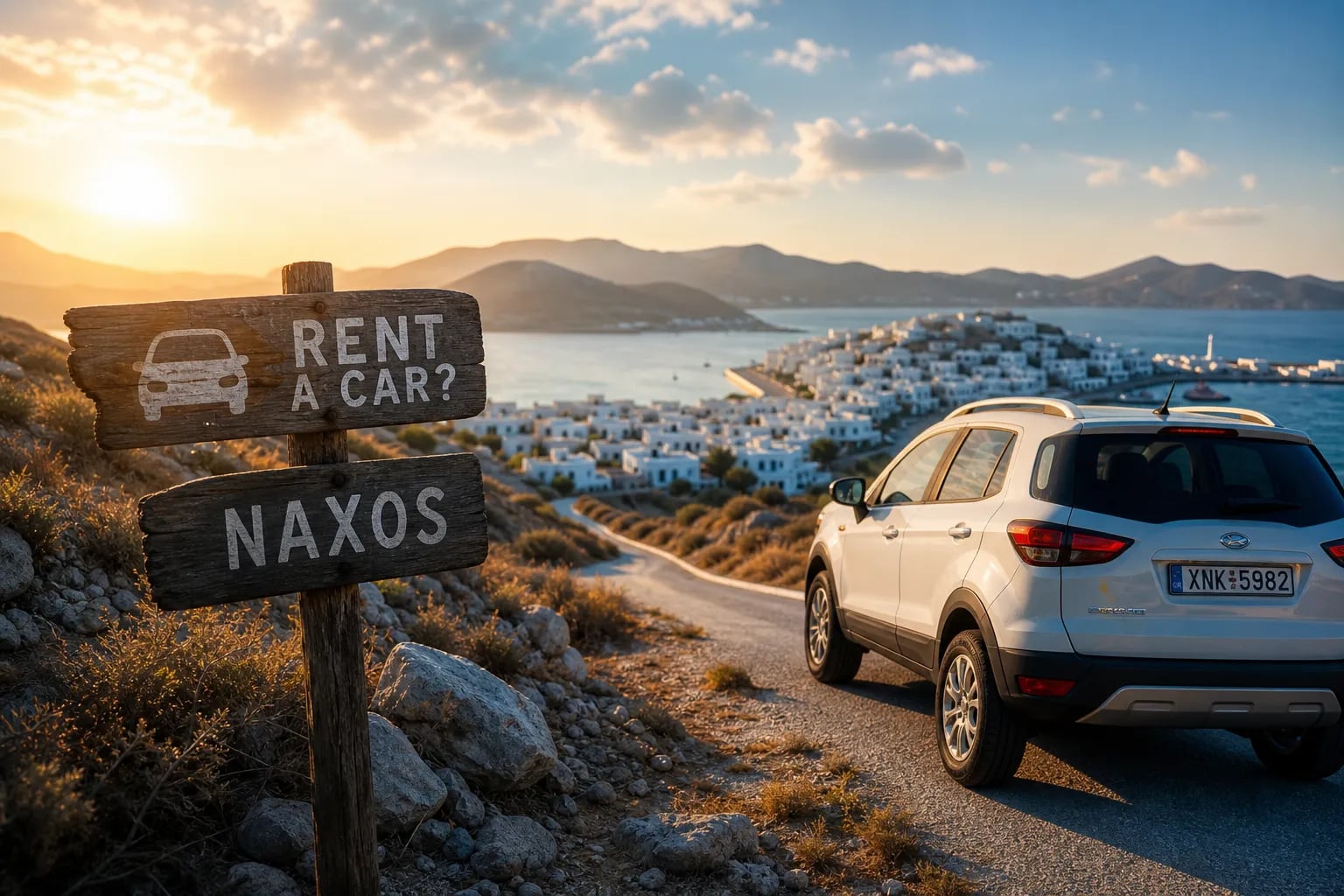
Renting a car on Naxos is the single best decision most independent travelers make before they step off the ferry. Naxos is one of the largest islands in the Cyclades, and it has a particular way of punishing the traveler who moves on someone else’s schedule. The ferry drops you in Chora with your bag and a list of things you want to see, and then you discover that the marble-paved mountain village you read about, a place like Apeiranthos, sits 40 minutes or more up a winding road on limited public transport. The quiet beach at the island’s southern tip is another story entirely. Naxos car hire isn’t just convenient; for a certain kind of trip, it’s essential.
At The Curious Atlas, we spend a lot of time thinking about how local transport shapes a travel experience. Understanding the ADO bus network through Mexico’s Yucatan Peninsula, or figuring out the ferry timetables between Bacalar and the coast, is where independent travel really begins. Naxos island car hire operates by the same logic: once you understand the actual costs, the insurance terms, and which roads genuinely need a capable vehicle, the whole thing stops feeling complicated. This guide covers everything you need to know to make a confident decision about renting a car on Naxos, Greece.
What Naxos island car hire actually costs
The honest answer is: it depends entirely on when you go. Low season (November through March) is the friendliest window, with economy cars running roughly €13, 22 per day and compact cars landing in the €15, 25 range. Shoulder season in April, May, and October pushes those numbers to €20, 35 for small cars and €35, 50 for SUVs. These are reasonable prices by any standard.
Peak summer is a different calculation. In July and August, economy cars jump to €45, 65 per day, compact cars hit €55, 80, and SUVs climb to €70, 110. Naxos rental pricing data for 2026 indicates that July and August rates run 60, 80% higher than May rates across all vehicle categories. If your trip falls in high summer, building the rental cost into your budget early is not optional. The car is one of the most important logistical decisions you’ll make for the trip.
Manual vs. automatic: the option that disappears fast
Automatic transmissions make up fewer than 10% of the rental fleet on Naxos. In peak season, that small inventory sells out weeks in advance. When automatics are available, expect a premium of €5, 15 per day over the manual equivalent, which can reach 40, 60% more during the height of summer. If you need an automatic, book it the moment you confirm your ferry dates. Waiting until the week before you leave is a reliable way to find nothing available.
Local Naxos car rental companies vs. international chains
Local operators are often the better choice for travelers willing to do a small amount of vetting upfront. Naxos car rental companies like Autotour Naxos, Alma Car Hire, Avance, and Matha Rent typically offer free delivery or pickup at the port and airport, more flexibility on longer rentals, and staff who know both the vehicles and the island roads well. Most operate daily from 08:00, 21:00 or later, which covers the majority of ferry arrivals.
The tradeoff is that you’re doing more due diligence yourself. Read recent reviews carefully, confirm in writing which insurance tier is included in the quoted price, and ask about the deposit amount before you hand over your card. A quote that looks competitive can change significantly once you work through the fine print. Often a short email exchange, a few messages back and forth, is all it takes to clarify the details, and it can save you a notable sum compared to booking blind through an aggregator.
International brands, primarily Avis, Enterprise, and Hertz, have offices at Naxos Airport and in Chora. Their value is standardization: the booking process is familiar, disputes have a formal resolution channel, and vehicle quality tends to be consistent. For first-time renters who are risk-averse, that predictability is worth something. The tradeoff is typically a higher base rate and less flexibility on pickup logistics.
Where to pick up your hire car: Naxos port, airport, and Chora
Most travelers arrive by ferry at Naxos Port in Chora, and several agencies meet you there directly. Alma Car Hire, Avance, Enterprise, Exer, Hertz, and Matha Rent all offer port pickup. Confirm your exact arrival time with the agency in advance. Late-night or early-morning ferry arrivals can fall outside standard hours and trigger an after-hours fee at some operators.
If you fly into Naxos Airport, Avis is the clearest option, operating from 07:30, 21:00 at the airport itself. Matha Rent also offers airport service from 09:00, 21:00. The airport is small and close to town, so pickup there adds very little complexity to your arrival. Avis Downtown in Chora operates 09:00, 21:00 for anyone who prefers to check in first and collect the car later in the day.
One parking note worth flagging: if you spend time in Chora during July or August, parking near the port fills early, sometimes by 11:00 on busy days, with availability varying from day to day. The old town is pedestrian-only, so you’ll park on the edges and walk in. Arrive before 10:00 for a free spot near the center, or accept a 10-minute walk from a lot on the periphery.
Insurance, deposits, and the fees that inflate your final bill
Third-party liability is legally required and included in all Greek rentals. Basic CDW is usually bundled into the base rate, but it leaves a deductible of typically €650, 1,000 on your card if the car is damaged. SCDW lowers that excess but frequently excludes tires, glass, underbody, and mirrors, which happen to be the most common types of damage on narrow island roads. FDW or zero-excess coverage removes the deductible almost entirely and is the option that actually delivers peace of mind. Know which tier is in your quote before you sign anything.
Five fee categories reliably catch travelers off guard. First, VAT: some quotes are pre-tax, and the final number can be meaningfully higher. Second, additional driver fees: some agencies include a second driver at no cost, others charge separately. Third, young-driver surcharges: the minimum rental age in Greece is typically 21, but drivers under 23 or 25 often face daily surcharges of €8, 12.40, depending on the agency and vehicle category. Fourth, after-hours fees: at least one Naxos agency charges €20 plus VAT for pickup or return outside standard hours. Fifth, delivery fees: free port and airport delivery is common among local Naxos car rental companies but not universal.
Always request an itemized written quote before confirming any booking.
Choosing the right vehicle for Naxos roads
The majority of Naxos is perfectly accessible in a standard economy car. The coastal road from Chora north through Agios Prokopios, Plaka, Mikri Vigla, and Alyko is paved and flat. Roads to inland villages including Halki, Filoti, Apeiranthos, and Apollonas are also paved, though they’re narrow and winding in places. For most travelers spending time at popular beaches and accessible villages, a compact car handles the island without difficulty.
Remote southern beaches are a different matter. The access road to Kalantos and Kalados is rough and unpaved; multiple local guides specifically recommend a capable 4×4 for this route. Some access tracks around Mikri Vigla and Psili Ammos are also dirt. One critical rule applies here: rental contracts frequently void the damage waiver for any damage incurred on unpaved roads, and off-road driving is prohibited island-wide. If a route is unpaved, check your contract before driving it, regardless of what vehicle you’re in.
First-timer’s guide to driving in Naxos
Driving in Naxos rewards patience over speed. Mountain roads inland are narrow enough that two cars passing each other requires both drivers to slow significantly, sometimes pulling partially off the road to clear each other. Goats, donkeys, and pedestrians appear with little warning. Speed limits are posted in km/h, with 30 km/h on many residential streets and 50 km/h on wider urban roads, though the terrain naturally enforces a cautious pace before any sign does. Treat every blind corner as if something is coming from the other direction. Often, something is.
Greece drives on the right, overtaking is on the left, and seat belts are mandatory for all occupants. The legal blood alcohol limit is 0.05% BAC, stricter than some tourists expect. Mobile phone use while driving is prohibited. At roundabouts, follow the directional signs posted at each junction rather than assuming a universal yield rule, in Greece, entering traffic does not automatically give way to traffic already in the circle, and signage can vary, so read each one as you approach.
The routes that justify rent a car Naxos Greece in the first place are genuinely worth the effort. The coastal road from Chora through Agios Prokopios and down toward Alyko is the island’s most scenic easy drive, entirely paved and manageable for any driver. For the interior, the mountain road through Halki and up to Apeiranthos is one of the most beautiful drives in the Cyclades: a marble-paved village perched in the hills, with views that require no filter. Push further north to Apollonas to see the ancient kouros, an unfinished marble giant half-buried in a hillside quarry that most visitors on day tours never reach. None of these experiences run on a bus schedule. They’re the reason to have the car.
Making your Naxos car hire decision with confidence
When it comes to renting a car on Naxos, a few things matter more than anything else. Automatics are scarce, book as soon as you confirm your dates, particularly in summer, because they disappear well before peak season begins. Read your insurance terms carefully and understand the difference between CDW, SCDW, and FDW before you’re standing at a rental counter. And match your vehicle to your actual itinerary: a compact car handles 90% of the island comfortably, but if remote southern beaches are calling, check your contract before you point the wheels at any unpaved track.
Naxos is the kind of island that gives more to the traveler who moves on their own terms. The marble villages, the quiet northern coast, the beach that hasn’t made anyone’s top-ten list: they’re all there, and they’re accessible. Naxos island car hire is just the tool that makes them feel like yours to discover.
If you’re building out a longer Greek islands trip and want firsthand guidance on slow travel logistics, from ferry schedules to navigating local transport systems with confidence, The Curious Atlas is built for exactly that kind of practical, curiosity-driven journey planning. Explore more destination deep-dives and independent travel guides to keep planning.
Leave a Reply