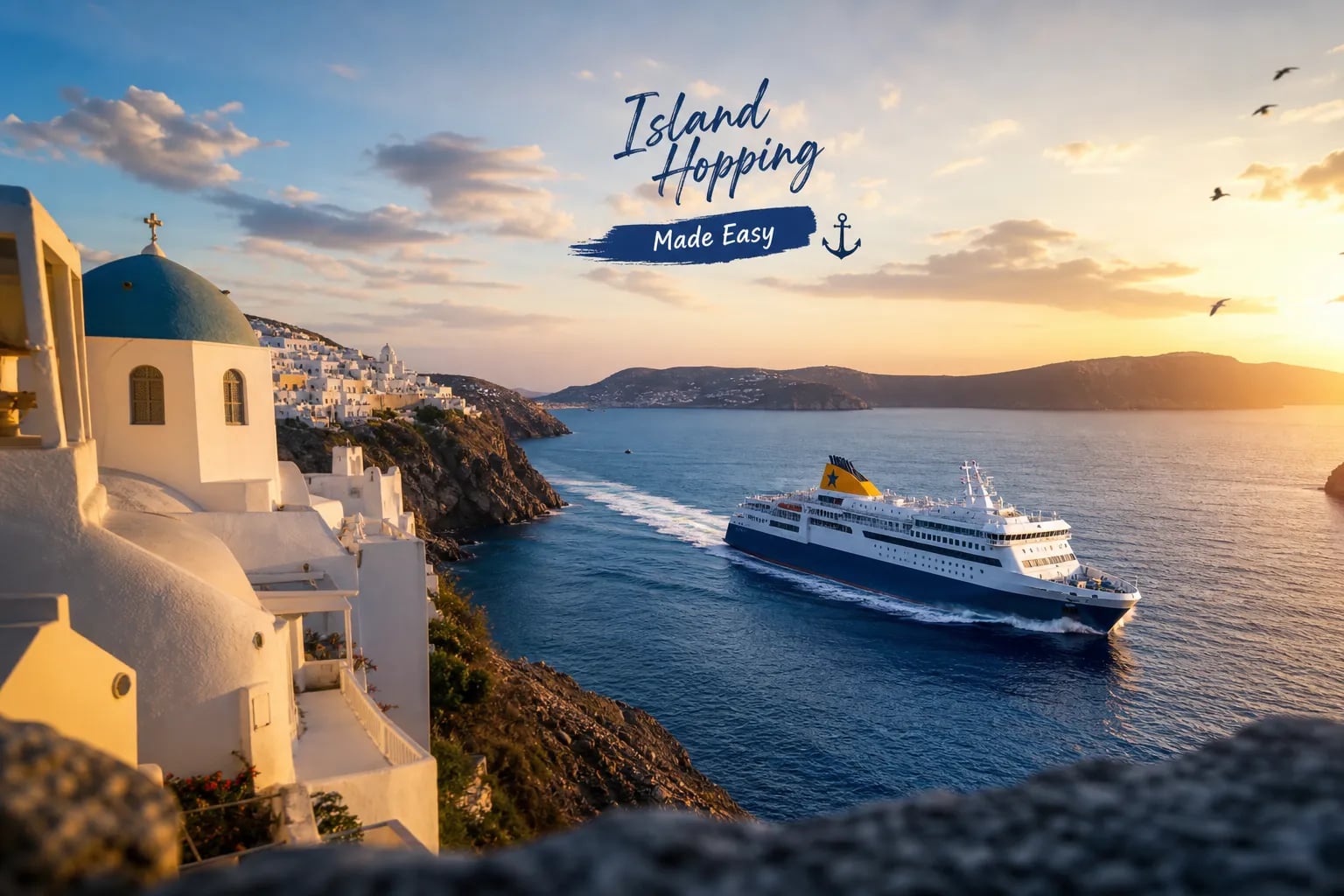
At 6 a.m., Piraeus port is already alive. Motorbikes roll up boarding ramps, departure boards flicker with gate changes, and a dozen identical-looking gates stretch out in every direction. For a first-time visitor, the whole system looks like controlled chaos. But there’s a logic underneath it, and once you find it, everything clicks into place.
Greece ferries are the connective tissue of the archipelago, linking hundreds of islands across the Aegean and Ionian seas. Without understanding them, an island-hopping trip can unravel fast: wrong port, wrong operator, sold-out vehicle space, or a canceled high-speed sailing stranding you for a day. By the end of this guide, you’ll know how to pick the right operator, book at the right time, manage your bags, and handle anything that goes sideways.
How Greece’s ferry network is actually structured
Before you touch a booking platform, you need to understand the two-port reality of Athens. Piraeus, on the city’s southwestern edge, is the dominant hub. It serves the Cyclades, Crete, the Dodecanese, the Saronic islands, and the North Aegean. Rafina, on the eastern coast closer to Athens International Airport, serves a narrower but important slice of the Cyclades: Andros, Tinos, and Mykonos are its core connections, with seasonal sailings to Naxos, Ios, and Santorini in summer.
The practical implication is significant. If you’re flying into Athens and heading straight to Mykonos, Rafina can save you serious transit time compared to crossing the city to Piraeus. Most generic travel guides gloss over this. The port question and the operator question are also intertwined because different companies depart from different ports, so you can’t separate one decision from the other.
Greece ferries: high-speed vs. conventional, the real tradeoff
High-speed catamarans, operated by companies like Seajets, compress journey times dramatically. Piraeus to Mykonos takes approximately 2 hours 40 to 55 minutes on a fast catamaran versus roughly 4 to 5 hours 50 minutes on a conventional Blue Star Ferries sailing. That time difference is real, but so are the tradeoffs. High-speed services are significantly more expensive, cannot transport vehicles, and are far more susceptible to cancellation in high winds across the Aegean.
Conventional ferries are larger, more stable in rough weather, and allow cars and motorcycles. For travelers doing a multi-island itinerary on a budget, or anyone bringing a vehicle, they’re often the smarter choice. The speed-versus-stability tradeoff isn’t just about time: it shapes your budget, your reliability, and your stress levels when the Aegean wind picks up.
The Greece ferry routes worth planning your itinerary around
The Athens-to-Cyclades corridor is the most-traveled in the Greek ferry network. Key routes run from Piraeus to Santorini, Mykonos, Paros, and Naxos, served by Blue Star Ferries, Seajets, Golden Star Ferries, Fast Ferries, and Hellenic Seaways. Paros and Naxos frequently appear on the same routing, making them natural back-to-back stops on a single itinerary without backtracking.
Once you’re on the islands, short inter-island hops become the rhythm of the trip. Mykonos to Paros runs 45 minutes to 1 hour 15 minutes on high-speed services; Paros to Naxos is 30 to 50 minutes. These crossings run frequently in summer and rarely require early booking in shoulder season. In July and August, however, they sell out fast, a distinction that catches a lot of travelers off guard after they’ve already sorted out the main legs.
The Dodecanese routes operate differently. From Piraeus, Blue Star Ferries and Dodekanisos Seaways are the dominant operators, with Rhodes and Kos serving as the natural entry points into the island chain. These are longer crossings with fewer daily departures, which tightens your booking window considerably. For summer travel on Dodecanese routes, plan to book 4 to 8 weeks in advance, flexibility is harder to maintain here, and it’s worth treating these reservations with the same seriousness you’d give an airline ticket.
Where and when to book Greece ferries
Three aggregator platforms cover the majority of Greek ferry routes: Ferryhopper, Ferryscanner, and DirectFerries. Ferryhopper is consistently the strongest choice for island hopping specifically in Greece. It pulls schedules and pricing from multiple operators, allows direct booking, and several independent travel guides report that its ticket prices match operator direct prices with no added fees. Ferryscanner is a solid second aggregator worth checking before you commit. DirectFerries is more useful when you’re combining Greece with other European ferry routes and want a broader comparison.
Booking directly through an operator’s own website, particularly Blue Star Ferries for conventional crossings, is also reliable and occasionally offers additional seat-class options. For vehicle reservations, some operators still require agency contact or direct communication rather than fully online booking, so don’t assume the standard digital flow applies to everything.
When to book based on your travel window
For July and August travel, book 4 to 8 weeks in advance. This isn’t excessive; it’s the practical minimum for popular Cyclades routes, and vehicle spaces sell out considerably faster than passenger seats. Shoulder season (May, June, September, October) offers far more flexibility, and booking a week or two ahead is usually sufficient. Aegean ferry timetables shift significantly between summer and winter schedules. Off-season crossings on some routes drop to two or three per week, which means your itinerary has to flex around the schedule rather than the other way around.
Bringing a vehicle adds another layer. Vehicle reservations typically require your license plate number and vehicle dimensions, and rental cars need written permission from the rental company before they’re allowed on board. Arrive at the port at least one hour before departure when traveling with a vehicle. On popular Cyclades routes in high season, vehicle deck space sells out before passenger seats; approach vehicle reservations as you would an airline seat on a peak-season route.
What Greece ferry tickets actually cost
Low-season conventional fares for Athens-to-Cyclades routes typically run in the €35 to €60 range for a one-way passenger seat. In high season, high-speed fares on the same routes climb to €70 to €110 and above. The price gap between conventional and fast ferry on an identical route can reach €30 to €50 per person. Across a multi-island itinerary, that difference adds up fast.
Ferry pricing on Greek island routes is dynamic; fares rise as boats fill. Booking early isn’t just about securing a seat, it locks in a lower fare before the algorithm adjusts upward. The best fares on the most popular summer routes disappear weeks before departure.
Understanding seat classes and what’s worth upgrading
Deck class is the cheapest option and means assigned or open seating on the passenger deck. For short hops under two hours, deck class is almost always fine. For overnight crossings to Rhodes or Crete, a cabin or airline-style seat is worth serious consideration. A cabin on a Blue Star Ferries overnight route can actually be a smarter financial choice than a budget hotel when you factor in the accommodation cost you’re offsetting while sleeping aboard.
Economy and business class seats add meaningful comfort on longer conventional crossings at a price point below a private cabin. If you’re on the fence, look at the total crossing time. Anything under three hours, save the upgrade fee. Anything over six hours, especially overnight, spend it.
Port logistics, luggage, and what to do when ferries go wrong
For conventional ferries, arriving 45 to 60 minutes before departure is the standard. For high-speed catamarans, some operators list 20 to 30 minutes as the technical minimum for check-in, but during peak season, when boarding lines form and gate confusion is common, aim for at least 45 minutes. Piraeus is large and can disorient first-timers; build in extra time on your first day until you know the layout.
Luggage on Greece ferries is largely self-managed. Blue Star Ferries and Seajets both cite an allowance of up to 50 kg per passenger, though in practice this is rarely checked strictly for foot passengers. Large bags go in designated storage areas near the lower deck; smaller bags stay with you in seating areas. Don’t leave valuables in stored luggage. Pack a small day bag that’s accessible without unpacking everything, crossings range from 30 minutes to six-plus hours, and you’ll want snacks, a jacket, and your documents within reach.
Your rights when sailings are canceled or delayed
Under EU maritime passenger rights regulations, if a departure is delayed beyond 90 minutes, passengers are generally entitled to either a full refund or care assistance including refreshments. For longer delays, the obligation can extend to meals and, where necessary, accommodation. Note that implementations vary between operators and may differ when delays stem from weather or force majeure. When an operator cancels a sailing outright, passengers are entitled to a full refund or rebooking on the next available crossing.
Standard passenger-initiated cancellation rules are tiered. For Blue Star Ferries, high-season cancellations are free up to 14 days before departure, drop to a 75% refund up to 7 days out, and settle at a 50% refund closer to departure. Low-season terms are more lenient. Cancellation policies vary by operator, Seajets’ specific terms, for example, should be verified directly on their site or at the point of booking. Read the fare conditions on your specific ticket before purchasing, because promotional fares and open tickets operate under different rules than standard fares.
Moving through Greece on your own terms
Greece’s ferries reward travelers who understand the system before they arrive. The apparent chaos of Piraeus at dawn resolves into a navigable network the moment you know your ports, your operators, and your booking window. What looked like a dozen identical gates becomes a logical departure sequence once you’ve matched your ticket to your terminal.
There’s also something clarifying about moving between islands by sea. It’s slow enough to feel the distance between places, purposeful enough to keep you on schedule. That unhurried rhythm, the spray off the bow, the island growing on the horizon, is part of what makes greece ferries worth understanding rather than just enduring.
If this kind of logistics-forward travel content resonates, you’ll find the same approach across The Curious Atlas. Our guides to Mexico’s ADO bus network and getting around the Yucatan Peninsula independently apply exactly this mindset: understand the system, learn its rules, and move through it confidently on your own terms. Head there next if your travel plans reach beyond the Aegean.
Leave a Reply