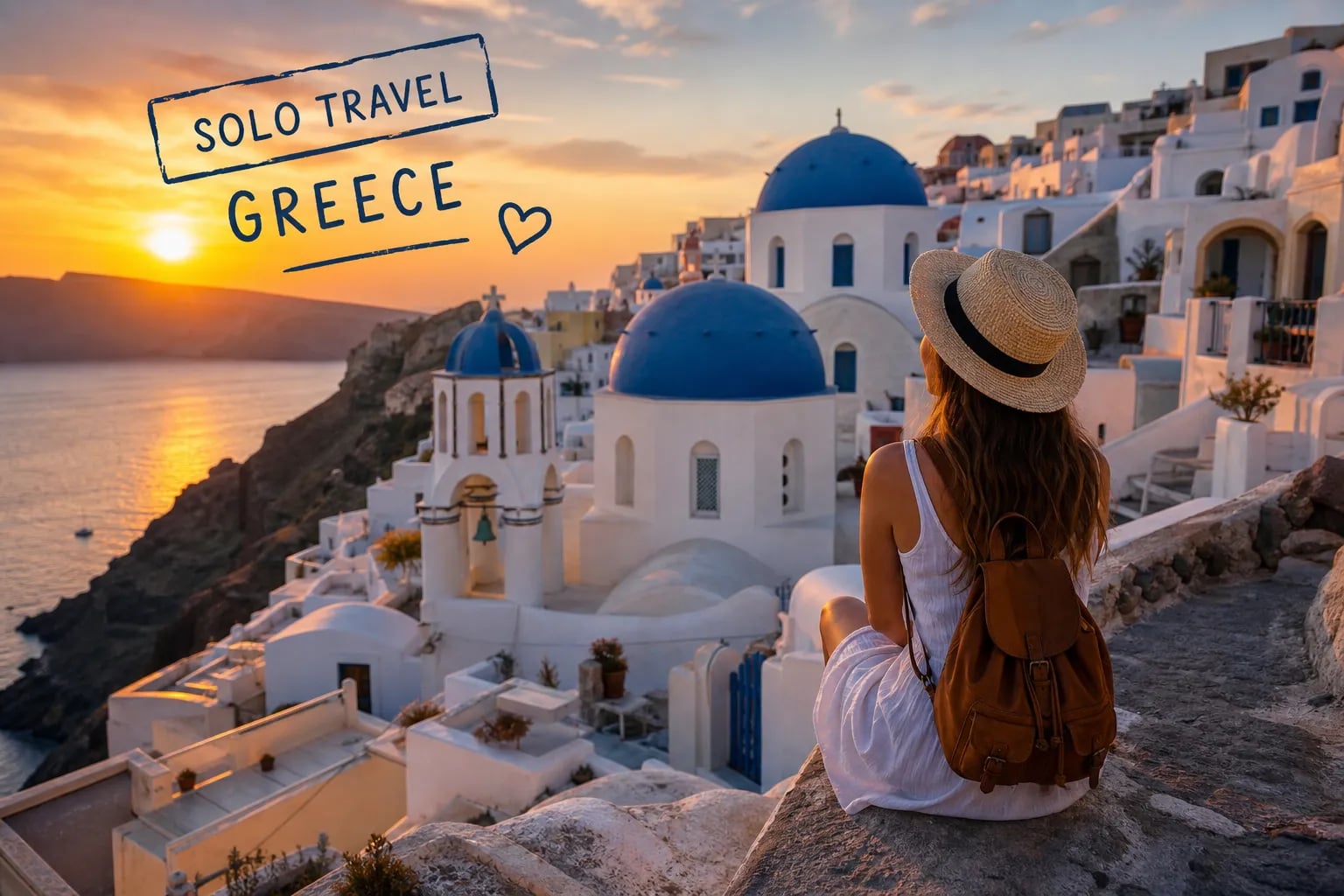
Solo travel in Greece rewards people who show up with a plan and the flexibility to abandon it. The smaller Cyclades islands, think Sifnos, Folegandros, or Hydra, are genuinely walkable in an afternoon, though larger islands like Crete and Naxos will keep you busy for days. What ties them all together is a culture that treats strangers at the dinner table like neighbors and a pace slow enough to actually breathe in. You don’t need a group to get the most out of this country. You need a plan.
Most solo travel guides for Greece pull you in two opposite directions: either they catalog every island in the Aegean and every ferry route connecting them, or they hand you a vague “just go and explore” and call it inspiration. Neither helps when you’re staring at a ferry booking platform at midnight trying to figure out whether to fly into Athens or Heraklion. This guide cuts through that noise. It’s a practical playbook for Greece solo travel, covering island selection, ferry logistics, real budgets, and safety habits, whether it’s your first trip or your third.
1. Pick the right island for your solo trip to Greece before you book anything
Match the island to your actual travel personality
Not every Greek island suits the same solo traveler, and choosing the wrong one is a common mistake that leads to either boredom or overstimulation, neither of which makes for a trip worth repeating. Before you compare ferry prices, be honest about what you actually want from your time there.
If beaches are your priority, Naxos and Milos consistently deliver: long stretches of sand, manageable crowds outside of August, and enough town life to keep evenings interesting. These are among the most solo-friendly Greek islands in the Cyclades. For a social scene and nightlife, Mykonos and Ios attract younger, more gregarious crowds where solo travelers often meet fellow wanderers quickly. If you’d rather earn your views through hiking boots, Crete and Karpathos reward active travelers with less-visited trails, routes like the Samaria Gorge on Crete or the path to Olympos village on Karpathos. And if quiet village immersion is what you’re after, Sifnos, Symi, and Folegandros offer something increasingly rare in the Aegean: actual stillness.
Build your Greece solo itinerary around Athens first
Athens is the logical anchor for any independent Greece trip, and most travelers underestimate it. Two full days in the city before island hopping resets your pace, absorbs jet lag, and gives you context for everything you’re about to see. The Acropolis deserves a morning, the National Archaeological Museum deserves another, and the rooftop tavernas in Plaka deserve your first real Greek dinner.
Logistically, Athens also makes sense as a starting point because both Piraeus and Rafina ports offer easy departures from the city. A practical rule for planning: seven days works well for Athens plus two islands; ten days opens up three islands without rushing. Push beyond that and you’ll spend more time in transit than in the places that actually matter. For more details, check our Athens solo travel guide.
2. Understand ferry logistics before you get to the port
Learn the difference between ferry types
High-speed ferries, operated by companies like Seajets and Hellenic Seaways, are significantly faster but cost more. The Piraeus to Mykonos crossing drops from nearly six hours on a conventional Blue Star ferry to about two hours and forty minutes on a high-speed vessel, at roughly double the ticket price. Conventional ferries are slower but often run overnight, which saves an accommodation night if you time the booking right.
For travelers island hopping solo in Greece on a tighter schedule, high-speed is usually worth the extra spend. For budget-focused trips with a flexible calendar, conventional ferries paired with a relaxed itinerary make more sense. One route worth knowing: Rafina port is faster and often cheaper than Piraeus for reaching Mykonos, with fares starting around €35 and travel times as short as one hour forty minutes (check Ferryhopper or Ferryscanner for current 2026 schedules and pricing before booking).
Book ferries early and use the right platforms
In summer, popular routes sell out weeks in advance. The Mykonos to Santorini crossing, which typically runs between €105 and €149, is one of the most booked segments in the Cyclades. For July and August travel, aim to book four to six weeks ahead for standard seats, and two to three months ahead if you need a cabin or a vehicle space. Shoulder season, roughly May through June and September through October, usually requires only one to two weeks of lead time on most routes.
Ferryhopper and Ferryscanner are the most reliable aggregators for comparing Greek ferry routes and pricing in one search. For confirmed bookings, you can also go directly to the ferry company’s own site. Whichever platform you use, double-check your departure port before locking anything in: Rafina handles many Mykonos sailings, while Piraeus covers most Cyclades routes and Crete connections.
For more information, visit our Greece Ferry Guide and The Complete Guide to Greek Island Hopping.
3. Set a realistic daily budget before your first taverna order
Know what each travel style actually costs
Greece is not a cheap destination, and treating it like one leads to budget shock mid-trip. Budget solo travel runs around €50 to €80 per day: hostel dorms at €15 to €25, meals at local bakeries and tavernas for €15 to €25, and selective spending on activities. Midrange travelers typically spend €100 to €150 per day, which unlocks private rooms, sit-down seafood meals, and occasional boat tours. Comfort travel, with private balcony hotels and nicer restaurants, runs €200 to €350 per day.
The numbers shift significantly depending on where you are. A seafood dinner that runs €18 on Naxos can cost €45 or more on Santorini. Mykonos and Santorini run higher than Naxos or Paros across every category, so if your itinerary mixes expensive islands with quieter ones, budget by destination rather than applying a single daily average to the whole trip.
Know where to save and where spending is worth it
On accommodation, well-reviewed guesthouses consistently outperform Instagram-famous hotels for value, and often for character. On food, eating where locals eat almost always means walking past the first row of restaurants at the main port. For inter-island transport, conventional ferries make sense for shorter hops where the time difference is minimal.
A few places where spending holds its value: a reputable airport transfer in Athens runs approximately €38 to €54 depending on the time of day (confirm the current official flat rate before you travel, as figures can change). At least one quality meal per island is worth the splurge. And any genuinely once-in-a-lifetime activity, a caldera sailing tour in Santorini, a hike through Samaria Gorge in Crete, deserves a line in your budget from the start. The goal isn’t to spend as little as possible; it’s to spend with intention.
4. Build safety habits that become automatic
Navigate Athens like a smart city traveler
Athens is generally safe but requires standard big-city awareness. Pickpocketing is most common in Monastiraki, Syntagma, and on the metro; carry a crossbody bag and keep your phone out of your back pocket. Avoid Omonia and Exarchia on foot late at night; use the metro or a ride-hailing app instead of walking through those areas after dark.
Decline unsolicited bar invitations, petition signers, and bracelet sellers near tourist sites. These are well-documented scams in the city’s tourist zones, and they work because they catch people off guard. Save two numbers offline before you arrive: 112 for general emergencies, 100 for police.
Apply consistent habits across all the islands
Solo female travel in Greece is something most women find manageable and low-stress in practice, particularly during daylight hours on the major islands. That said, the risk profile shifts with the activity. Nightlife zones in Mykonos or Ios require more active awareness: pre-arrange your transport back before you go out, not after.
On all islands, book accommodation centrally so you can walk back during daylight hours. Check ferry arrival times carefully to avoid landing somewhere unfamiliar after dark. Trust the local knowledge at your accommodation about which roads and beaches to avoid at night, that kind of firsthand, place-specific advice is often more practical than anything you’ll find in a generic online safety guide.
5. Slow down enough to actually find Greece
Resist the urge to see everything
The most common regret among first-time solo travelers in Greece is over-scheduling. Three islands in seven days leaves you perpetually in transit, moving through places rather than into them. The trip you’ll talk about years later is the one where you ate dinner at the same taverna twice because the owner remembered how you took your wine.
Spending at least two full days on each island, wandering without an agenda, letting a morning stretch into afternoon, is what transforms a Greek holiday into something that actually sticks with you. That unhurried philosophy shapes the way The Curious Atlas covers travel everywhere: fewer places, deeper presence. Build in at least one “nothing day” per island stop, especially on Naxos, Sifnos, or Folegandros, where the reward is entirely about atmosphere rather than ticking off sights.
Find the authentic local experience deliberately
Authentic Greece isn’t hard to find, but it requires stepping slightly off the main port drag. Look for tavernas with handwritten menus, no photos on the wall, and a mostly Greek-speaking clientele. Ask your accommodation host for their neighborhood picks rather than consulting a tourist brochure; those recommendations reliably outperform anything on a curated list.
Some specific experiences worth seeking out: a morning at a local fish market before the tourist crowds arrive, a coffee in a village square inland from the port, a late-night walk through an unlit alley in Naxos Town where the only sound is cats on cobblestones. A handwritten menu in Greek, a table full of locals, these are the signs you’ve found the right place, and the memories that outlast the sunset photographs.
Greece solo travel, in plain terms
Traveling Greece independently rewards people who plan the logistics carefully and then hold the itinerary loosely. Get the ferry bookings and the island sequence right. Set a real budget before you arrive. Build safety habits that run in the background without requiring constant attention. Then let the trip breathe.
The strategies in this guide all point toward the same thing: a Greece solo travel experience that feels personal rather than packaged. Match your island to your actual travel style, not to someone else’s highlight reel. Understand the ferry system well enough that port days feel calm rather than chaotic. Spend intentionally, slow down deliberately, and ask one local for one recommendation per island. That formula works whether you have seven days or ten, and whether you’re building a tight Cyclades sprint or a slow loop through quieter solo-friendly Greek islands.
The trip that changes how you travel is closer than you think. Start with one island, one ferry booking, and one honest answer to the question of what kind of traveler you actually are. The rest follows from there.
Leave a Reply