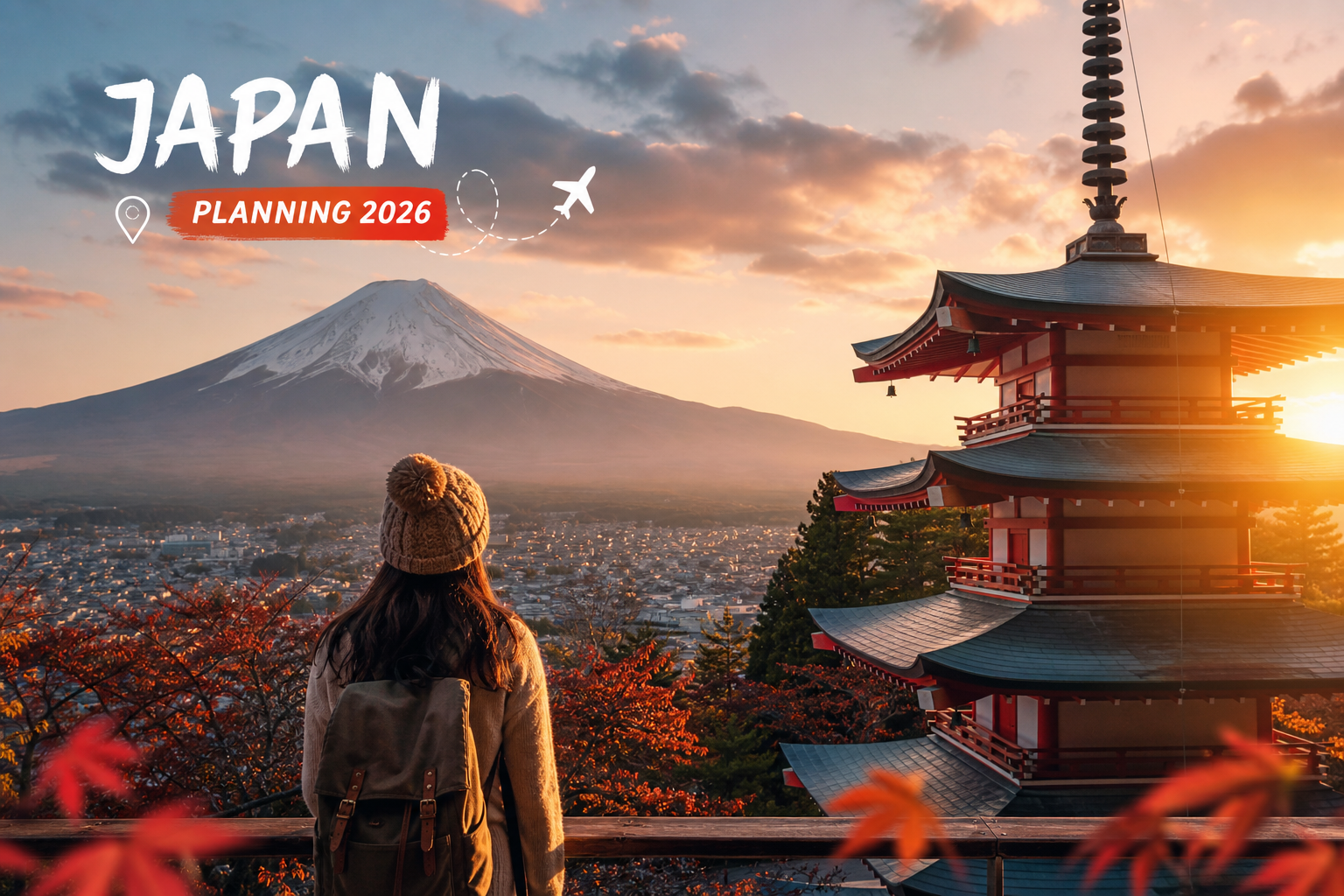
Most Canadians plan a first trip to Japan like a highlight reel. Seven days, five cities, one bullet-train blur. Yet Japan rewards patience. The country opens itself to the traveler who lingers in a Kyoto side street, who sits for a second bowl of ramen just to taste how the broth changes as it cools.
At The Curious Atlas, the trips we remember are never the rushed ones. If you’re planning Japan travel from Canada, good news: in 2026, the logistics are more manageable than most people expect, and you can build an itinerary that sticks. This guide gives Canadians the full playbook, entry rules, flights, arrival procedures, timing, budgets, insurance, and a slow-travel framework that turns your checklist into something closer to memory.
The first question most Canadians ask: do you need a visa?
Do Canadians need a visa to visit Japan?
Visa-free access and what it actually means
Canadian passport holders enter Japan visa-free for up to 90 days for tourism or short-term business without paid work. There is no advance application, no eVisa form, and no fee for tourism. Activities like sightseeing, visiting friends, and attending business meetings are all permitted; any paid work requires a separate visa. Japan’s proposed JESTA pre-travel authorization is not in force in 2026 and is expected around 2028 to 2029, so you are unaffected this year.
Passport and document requirements at the border
Your passport must be valid for the full duration of your stay. There is no six-month rule for Canadians. Immigration officers may ask to see your return or onward ticket, first-night accommodation details, and proof of funds, so keep confirmations handy on your phone. While in Japan, carry a photocopy or digital scan of your passport and keep the original secure; hotels will scan it at check-in.
What changes are coming (and what does not affect you yet)
Japan plans a visa fee increase from April 2026, raising single-entry fees for nationalities that require a visa. Canadians using visa-free entry are not affected. If you later pursue a work or long-stay visa, fees may differ, but that falls outside the scope of short-term tourism.
Japan travel from Canada: flights and routes by city
Vancouver: the strongest launch point for Japan travel from Canada
Vancouver is your best starting point. Air Canada runs daily nonstop flights to Tokyo Haneda year-round, with seasonal Narita service from June through August. Fares from the west coast trend lower than the rest of Canada, and off-peak sales often undercut Toronto prices by a wide margin. Winter travelers should note a new nonstop to Sapporo launching in December 2026, a welcome addition for powder seekers.
Toronto and Montreal routes and realistic pricing
From Toronto, nonstop flights to Tokyo are available, with summer 2026 round-trip pricing typically landing around CAD 2,321 to 2,483. Reaching Osaka adds a connection in Tokyo and roughly two to three extra hours. Montreal travelers usually connect, with spring and fall round-trips often in the CAD 1,454 to 1,544 range. If your dates are flexible, routing through Vancouver can sometimes beat nonstop Toronto fares, even after paying for a separate Vancouver connector (flying to Vancouver first to catch the nonstop).
Package tours vs. booking independently
Guided packages from Canada, including options from Air Canada Vacations and Asia Odyssey Travel, commonly price at CAD 2,800 to 4,500 per person for 7 to 9 days with flights, hotels, transfers, and some meals. They suit first-time visitors who want a structured preview of Tokyo, Kyoto, and Mount Fuji. Independent bookings unlock more neighborhood character and better value, especially for two- to three-week trips. If you plan to slow down and stay longer, booking on your own almost always wins on both freedom and cost. If you’re weighing guided versus independent options specifically for solo travelers, our All-Inclusive vs. Independent Travel: A Solo Traveler’s Honest Guide digs into the trade-offs.
Japan travel from Canada: clearing immigration on arrival
Registering on Visit Japan Web before you fly
Visit Japan Web is the digital system that replaces the paper arrival card and customs form. It is optional but strongly recommended: it generates QR codes and enables Fast Track lanes at major airports including Narita, Haneda, and Kansai. Create an account, enter your personal and flight details, add your first accommodation, complete the immigration and customs questionnaires, then save the QR codes offline. The whole setup takes 10 to 15 minutes and saves you the paper scramble on the plane.
What happens at the immigration desk
On arrival, follow the Fast Track signs and present your QR code, or hand over the paper forms if you did not pre-register. Officers will scan your passport and collect biometrics, fingerprints and a quick photo, then wave you through to baggage claim and customs. No COVID documentation or quarantine is required in 2026. Hotels will register you at check-in and typically keep a copy of your passport on file, which is standard practice throughout Japan.
2026 safety context: what Global Affairs Canada says
Japan remains at the lowest advisory level, listed as “take normal security precautions.” In April 2026, a magnitude 7.7 earthquake off the Sanriku coast prompted temporary warnings and service interruptions in northern prefectures, including Hokkaido, Aomori, Iwate, Miyagi, and Fukushima. If your itinerary includes Tohoku or northern Honshu, monitor Global Affairs Canada’s travel advisories on travel.gc.ca and local news regularly. Note that some areas around Fukushima still carry access restrictions.
When to go and why slow travel changes everything
Breaking down Japan’s travel seasons for Canadians
Cherry blossoms from late March to early April are iconic, busy, and expensive, while summer brings festivals alongside heat and humidity. Autumn foliage from mid-October into November may be the best balance of weather, color, and manageable crowds. Winter offers value and clarity. Think powder in Hokkaido and quiet temples in Kyoto, many Canadians find the cold entirely reasonable. For peak seasons like sakura or fall foliage, book flights and key accommodations 6 to 9 months ahead. Check out our Tokyo’s Weather by Season article for a detailed breakdown.
Why two or three weeks outperforms a 7-day highlight tour
A one-week sprint is like speed-reading a great novel: you finish, but you miss the sentences that change you. With 14 to 21 days, you can move from Tokyo to the Alps to Kyoto and then pause in a countryside onsen town without living out of a suitcase. Longer trips amortize the flight cost and create room for serendipity, the tea ceremony you stumble into, the night market you never planned.
A loose multi-week framework to build from
Use this flexible skeleton. Week one in Tokyo, with day trips to Nikko or Kamakura. Week two through the Kiso Valley and into Kyoto and Osaka. Week three as a wildcard: Hiroshima and Miyajima, Shikoku’s pilgrim paths, or northern Japan if it is winter. Japan’s train network makes it easy to adjust as you go, so compress or expand this arc to match your time and interests. Check out our 14-day itinerary recommendations covering Tokyo, Kyoto and Osaka here.
Budget breakdown and your pre-departure checklist
What Japan actually costs for Canadians in 2026
For independent travelers, budget roughly CAD 80 to 120 per day if you lean on hostels, convenience-store meals, and public transit. Mid-range travelers who prefer business hotels, sit-down restaurant meals, and the occasional splurge should expect CAD 150 to 220 per day. Both figures exclude flights and any rail pass. The nationwide JR Pass currently costs about ¥80,000 for 14 days and ¥100,000 for 21 days, roughly CAD 728 and 910 at recent exchange rates. It only makes sense if you stack several long Shinkansen legs; point-to-point tickets or regional passes often come out ahead. Note that price increases are coming to the nationwide Japan Rail Pass in 2026, so check the latest pricing before you buy.
Travel insurance and local logistics
Travel insurance is essential, treat it as a fixed line in your budget. Look for high medical limits, evacuation coverage, and trip cancellation protection, and confirm that natural disaster disruptions are covered given Japan’s seismic and typhoon risk. For connectivity, book a pocket Wi-Fi or an eSIM before you go, then download Google Maps, Google Translate with the camera feature, and a rail planner like Japan Transit Planner. The CAD to JPY exchange rate moves, so check it just before departure to fine-tune your daily budget.
Pre-departure action checklist
Set yourself up for a smooth arrival with this short, sequential checklist, easy to tick off in an evening.
- Confirm your Canadian passport is valid for your full trip.
- Register on Visit Japan Web and save your QR codes offline.
- Purchase travel insurance with medical and cancellation coverage.
- Book flights, checking Vancouver nonstop options if your dates are flexible.
- Purchase a JR Pass online before arrival if your itinerary genuinely benefits from it.
- Download offline maps and translation tools, and set up your eSIM or reserve pocket Wi-Fi.
Conclusion
Japan travel from Canada in 2026 is simpler than it looks: visa-free entry for Canadians, nonstop options from Vancouver, and a 10-minute arrival flow through Visit Japan Web. The harder, and better, question is not how to get in, but how long to stay and how slowly to move once you do. The magic lives in the spaces between your pins on the map.
Leave a Reply