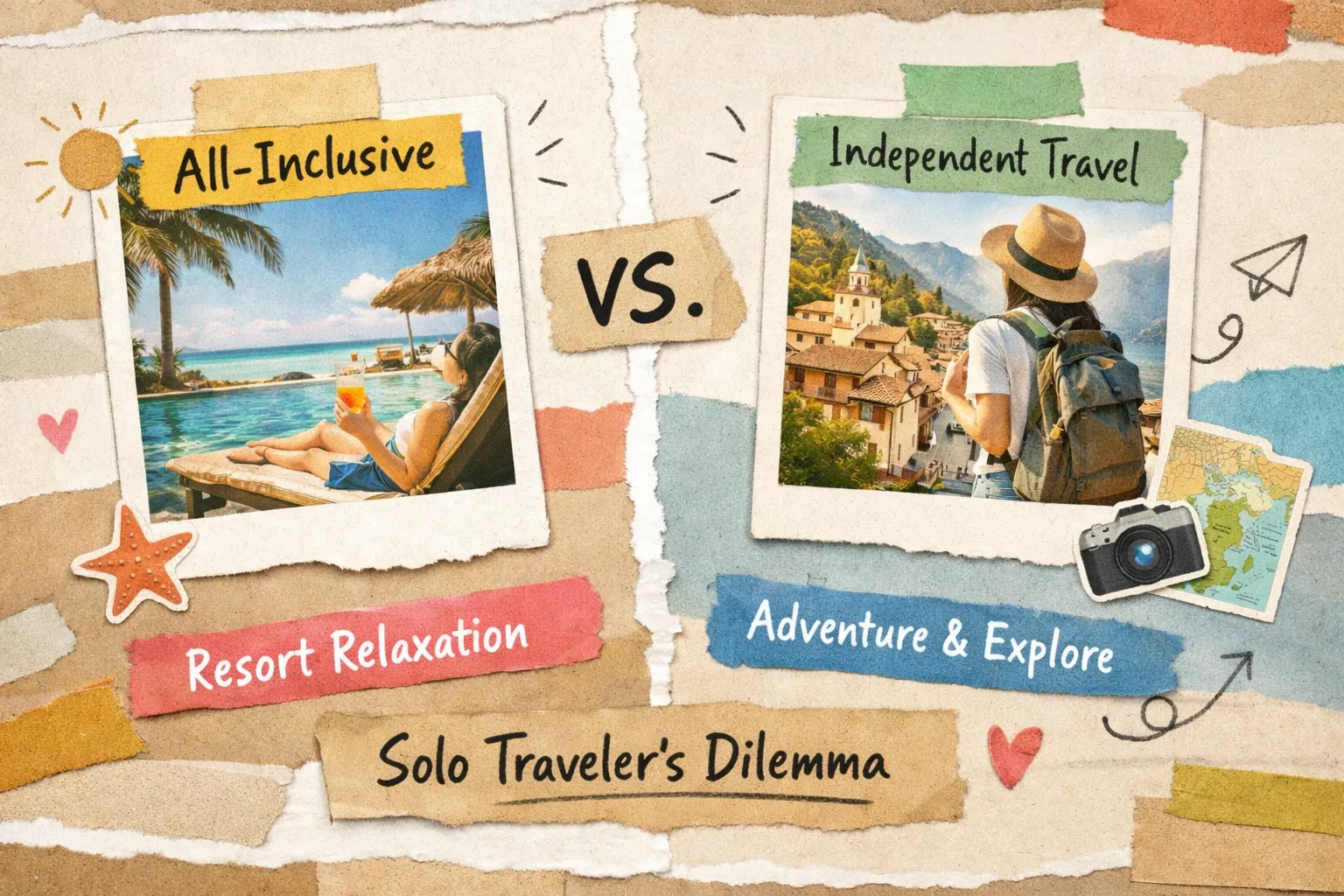
Are all-inclusive vacations worth it for solo travelers? It’s the question we hear often, and the honest answer isn’t a clean yes or no. All-inclusive resorts sell one thing above everything else: the promise that you won’t have to decide anything. No restaurant hunting, no budget math at the bar, no negotiating taxis. Just a wristband and a sun lounger. It’s a compelling pitch. The problem is that the entire package was built around two people. The room pricing assumes two people. The dinner table assumes two people. The promotional photography, almost always two people. When you show up solo, you’re inserting yourself into a format that wasn’t designed with you in mind, and that tension shapes every part of the experience in ways the booking confirmation never warns you about.
Readers want a straight answer. The honest one isn’t “yes” or “no”, it’s “it depends entirely on who you are as a traveler.” This guide works through the real variables: the actual cost math (including the single supplement arithmetic that most booking platforms bury), what you genuinely get for your money as one person, how the social side plays out in practice, and what you quietly give up by staying inside the gates. By the end, you’ll have a clear enough picture to make a confident decision for your next trip.
The real math behind all-inclusive pricing for solo travelers
The single supplement: what it is and what it actually costs you
Most all-inclusive resorts price their rooms assuming two guests sharing. When you travel alone, you either absorb the full double-occupancy rate yourself or pay what’s called a single supplement, an additional charge to compensate the resort for the empty side of the bed. That supplement typically adds 30 to 50 percent on top of the base rate, though a growing number of solo-friendly properties have moved to cap it at around 20 percent, and a few eliminate it entirely. Chains like Excellence Resorts and Club Med properties have made more transparent solo pricing part of their marketing. Transat’s Solo Collection goes further, covering 47 participating all-inclusive hotels across Mexico, the Dominican Republic, Jamaica, and Central America with zero single supplement fees. Always ask for the single supplement rate in writing before paying any deposit.
All-inclusive vs. pay-as-you-go: how a 7-day trip actually compares
A mid-range all-inclusive in Cancun or Punta Cana runs roughly $130 to $150 per person per night, landing you around $1,800 to $2,100 for a seven-night stay. A comparable pay-as-you-go setup looks cheaper on paper until you add the daily reality: a hotel room at roughly $288 per night, plus meals, drinks, and basic activities that push costs past $200 per day without much effort. For a solo traveler eating three meals, drinking a few cocktails, and using the pool, the all-inclusive math often wins. The break-even point is roughly two drinks and two full meals per day. Light consumers who skip breakfast, eat street food, and spend most of their time exploring off-property rarely recoup the all-inclusive premium. Heavy consumers, especially those who would otherwise rack up bar tabs and activity fees independently, often come out ahead.
What resorts actually deliver for one person
Amenities that justify the price tag for a solo guest
For solo travelers, the value of an all-inclusive concentrates in a few key areas: unlimited food and drink, wellness facilities, and included land or water activities. BodyHoliday in St. Lucia builds a daily 50-minute spa treatment directly into the base rate, a session that would cost $80 to $120 per day at a boutique hotel. Pools, yoga studios, fitness centers, tennis courts, and water sports stations are available without signing up as part of a group or waiting for a partner. When you add up what you’d pay for these inclusions individually across a full week, the savings are real.
The wellness angle deserves particular attention. Resorts like Lake Austin Spa Resort and BodyHoliday have essentially built their model around the solo guest who wants to invest deeply in rest and recovery. Group yoga and meditation classes function as natural social touch-points without any pressure to perform. You show up, participate as much or as little as you like, and leave. That format works exceptionally well for introverted solo travelers who want human presence without forced interaction.
Safety and convenience: the underrated solo travel benefit
Solo travelers, particularly women, consistently identify the controlled environment of a gated resort as a meaningful comfort advantage. On-site security, well-lit grounds, 24/7 staff presence, and access to on-site medical support reduce the cognitive load that independent travel in unfamiliar cities demands. Not having to research neighborhood safety, source a taxi at midnight, or navigate a foreign healthcare system while you’re sick, that peace of mind has genuine value that doesn’t show up in cost comparison tables. This isn’t a trivial consideration.
The trade-off is equally real. The same walls keeping risk out are keeping the destination out too. A resort in Cancun gives you a version of Mexico that has been thoroughly filtered for comfort. The actual Mexico, its markets, its street corners, its people living ordinary lives, exists just beyond the property line, and the resort architecture quietly discourages you from going there.
The social side of going solo at a resort
How resorts structure connection opportunities for single guests
The best solo-friendly all-inclusives engineer connection into the daily schedule rather than hoping guests figure it out themselves. Club Med properties structure daily group activities, yoga sessions, cooking demonstrations, beach volleyball tournaments, evening shows, as natural gathering points where arriving alone feels unremarkable rather than conspicuous. Communal dining tables at certain properties dissolve the awkwardness of eating solo. Adults-only properties like Breathless Cabo, Riu Palace Jamaica, and Temptation Cancun attract a more socially outgoing crowd than family resorts, which shifts the probability of genuine connection meaningfully in your favor. Hard Rock Los Cabos has developed a specific reputation among solo travelers for its open social atmosphere.
It’s also worth knowing that some resorts actively market themselves as singles vacations all-inclusive destinations, with programming built around meeting other solo travelers rather than simply tolerating their presence. These singles-focused properties, a niche but growing segment, run organized group dinners, day-trip pairings, and introductory social events that make the solo experience feel intentional rather than incidental. If structured socializing is important to you, filtering specifically for these properties is worth the extra research.
The reality: most resorts still skew heavily toward couples
No amount of honest planning fully papers over this: the dominant social unit at an all-inclusive is a couple. Two sun loungers, side by side. Two menus at dinner. Two wristbands. Solo travelers often feel this most acutely during evening entertainment and at dinner service, even when the daytime energy around pools and activity areas is more genuinely social. The solo travelers who thrive at resorts tend to be proactive, comfortable initiating conversations with strangers, and genuinely unbothered by stretches of their own company.
If that describes you, the social limitation of a resort is manageable, even enjoyable. If it doesn’t, the couple-centric design can quietly define the whole trip. Be honest with yourself about which category you fall into before you book. The answer changes the calculation entirely.
What the brochure doesn’t mention
Hidden fees that chip away at the “all-in” value
Bridging from the social realities to the financial ones: the hidden cost picture is just as important to understand before you commit. “All-inclusive” is one of the most inconsistently defined terms in travel marketing. Premium specialty restaurants within the property often require reservations and carry upcharges. Branded or imported spirits frequently sit behind a paywall even when “unlimited drinks” is prominently advertised. Wi-Fi is sometimes a paid add-on. Off-site excursions, the kind that actually get you into the destination rather than a resort simulation of it, are almost always extra, and sold at markedly inflated resort rates. In practice, a realistic buffer is 20 to 50 percent on top of the advertised package price, simply to cover the things that turn out not to be included.
The flexibility you quietly give up inside the gates
An all-inclusive resort is a self-contained micro-economy, and everything in it is designed to keep you on property. That means every hour you spend off-property is an hour you’ve already paid for and won’t use. This shapes behavior in ways most travelers don’t anticipate until they’re already there. You’ve paid for lunch at the buffet. The taxi to the town center costs extra. The half-day you wanted to spend wandering a local market feels like a financial loss, even when it rationally isn’t. That subtle friction discourages exploration, and over a full week, it can compress your entire experience of a destination into a small rectangle of beach and pool.
Are all-inclusive resorts worth it for solo travelers? Choosing the right property
Resort types and chains that genuinely cater to solo travelers
Not all all-inclusives are built the same for solo guests. Club Med properties with Zen Oases, adults-only quiet pool areas and structured social programming, sit at one end of the spectrum. Wellness-first resorts like BodyHoliday in St. Lucia and Lake Austin Spa Resort cater to solo travelers who want solitude and self-investment without loneliness. For Mexico specifically, Hard Rock Los Cabos and Breathless Cabo have earned genuine reputations as properties where solo travelers integrate more naturally into the social fabric of the resort.
Filtering explicitly for resorts that advertise single rates, capped supplements, or dedicated solo-traveler programming is the most efficient starting point. Transat’s Solo Collection is worth examining if your destination falls within their portfolio. Prioritize resorts where the supplement is capped at 20 percent or negotiated out entirely, check whether the property runs structured social events you’d realistically attend, and read recent reviews written specifically by solo travelers rather than couples.
What to verify before you book
A few factors consistently separate a resort that works for solo travelers from one that doesn’t. Confirm the exact single supplement terms in writing before paying any deposit. Check whether the property has structured social activities that fit your interests, not just generic “entertainment.” And read solo traveler reviews specifically, not aggregate scores. A property rated 9 out of 10 by couples can feel genuinely isolating to a single guest.
- Search for solo female traveler reviews on travel forums, not just booking platform summaries
- Look for recent posts about the social atmosphere in the past 6 to 12 months
- Ask the resort directly about communal dining options and solo-focused events
That last point matters more than most booking platforms make obvious. Food quality and pool size are easy to photograph and rate. Social atmosphere is harder to capture, and it’s often the variable that determines whether a solo traveler leaves feeling refreshed or quietly disappointed.
When independent travel simply wins
What stays locked behind the resort gates
There’s a specific kind of richness that an all-inclusive resort cannot replicate, regardless of its star rating or amenity list. It lives in a market stall at 7am, in a conversation with a cook who has been making the same dish for four decades, in navigating a cobblestone street where no other tourist has gone that morning. Resorts are designed to simulate the best of a destination while filtering out everything inconvenient. Unfortunately, the inconvenient parts are often where the most lasting travel memories happen. Independent travel asks more of you. It also gives more back.
The Yucatán argument: why slow travel changes everything here
Mexico’s Yucatán Peninsula is one of the most vivid cases for going independent. The resort corridor between Cancún and Tulum packages a version of Mexico that is clean, familiar, and deliberately frictionless. But an hour inland, in towns like Valladolid, Izamal, or along the quiet hacienda routes of the interior, a completely different Mexico exists.
Here, Mayan culinary traditions define the experience rather than decorate it: cochinita pibil slow-roasted underground in traditional pits, tortillas made by hand in village cooperatives, markets that don’t appear on any tourist map. Cenotes unmarked on most maps, community-based tourism projects run by indigenous cooperatives, and the walking pace of ordinary Yucatecan life are all available to the traveler willing to move through the region rather than observe it from a sun lounger.
So, are all-inclusive vacations worth it for solo travelers?
The answer lives in the individual. For the traveler who wants safety, simplicity, a predictable budget, and an environment engineered for relaxation, an all-inclusive makes genuine sense, especially if you select a solo-friendly property, verify the single supplement terms upfront, and go in with realistic expectations about the social atmosphere. The math often works, the amenities deliver, and the peace of mind has real value that’s easy to underestimate until you’re somewhere unfamiliar and feeling genuinely at ease.
For the solo traveler driven by curiosity, cultural depth, and the kind of discovery that only comes from moving through a place rather than watching it from a curated distance, the all-inclusive bubble will always feel too small. The gates that provide safety also provide containment. The buffet that eliminates decision fatigue also eliminates the question of where locals actually eat. The resort that packages everything also packages away the destination itself.
Know which kind of traveler you are before you book. So, are all-inclusive vacations worth it for solo travelers? For some, absolutely, the value, safety, and social infrastructure make it the right call. For others, the answer is just as clearly no: one of these formats rewards that version of you completely, while the other leaves you sitting at a perfectly adequate dinner table somewhere around day three, wondering what’s happening just outside the gates, and quietly wishing you were already there.
Leave a Reply