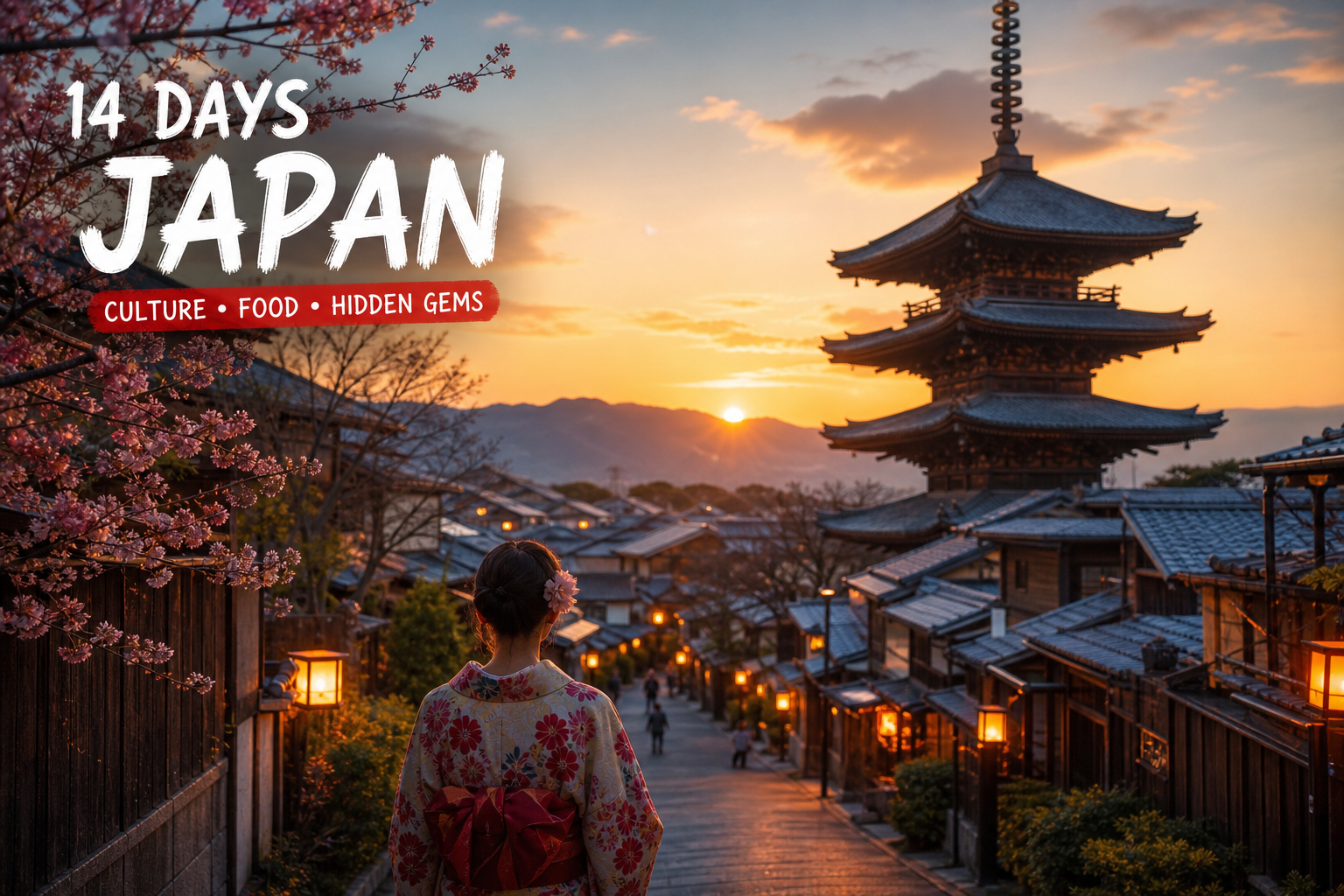
Build a Japan itinerary that starts with a refusal to rush. Japan rarely rewards the hurried traveler; it reveals itself to the one who pauses, listens, and lets the small rituals of daily life set the pace.
Most routes are engineered around box-ticking, not meaning. At The Curious Atlas, we plan itineraries the way we eat: slowly, intentionally, and always with room for something unexpected. The promise here is simple, a 14-day framework that trades the highlight reel for ryokan mornings, ramen hunts, and temple rituals you will remember long after the jet lag fades. Follow this path and your two weeks become a lived story, not a checklist.
Why 14 Days Is the Sweet Spot for a Japan Trip
A one-week sprint looks tidy on paper. You skim Tokyo, dart to Kyoto, drop into Osaka, and spend more time on platforms than in neighborhoods. The famous “Golden Route” compresses everything into a highlight montage. The real cost is felt later when memories blur because nothing had time to settle.
Two weeks change the texture of your Japan trip plan. You anchor yourself: four nights in Tokyo to arrive and decompress, five in Kyoto to learn the rhythm of mornings, three to four in Osaka to eat your way through alleys, then a final transition day to close the loop. A 2-week Japan route creates margin: room for backtracking, a rain day, a second visit to a place that surprised you.
In our experience talking to travelers, a pattern comes up often: those who spent 9 to 12 days in Japan say they wished for more time in Kyoto specifically. With fourteen, you can give Kyoto the mornings it deserves, build food rituals in every city, and still fit an onsen introduction without sprinting. Depth beats breadth when the country’s soul is in its rituals.
Days 1, 4 in Tokyo: Neighborhoods Over Landmarks
The Icons, Revisited
Tokyo is a mosaic of villages stitched together by trains. See the anchors, but recast them as rituals: Senso-ji at sunrise while shop shutters creak open, Meiji Shrine as a quiet walk before coffee, Shibuya Crossing late at night when its pulse slows. Treat the icons as warm-ups, not trophies.
Where the City Keeps Its Character
Then go where the city keeps its character. Yanaka gives you lanes that still carry the feel of old Edo, a neighborhood well-regarded among slow travelers for its traditional shotengai shopping street and unhurried pace. Shimokitazawa draws a creative crowd to its secondhand bookshops, intimate live music venues, and cafés that feel more like living rooms than businesses. Koenji pulses with vintage market culture and basement bars. Arrive jet-lagged and let those first early mornings be for wandering. Your body is awake, the streets are soft, and the city is generous to walkers who do not rush.
Building Your First Food Ritual
Build your first food ritual on Day 1. Choose a ramen shop and make it yours, then return before you leave. Ramen Street under Tokyo Station collects well-regarded shops in one spot; look for a local shoyu spot near your lodging if you prefer to keep it neighborhood-scale. Do a Tsukiji outer market lap one morning for tamagoyaki, grilled scallops, and tuna onigiri, then learn the art of the convenience store breakfast: onigiri, yogurt drink, canned coffee on a park bench. Food rituals anchor memory more than skyline views.
On Day 3 or 4, take a deliberate day trip to Hakone. Ride the loop, watch Mt. Fuji reveal and conceal itself, and end in an onsen to learn the bathing rhythms you will meet again in Kyoto. The point is not Fuji on a clear postcard day, it is your first meeting with slowness, the pace Japan is quietly offering if you accept the invitation.
Days 5, 9 in Kyoto: Ryokan Culture and the Morning Temple Walk
The Ryokan Experience
Kyoto is where your Japan travel itinerary becomes a practice. Book at least two nights in a ryokan, the traditional inn that is the cultural centerpiece of any honest route: tatami rooms, futon bedding, kaiseki dinners that map the seasons, and communal baths that reset the body. Budget ryokans typically start around ¥8,000 to ¥12,000 per night, with mid-range options including meals from ¥20,000 and up (prices vary by season and property). For popular properties and peak travel periods, booking well in advance is strongly recommended, plan dinner times like appointments once you arrive.
Mornings Are Non-Negotiable
Fushimi Inari before 7 am, or after 5 pm, shifts from spectacle to silence. Arashiyama’s bamboo grove is best experienced early in the morning before crowds arrive; take the side path up to Jojakko-ji and listen to the wind sift through maples. Kyoto’s temples are not “things to see.” They are a practice in attention. Give them the hour before the city remembers it is busy.
The Free Day
With five nights you gain a free day. No agenda, no reservation, no temples unless you feel pulled. Drift into Nishiki Market for a midday graze, the covered arcade is known for small-bite specialties like tako tamago (octopus on a skewer) and fresh yuba (tofu skin), among other local snacks, then let the Philosopher’s Path be an evening stroll rather than a tourist stop. This is when the trip settles in. You will notice how locals wait for the light to change even on empty streets, how trains whisper into stations, how a bowl of clear shio ramen tastes like restraint.
Use the rest of your Kyoto time to vary your cadence. One structured cultural experience, like a tea ceremony or a craft workshop. One neighborhood wander in Higashiyama that leaves plenty of time for a quiet coffee. One evening where your only task is to watch the Kamo River and feel the city breathe.
Days 10, 13 in Osaka: Ramen Trails and the Street Food Circuit
Osaka as Classroom
Osaka is appetite with a skyline. It is not historically the ramen capital, which is what makes it a perfect classroom for regional styles. Plan your meals with intention and your 14-day plan becomes a crash course in culinary geography. Think of ramen as cultural literacy, not a food tour stunt.
A Ramen Tasting Map for the Whole Trip
Across your two weeks, you will move through enough geography to sample genuinely distinct regional styles. Here is a simple framework for what to look for:
- Tokyo-style shoyu: clear, soy-framed broth with curly noodles.
- Kyoto-style shio or light chicken: clean, delicate, quietly elegant.
- Hakata tonkotsu from Fukuoka: creamy, pork-rich, thin straight noodles.
- Sapporo miso from Hokkaido: robust, often with butter and corn for cold nights.
In Osaka, seek out a couple of well-regarded shops and go in with curiosity rather than a checklist. Ask your accommodation for current local recommendations, since the ramen scene moves quickly. Two focused bowls will teach you more about regional style than hours of scrolling. If you plan just one sit-down bowl per day, this Japan day-by-day plan gives you a natural opportunity to work through three distinct regional styles across your two weeks.
Dotonbori, Shinsekai, and Nara
Treat Dotonbori and Shinsekai as ecosystems, not spectacles. Walk them in the morning to smell the grills warming up, then return early evening for takoyaki, kushikatsu, and whatever your nose tells you is right. On Day 13, take a half-day to Nara. The deer are real, but Todai-ji’s Great Buddha and the quiet corners of Nara Park are the actual reason to go. You will be back in Osaka by dinner, with room for one last bowl.
Timing and Transport for Your 2-Week Japan Itinerary
When to Go
Season shapes experience. Cherry blossoms in Tokyo typically peaks around late March, Kyoto and Osaka around early April. Avoid Golden Week from unless festival crowds are part of your goal. Fall from October to November is the quieter alternative, maples, crisp air, and easy walking with noticeably thinner crowds at major temples. Check out our Tokyo’s Weather by Season article for a detailed breakdown.
Shinkansen and Rail Passes
The Shinkansen makes this 2-week Japan route simple. Tokyo to Kyoto on the Hikari takes about 2.5 hours and costs roughly ¥13,320 one way. Kyoto to Osaka is a 15-minute hop to Shin-Osaka, though if you’re not staying near the shinkansen stations, or do not have the rail pass, it might be better to use local trains. The Japan Rail Pass covers Hikari but not the faster Nozomi. For a Tokyo, Kyoto, Osaka loop, the 14-day pass at around ¥80,000 rarely beats buying individual tickets unless you add long side trips.
Getting Around Day to Day
Buy long-distance tickets at machines or counters, then load a Suica or Pasmo IC card for local trains and buses, both are widely accepted across the main cities. Reserve seats if you prefer certainty, or ride unreserved outside peak hours and keep flexibility as part of the adventure. The goal is not to master every transport option but to understand the backbone well enough that you can focus on what actually matters: the neighborhoods, the meals, and the mornings you did not plan.
How to Customize This Japan Itinerary to Your Style
You have the core Tokyo, Kyoto, Osaka itinerary. Now tune it to how you travel. Swaps work best when they protect the ratio of arrival days, reflective mornings, and food-anchored evenings. Consider these alternatives if they fit your story:
- Trade one Osaka city day for an overnight in Kanazawa or Takayama to deepen your ryokan experience and meet quieter streets.
- Add the Kiso Valley between Tokyo and Kyoto for a half-day Nakasendo hike and a traditional inn night if you are traveling with older kids or crave historical texture.
- Reverse the route and start in Osaka if you want a softer landing. The scale is manageable, the food is immediately welcoming, and ending in Tokyo feels like turning up the volume gradually.
If food is your compass, build the route around it. Choose one signature meal in each city and protect it with a reservation or a planned early arrival. Sketch a market morning, a convenience-store breakfast, and a neighborhood izakaya night into every block of four days.
Close the Loop: Why This Two-Week Rhythm Works
We opened with a claim: Japan does not give itself to the hurried traveler. Over fourteen days, if you slow down enough, something shifts. You stop chasing and start noticing. The small rituals become the big memories, and the cities feel less like attractions and more like places you briefly lived.
Here is the framework you now hold: four days in Tokyo for neighborhoods and a measured Hakone day trip, five in Kyoto for ryokan culture and morning temple practice, three to four in Osaka for ramen and street food, and one day to close the loop. It is a Japan itinerary that privileges mornings, meals, and meaning over motion. Keep the structure, then customize the details until it sounds like your life.
The route is ready. The trains are on time. Choose your dates, book the anchors, and leave room for the unexpected. When you want a hand fine-tuning the details or you are ready for a deeper food trail, The Curious Atlas is here to help you turn a plan into a lived story.
Leave a Reply