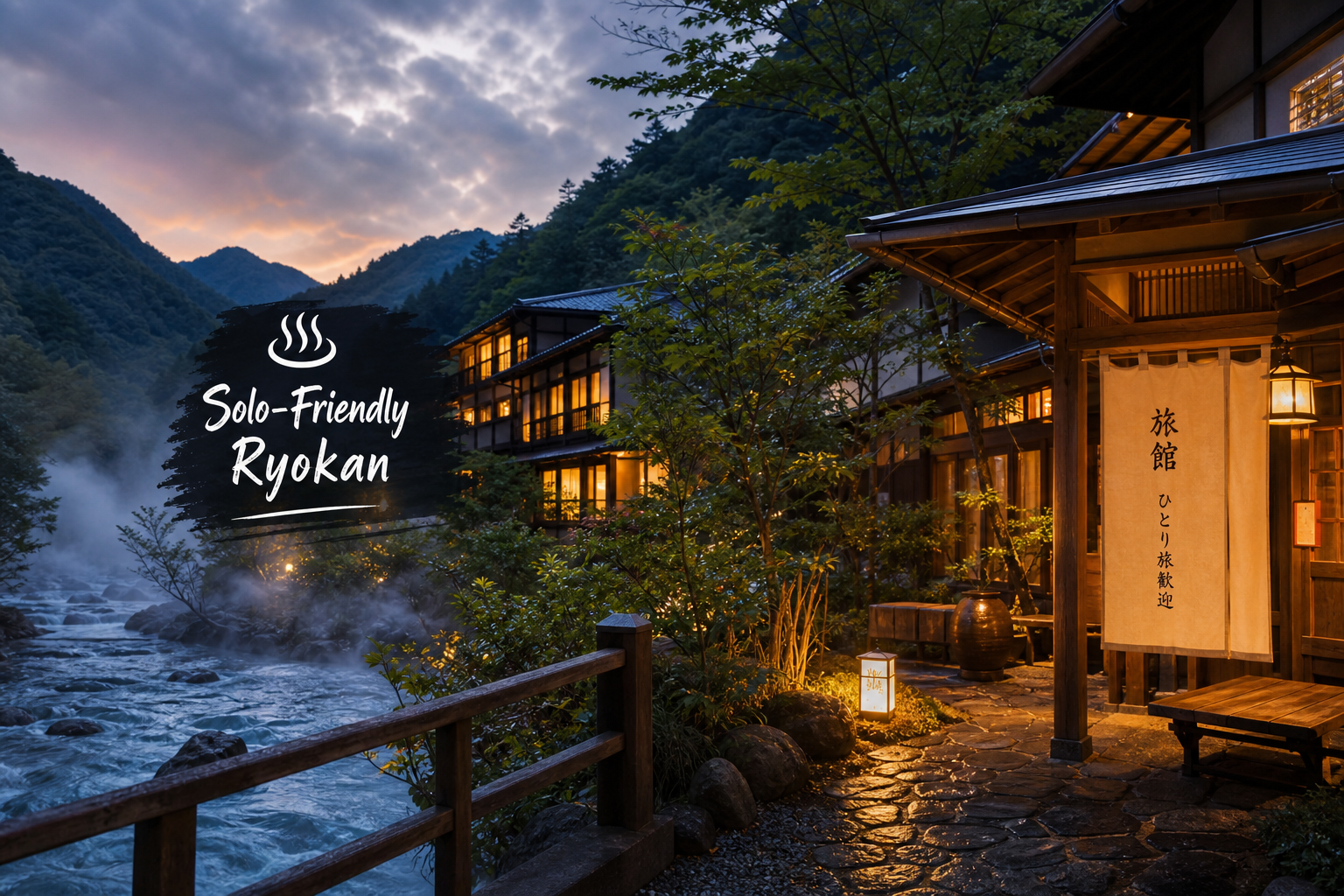
Picture it: a sliding paper screen diffuses the last of the evening light, a lacquered tray arrives with seven small courses you couldn’t name but will never forget, and somewhere just outside the garden wall, you can hear water moving over stone. This is what a ryokan stay feels like at its best. It’s the kind of overnight experience that sits at the heart of what slow, curious travel is supposed to be. Not the photograph at the temple gate, but the quiet morning in a yukata, hands wrapped around a bowl of miso soup, before anyone else in the inn has stirred.
The complication is that many ryokans are configured for two. Couples, families, travel companions, the physical rooms, the meal structures, and the pricing logic all assume more than one guest. Knowing how to book solo-friendly ryokans or traditional inns in Japan takes more strategy than a single search on Google Hotels, and the wrong approach leads to inflated rates, flat rejections, or unpleasant surprises at check-in. At The Curious Atlas, we’ve always believed that the most layered travel experiences are accessible to independent travelers; you just need to know how to find them.
This guide covers the platforms that actually surface solo plans, the Japanese terms that decode any listing, how to contact a ryokan directly with phrases that work, what to watch for before you pay, and the etiquette norms that make the experience feel natural rather than awkward.
How to book solo-friendly ryokans or traditional inns in Japan
The problem isn’t that ryokans dislike solo guests. It’s that the economics of a solo booking are genuinely inconvenient for the property. Understanding that friction is the first step to navigating it without frustration.
The per-person pricing model explained
Most ryokans charge per person, not per room. That rate typically includes two full meals: an elaborate kaiseki dinner and a traditional Japanese breakfast. When a room designed for two is occupied by one guest, the ryokan absorbs the cost of an empty seat at the table and reduced food revenue. This explains, without excusing, why solo travelers often encounter walls when searching. A property that feels unwelcoming isn’t necessarily hostile to solo travel. It’s navigating a structural pricing problem that most Western hotels don’t face in the same way.
What “single supplement” actually means in practice
A single supplement is a surcharge applied when one person occupies a room sized for more. At mid-range ryokans in Japan, this typically ranges from 10 to 30 percent above the standard per-person rate; during busy periods it can reach 50 percent or more. In the worst cases, the solo rate approaches the full double-room price. Some properties skip the surcharge entirely by offering a dedicated solo room or a plan labeled 1名利用 (single-use). That distinction shapes the entire booking strategy: if you find a true solo plan, the rate is designed for you. If you find a standard room with a single supplement tacked on, you’re paying a penalty for traveling alone.
The platforms that actually work for one-person ryokan searches
Not all booking sites surface solo plans equally. The Japanese OTAs have better infrastructure for this kind of search, and starting on the right platform saves hours of dead-end browsing.
Booking platforms for solo-friendly ryokans: Jalan, Ikyu, Rakuten Travel, and Japanican
These four platforms are built for the Japanese domestic travel market, which means ryokan listings tend to be more detailed, more accurate, and more likely to include proper solo-travel filters.
- Jalan is the strongest starting point. It has a dedicated ひとり旅 (solo travel) filter that surfaces plans built for one guest, not just rooms listed with a single occupant. Jalan offers an English interface at jalan.net/en, though the Japanese version exposes more filters, abrowser translation toolalongside the Japanese site gives you the best of both.
- Ikyu skews toward higher-quality properties that explicitly market to solo travelers, and its guest-count filtering returns true solo plans rather than standard rooms with a supplement attached.
- Rakuten Travel supports 1-guest searches and has published curated solo-friendly lists for popular regions including Hakone. Pricing clarity varies by property, but searching with guest count set to 1 is a reliable first filter.
- Japanican is the most accessible for non-Japanese speakers and works well for solo searches, though its inventory is less exhaustive than the larger Japanese OTAs.
Where Booking.com and Agoda fit in
Both platforms allow 1-adult searches and are genuinely useful for checking availability across a region. The gap is in labeling: a 1-guest result on these sites may still show a double room priced at near-full rate, with no indication that a single supplement is embedded in the figure. Use them to confirm that a property has availability, then cross-check the actual plan on Jalan or Rakuten Travel before booking. They’re a useful second step, not the first.
How to read a listing and identify a truly solo-friendly property
Getting a ryokan to appear in a 1-guest search is the easy part. Confirming it won’t charge double or turn you away at check-in requires reading the listing carefully, even in translation.
Japanese terms that reveal solo policies at a glance
Three phrases tell you almost everything you need to know about how a property handles solo guests. Scan for these in the plan description, even through Google Translate or a bilingual interface:
- 1名利用 / お一人様: single-use plan, designed for one person. This is the positive signal you want.
- ひとり旅プラン: solo travel plan. The most explicit positive label; properties using this phrase have actively marketed to solo travelers.
- シングルチャージ: single supplement charge. This is a cost, not a feature. If you see it, factor the extra fee into your comparison.
When you spot 1名利用 or ひとり旅プラン in a listing, you’ve found a property that’s worked through the logistics of accommodating solo guests and built a plan around it. That’s meaningfully different from a property that technically allows solo bookings but hasn’t designed for them.
Why a private onsen room changes the solo calculus
A room with a private onsen, called kashikiri (貸切), is often framed as a luxury upgrade. For solo travelers, it’s more strategic than that. It removes the social dynamic of shared baths entirely, sidesteps any anxiety around being the lone person in a communal onsen, and eliminates the tattoo restrictions that bar some guests from shared baths at certain properties. When a private bath is included in the room rate rather than charged as a timed session, the solo supplement can feel proportionate rather than punitive.
Strong examples by region include:
- Kashiwaya Ryokanin Shima Onsen (Gunma), three private open-air baths and in-room dinner service, making it genuinely designed for solo comfort.
- Utsuroi Tsuchiya Annexin Kinosaki Onsen, an explicit “Solo Traveler Welcome” plan with two private baths and no reservation required for bath access.
- Yamanochaya in Hakone, rooms with private in-room onsen and a track record with solo guests.
- Mozumo and Hidaji in Hida Takayama, private outdoor baths included as a room feature rather than an add-on.
Reaching out to a ryokan directly (with phrases that actually work)
Smaller, family-run ryokans often don’t update online listings frequently. The most reliable way to confirm solo availability, clarify meals, and ask about the onsen is a brief, polite direct inquiry. A few sentences in Japanese can significantly improve the odds of a helpful response, particularly at family-run properties where staff may be more comfortable corresponding in their first language.
A ready-to-use Japanese email template
Copy and paste this into an email or a booking-site message. The romaji pronunciation and English translation are included below each line:
件名:予約についての問い合わせ Kenmei: yoyaku ni tsuite no toiawase Subject: Inquiry about a reservation
こんにちは。 Konnichiwa. Hello.
一人で宿泊したいのですが、予約できますか。 Hitori de shukuhaku shitai no desu ga, yoyaku dekimasu ka? I would like to stay alone. Can I make a reservation?
夕食と朝食は付いていますか。食事の時間も教えていただけますと幸いです。 Yuushoku to choushoku wa tsuite imasu ka? Shokuji no jikan mo oshiete itadakemasu to saiwai desu. Are dinner and breakfast included? I would also appreciate knowing the meal times.
また、貸切風呂はありますか。温泉の利用時間も教えてください。 Mata, kashikiri-buro wa arimasu ka? Onsen no riyou jikan mo oshiete kudasai. Also, do you have a private bath? Please let me know the onsen hours as well.
お忙しいところ恐れ入りますが、よろしくお願いいたします。 Oisogashii tokoro osoreirimasu ga, yoroshiku onegai itashimasu. Sorry to trouble you, and thank you very much in advance.
Three things to confirm before you pay
Regardless of how you book, get these three points confirmed in writing before completing the reservation:
- Whether the quoted rate is a true solo plan or a standard double room with a single supplement added. The number on the screen doesn’t always tell you which one it is.
- Meal times and whether dinner can be served in-room. For solo guests, in-room kaiseki removes the pressure of communal dining; some properties offer this arrangement, particularly those with dedicated solo plans, so it’s worth asking directly.
- Onsen access hours and whether shared baths require advance reservation. Some ryokans with high occupancy book out bath time slots quickly, and solo guests without a private bath benefit from securing a slot early.
Ryokan etiquette every first-time solo guest should know
The booking is the logistical half of the experience. The other half is knowing how a ryokan operates before you walk through the door. These social codes are rarely explained in the booking confirmation, and as a solo traveler, you don’t have a companion to follow when you’re unsure what to do next.
Arrival customs, yukata, and onsen protocol
Remove your shoes at the entryway, the genkan, and wait for staff guidance before moving further into the inn. You’ll be shown to your room and typically offered tea. The yukata provided is worn throughout the inn, not just inside your room. Walking the corridors or visiting the onsen in your yukata is entirely expected and part of the atmosphere.
In the shared onsen, the rules are consistent across most properties: wash thoroughly at the individual stations before entering the communal bath, no swimwear, and no photographs. If you have tattoos, confirm the policy in advance, some properties have relaxed this restriction, particularly for smaller or private baths, but many still enforce it. Asking before you arrive avoids an uncomfortable moment at the bath entrance.
Navigating solo meals without feeling out of place
The social dimension that solo travelers often find daunting is the kaiseki dinner: a multi-course meal in a formal setting, where being the only single diner in a shared dining room can feel conspicuous. Many solo-friendly ryokans address this by serving dinner in-room, which transforms the meal into a private, leisurely experience. You eat at your own pace, without an audience, with the garden or the mountains outside your window.
For properties with communal dining, arrive on time. Meal slots are set in advance, and the staff coordinates the kitchen around those times. Ryokan staff are accustomed to solo guests and typically attentive without being intrusive. Many solo travelers find the experience far less awkward than they anticipated. When it’s done well, a solo ryokan meal is not a lesser version of the experience. It is the full version, with nothing diluting your attention to the food, the quiet, or the room.
Start here, book carefully, arrive slowly
A ryokan stay is one of the most complete expressions of Japanese hospitality culture available to a traveler. The architectural restraint, the seasonal menu, the ritual of the bath, the unhurried pace of a morning with nowhere to be: all of it is accessible to solo travelers. The preparation just requires more precision than a standard hotel search.
The practical sequence for booking solo-friendly ryokans or traditional inns in Japan: start on Jalan or Rakuten Travel with the guest count set to 1, scan listings for the 1名利用 or ひとり旅プラン labels, send a direct inquiry to confirm the rate structure and meal arrangements, and choose a room with a private bath if the budget allows. Properties in Shima Onsen, Kinosaki, Hida Takayama, and Kurokawa Onsen have strong concentrations of solo-friendly options beyond the more obvious Hakone and Kyoto circuits. For a suggested route that includes many of these places, see 14-Day Japan Itinerary: Culture, Food & Hidden Gems. Also, for an authoritative perspective on ryokan pricing structures over time, consult the ryokan association’s pricing page.
The work of finding the right ryokan is worth doing carefully. This is the kind of travel planning that shapes the memory you’ll carry home: not a hurried overnight for the sake of checking a box, but an unrushed stay that gives Japan’s hospitality culture the time it actually needs to unfold. Stay one more night if you can. You’ll understand why by morning. If you’re planning from North America, our practical guide How to Plan a Japan Trip from Canada in 2026 may be helpful for visas, timing, and flights.
Leave a Reply