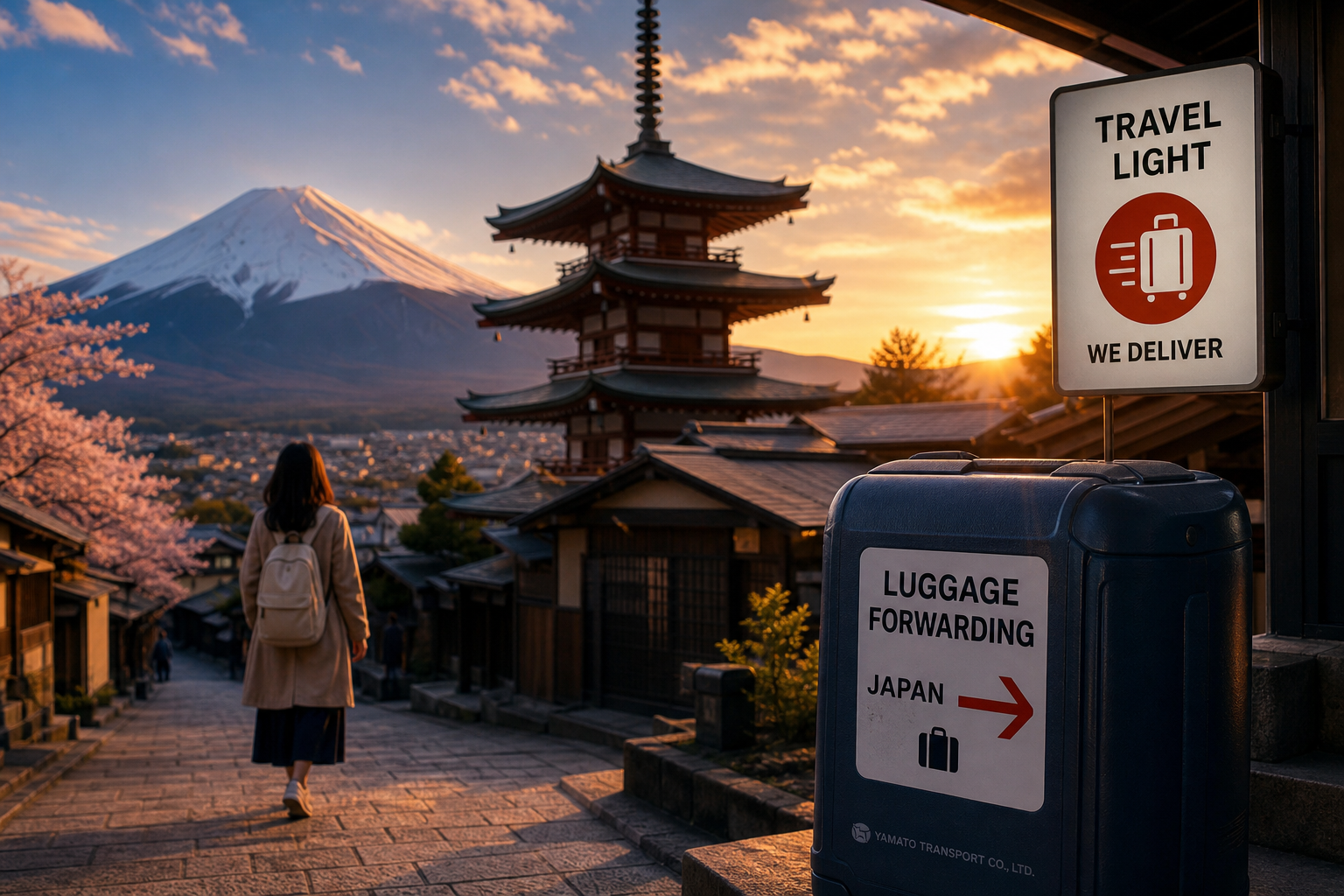
Most travelers spend months planning a Japan trip for its sense of freedom: the clean station platforms, the seamless trains, the quiet streets, the feeling of moving through a country that runs like clockwork. Then they arrive, and they spend the first morning of that dream trip dragging a 20 kg suitcase up four flights of stairs at a subway station with no elevator. The freedom they planned for evaporates in the humidity before they’ve even reached their first ryokan. The good news: Japan’s convenient luggage forwarding services, known as takkyubin, exist precisely to solve this problem, and most travelers never know to use them.
Japan built the answer to this problem decades ago. Takkyubin (also written as takuhaibin) is a domestic courier network so reliable and precise that locals use it to ship ski equipment to mountain resorts before they board the train. For independent travelers, it’s something more profound: the difference between seeing a country and carrying your life through it. Ship your bags from hotel to hotel, walk out with a daypack, and Japan opens up in a completely different way. This guide covers the main providers, where to drop off, what it costs, size rules, and how to time deliveries across a multi-city itinerary so the system works for you rather than against you.
What luggage forwarding in Japan actually is (and who runs it)
Takkyubin is a domestic courier service where you ship your bags from one location to the next and meet them at your destination. This is different from luggage storage: your bag actually travels, separately from you, and arrives at your next hotel before or shortly after you do. You board the Shinkansen with nothing but a daypack. Your suitcase makes its own journey.
Four providers are worth knowing. Yamato Transport, recognized by its black cat logo and operating under the TA-Q-BIN brand, is the most traveler-friendly and the one most hotels default to. Its network is the widest, its convenience store partnerships the most extensive, and its English-language support the most accessible of the major carriers. Sagawa Express is a solid nationwide alternative with comparable coverage, though it’s less commonly referenced by tourists. JAL ABC operates specifically at major airports, including Narita, Haneda, and Kansai International, and is particularly useful for arrival-day forwarding. Japan Post’s Yu-Pack rounds out the options as a general parcel service that works in a pinch, though it’s geared toward standard parcels rather than traveler-focused forwarding the way the others are.
Service types available
The four forwarding flows that matter for most itineraries are hotel-to-hotel, airport-to-hotel, hotel-to-airport, and convenience store drop-off with pickup at your destination hotel. Most services allow you to request delivery on a specific date and select a preferred time window. In practice, this means you can often specify a morning delivery slot so your suitcase is sitting in your room before you check in, though exact time-window availability can vary by carrier and drop-off location, so confirm the options when you book.
Convenient luggage forwarding services in Japan: where to drop off and arrange pickup
First-time users often assume this requires a dedicated shipping office or fluent Japanese. Neither is true. Drop-off points are embedded in places you’re already passing: the convenience store on the corner, your hotel front desk, the station you’re leaving from.
Convenience stores: the easiest option
Yamato partners with 7-Eleven, FamilyMart, and Lawson locations across Japan. The process is straightforward: pick up a delivery slip at the counter, fill in the destination address and contact details (your next hotel), hand over the bag, pay, and keep the receipt. English-language waybill forms are generally available at Yamato service counters, and hotel staff can help you fill them out if needed. Availability at individual convenience stores can vary by location, so if the form isn’t available, ask at the counter or head to the nearest Yamato service center. For convenience store drop-offs, Google Translate’s camera mode is a useful tool for navigating the Japanese slip if you’re going it alone, many travelers rely on it and find it gets the job done.
One rule to keep in mind: convenience stores have tighter size acceptance limits than Yamato service centers. Many stores won’t accept items larger than 180 cm in combined dimensions, though this varies by location, so it’s worth confirming with the specific store before you rely on it. If your suitcase is oversize, take it directly to a Yamato service counter rather than the nearest FamilyMart. Drop-off cutoff times at convenience stores are typically mid-afternoon, around 3:00 to 5:00 p.m. in most locations, though hours vary by store and region, so factor that into your morning before departure.
Hotels, airports, and train station counters
Most hotels in tourist corridors arrange Yamato collection directly from the front desk. You hand over your bag the night before or on the morning of departure, and the hotel handles the rest. For airport forwarding, JAL ABC operates counters at Narita (Terminals 1 and 2), Haneda (Terminals 2 and 3), and Kansai International Airport. Narita arrival counters open at 6:30 a.m. and remain open until approximately one hour after the last international arrival; departure counters run from 7:00 a.m. to 9:00 p.m. These are the clearest option for travelers who want to forward their bag immediately on landing rather than hauling it to an accommodation first.
Some major Shinkansen-adjacent stations also have luggage services or nearby convenience stores that function as drop-off points. Operating hours vary by location, and airport counters typically close earlier than the arrivals hall itself, so confirm times before you rely on them for a late-night connection.
What it costs and how long delivery takes
Many travelers assume luggage forwarding in Japan is a premium service. The actual numbers are more reasonable than most people expect. Yamato prices by size category (combined dimensions of length plus width plus height) and distance, and for most standard suitcases on common routes, the cost is comparable to, and often less than, typical domestic transport add-ons.
Typical price ranges by route
A standard checked suitcase typically falls in the 160 cm size class (up to 160 cm combined dimensions, up to 25 kg). Osaka and Kyoto routes from Tokyo run approximately ¥2,770. Hokkaido comes in around ¥3,010, Kyushu around ¥3,140, and Okinawa reaches about ¥3,420. Smaller carry-on bags in the 100 to 120 cm range cost noticeably less on every route. Four factors move the price: bag size (the primary driver), weight, destination distance, and any airport-specific handling fees that apply to JAL ABC services.
Delivery windows to plan around
Same-day delivery exists but covers only limited regional routes, such as Haneda to hotels within Tokyo’s 23 wards, or Kyoto Station to hotels within Kyoto city, and requires drop-off before mid-afternoon. For planning purposes, treat it as a bonus when it applies, not a baseline. Tokyo to Kyoto or Osaka commonly arrives next day for bags dropped off before the afternoon cutoff, though some itineraries may require two days depending on timing. Routes to Sapporo and Okinawa require two to three days. Airport-to-hotel deliveries within the same region typically arrive the following morning, not the same evening as your flight.
Size limits, prohibited items, and packaging basics
Standard Yamato takkyubin accepts luggage up to 160 cm combined dimensions and 25 kg for typical suitcase forwarding. The broader domestic service cap extends to 200 cm and 30 kg, with items beyond that requiring special counter handling. If your bag sits at or near 160 cm, measure it at home before your trip so there are no surprises at the drop-off counter. Note that convenience stores may apply stricter size limits than service centers, so when in doubt, head to a Yamato counter directly.
What can’t go in the shipment
The prohibited items list is specific and worth reviewing before you pack. Cash, passports and all ID documents, credit cards, original artworks, items valued over ¥300,000 (per Yamato’s published service terms), flammables, hazardous materials, and animals cannot be shipped. This means your passport and wallet stay with you in your daypack at all times, good travel practice regardless. Fragile items can be shipped but should be declared on the delivery slip and packed with adequate internal protection. When in doubt about whether your bag will be accepted at a convenience store, take it to a Yamato service center instead. Service centers apply the broader limits; convenience stores sometimes don’t.
Timing deliveries around a multi-city itinerary
Luggage forwarding is only as useful as your itinerary allows. Move cities every 24 hours and the system works against you. Spend two or three nights per city and it becomes one of the most freeing tools in the travel kit. The mental shift from “I need to manage my bags today” to “my bags are already there” is not a small one.
The one-day buffer rule
The practical formula is simple: always ship bags at least one full day before you need them at the next destination. If you’re leaving Tokyo on a Tuesday and checking into Kyoto on Wednesday, ship the bag on Monday. This comfortably accounts for next-day delivery windows on most common routes and removes any stress about arriving before your luggage does. For longer routes, Sapporo, Okinawa, or remote areas, build in two to three days to be safe. The delivery slip includes a date selection field where you can specify the exact arrival date, so use it. Requesting delivery for the morning of your check-in day means you arrive to a room where everything is already waiting.
Why slow travel and takkyubin are a natural fit
At The Curious Atlas, Japan itineraries are built with buffer days between cities for exactly this reason. Spending three nights in Osaka before moving to Hiroshima gives you time to ship the bag on the morning of day two, explore freely on day three without it, and arrive at your next destination to find your things already in the room. The pacing isn’t just more relaxing, it’s what makes hands-free travel genuinely practical rather than aspirational. It also makes Shinkansen travel more comfortable. Shinkansen have real restrictions on oversize luggage on key routes, and a suitcase you’ve already forwarded is a suitcase that isn’t your problem on the platform. For more resources and route ideas, see our Japan Archives, The Curious Atlas.
The bigger picture: a system worth building your trip around
Japan designed takkyubin for its own citizens, but independent travelers who understand the system get the same gift. The ability to walk out of a Kyoto ryokan with nothing but a daypack, spend two days exploring freely, and arrive at your next hotel to find everything already waiting is not a luxury reserved for people who pack light. It’s a choice available to any traveler who plans for it. For a practical external overview of how takkyubin works in everyday travel, the Japan Guide takkyubin overview is a useful reference.
The core takeaways are straightforward. Yamato is the most accessible provider for tourists, with convenience store drop-offs at 7-Eleven, FamilyMart, and Lawson making luggage forwarding in Japan available almost anywhere you’re staying. Next-day delivery covers most major routes. The one-day buffer rule, and a two-to-three-day buffer for longer routes, eliminates nearly all the stress around timing. And the cost, for many common routes with a standard suitcase, typically falls in the ¥2,000 to ¥3,500 range, which is less than most people spend on a single tourist attraction entrance fee.
If you’re building a Japan itinerary and want to structure it specifically for slow, hands-free travel through Japan’s cities and countryside, The Curious Atlas has detailed destination guides built around exactly this philosophy. Use convenient luggage forwarding services in Japan to move freely between cities, plan the itinerary first, and let the logistics follow. For a ready-made plan you can adapt, see our 14-Day Japan Itinerary: Culture, Food & Hidden Gems, and be sure to pack the right adapters so your devices stay charged on the road.
Leave a Reply