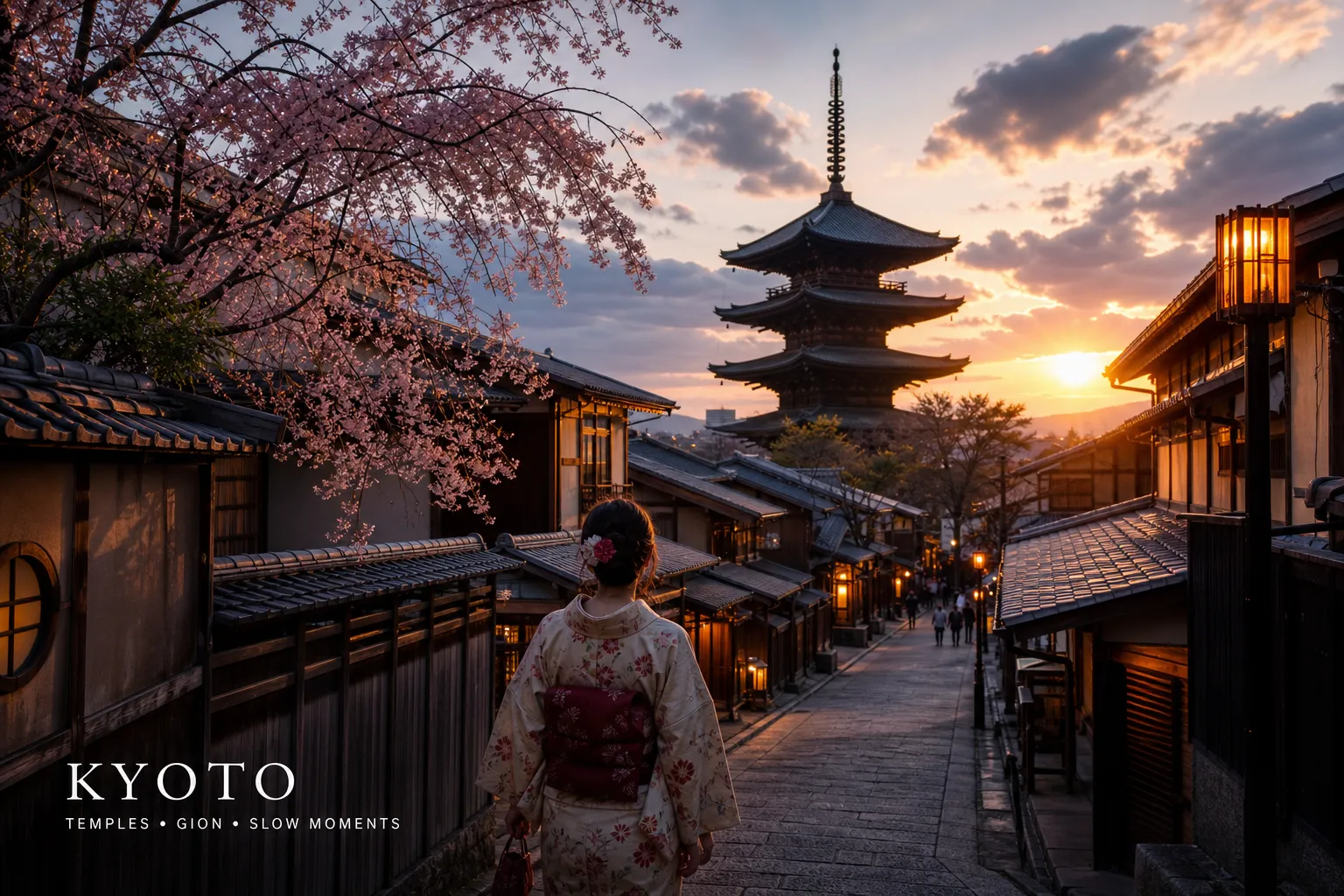
This Kyoto travel guide is built for the traveler who slows down rather than sprints. Kyoto rewards the person who turns down the wrong alley, sits with a cup of tea twenty minutes longer than planned, and notices the way morning light hits a moss-covered stone wall at 7 AM. Most visitors arrive with a tightly packed checklist, race between the same five landmarks, and leave having technically seen Kyoto without ever having felt it. That gap between seeing and feeling is what this guide is designed to close.
The approach here follows the same philosophy behind every guide on The Curious Atlas: slow down, eat where locals eat, and give yourself room to be surprised. What follows covers the neighborhoods worth your time, the temples that justify genuine attention, the food culture most itineraries ignore, and a practical day-by-day framework you can actually use. Kyoto is one of the most layered cities on the planet. The only way to access those layers is to stop rushing through them.
Why Kyoto rewards the traveler who slows down
There’s a practical case for slow travel in Kyoto that goes beyond philosophy. The city is compact. Walking between major sights is often faster than waiting for a crowded bus, and the most memorable moments tend to happen in transit: a wooden gate you walked through by accident, a garden glimpsed through a sliding door, a quiet canal street that exists three minutes from somewhere famous. The traveler who builds buffer time into their day sees a fundamentally different city than the one who doesn’t.
The problem with the “checklist Kyoto” mindset
The standard approach goes something like this: Fushimi Inari by 6 AM, Arashiyama by 9 AM, Kinkaku-ji by noon. On paper, it looks efficient. In practice, it produces stress rather than experience. Kyoto has over 1,600 registered temples. The goal was never to visit them all, it was to genuinely inhabit a handful of them. Racing between attractions treats a sacred city like a theme park, and you end up with a camera full of photos and very little to say about any of them.
What slow travel actually looks like in Kyoto
Concretely, it means staying at least three nights, revisiting one neighborhood at different times of day, and eating where residents eat rather than where tour buses park. Use transit like someone who lives here, not someone running a shuttle route. The traveler who spends a full evening in Gion, has lunch twice at the same market stall, and allows a full morning for one temple is going to come away with something the checklist traveler misses entirely.
Kyoto travel guide: neighborhoods and what makes each one worth your time
Kyoto’s soul lives in its traditional townscapes, what the Japanese call machinami. Three neighborhoods in particular carry that character most clearly: Gion, Higashiyama, and Fushimi. They connect geographically and can be explored in a single unhurried day or spread across two. Either approach works. What doesn’t work is treating them as quick stops.
Gion: the geisha district beyond the Instagram shot
Most visitors go directly to Hanamikoji Street, take a few photos, and leave. The quieter lanes of Shinbashi-dori and the Shirakawa Canal, which most people walk right past, are what actually justify a slow evening in Gion. Arrive before 9 AM on a weekday or after 6 PM when the lanterns come on and the tour groups thin out. Photography rules apply in some Gion sub-districts; do not photograph maiko or geiko without consent, and pay attention to posted signs near private residential lanes.
Higashiyama: stone paths and preserved Edo-era streets
Sannenzaka and Ninenzaka are worth the walk even when they’re busy. Arriving before 8 AM or after 5 PM completely changes the experience; the stone-paved streets take on a different quality when they’re not packed with tour groups. Kiyomizu-dera sits at the top of this corridor, open from 6 AM, admission ¥400. The wooden stage views are best in early morning light, when the city below is still quiet.
Fushimi Inari: the full hike, not just the postcard gate
Most tourists turn back after fifteen minutes, which is exactly why you shouldn’t. The full two-hour hike up Mount Inari thins out dramatically after the first twenty minutes of climbing. Entrance is free, and the shrine is open 24 hours. Arriving at 6 AM or at dusk changes the experience entirely. For the lowest crowd levels, aim for before sunrise on a weekday; by 10 AM, the lower paths fill with tour buses and the magic is largely gone.
Temples worth lingering in, Kyoto travel guide picks
Kyoto has more temples than any reasonable traveler can visit in a week. The question isn’t which ones to add to your list; it’s which ones deserve unhurried attention. A few of them genuinely do.
Kinkaku-ji and Ryoan-ji: iconic, and genuinely worth it
Kinkaku-ji is one of those places that actually lives up to its reputation. Arrive at opening (9 AM, ¥500) before the coaches arrive. Pair it with Ryoan-ji, a fifteen-minute walk away, to experience Kyoto’s most celebrated Zen rock garden. The combination takes about two hours at an unhurried pace. The contrast between the two sites, one opulently gold, one almost brutally minimal, is worth thinking about as you move between them.
Arashiyama: the bamboo grove is just the beginning
The bamboo grove is free and technically accessible at any hour, but the surrounding area is what makes Arashiyama worth a half-day. Tenryu-ji’s garden (¥500, UNESCO-listed) is one of the finest Zen gardens in Japan. The quiet riverbank and the specialty coffee at % Arabica Arashiyama round out an experience that the bamboo selfie alone doesn’t deliver. Arrive before 8 AM to see the grove before it becomes a foot traffic problem.
The case for skipping one major temple entirely
This is the most useful piece of advice in this entire guide: remove one famous attraction from your Kyoto itinerary on purpose. Freeing up that slot creates space for a longer meal, a slower walk through a neighborhood, or a second visit to somewhere you want to see again. The emotional bandwidth required to actually absorb what you’re seeing is finite, and over-scheduling is the fastest way to exhaust it.
Where and how to eat like a local in Kyoto
Kyoto’s food culture is as specific and layered as its architecture. The cuisine draws on centuries of Buddhist temple cooking, regional produce, and a precision that makes even a simple lunch feel considered. Treating the food with the same curiosity you bring to the temples pays off significantly.
Nishiki Market and what to actually eat there
Nishiki Market, a narrow covered arcade near downtown, earns its reputation as Kyoto’s kitchen, but only if you arrive before 10 AM. Consider a Nishiki Market tour for an insider’s view, and read How to Explore Japan Markets Like a Slow Traveler if you want a slower, vendor-focused approach. Walk through and eat as you go: fresh tofu, pickled vegetables (tsukemono), and grilled skewers are the local staples. Later in the day it tilts heavily tourist; in the morning you’re shopping alongside residents running errands. The experience at 8 AM and at 1 PM are genuinely different.
Shojin ryori, teishoku, and the best ¥900 lunch in the city
Shojin ryori, Buddhist temple cuisine, is one of Kyoto’s most distinctive food experiences and one of the most underused by visitors. Izusen near Daitoku-ji is a reliable entry point. It offers set courses in a garden setting that alone justifies the visit. For everyday lunches, local teishoku spots, Japanese set-meal restaurants, deliver exceptional quality for ¥900 to ¥1,500. Daily food costs in Kyoto are very manageable if you eat where the office workers eat rather than where the tourist maps point.
Kyoto travel guide: 3-day itinerary, transit, and timing
The framework below is a starting point. Treat it as a scaffold, not a schedule, and adjust it to how you actually move through a city.
A 3-day Kyoto itinerary for the unhurried traveler
Day 1 groups the eastern corridor: Fushimi Inari at dawn, then the Higashiyama corridor, Kiyomizu-dera, Sannenzaka, Gion by evening. Day 2 moves west: Arashiyama at dawn, Kinkaku-ji and Ryoan-ji mid-morning. Day 3 covers central Kyoto: Nishiki Market in the morning, Nijo Castle mid-day, Pontocho at dusk. This structure front-loads the most crowd-sensitive sights and groups neighborhoods geographically, which saves significant transit time.
Transit: buses, subway, and the IC card worth getting
Kyoto runs on a two-line subway (Karasuma and Tozai lines) combined with an extensive city bus network. The Kyoto Subway & Bus 1-Day Pass costs approximately ¥1,100 and covers both for a single day; it’s worth purchasing on heavy sightseeing days. For multi-day travel, an ICOCA IC card is the most flexible option. Buy it at Kyoto Station on arrival, load it with cash, and use it across trains, buses, and subways without fumbling for exact change every time. For maps and station details, consult this Kyoto subway lines guide.
When to go and what your budget actually looks like
Cherry blossom peak in 2026 falls roughly around March 30 to April 5, with full bloom centered around April 2. Fall foliage peaks in mid-to-late November. Both windows are extraordinary and both are crowded; if you’re traveling during either, book accommodation two to three months in advance. Budget travelers can manage comfortably on ¥10,000 to ¥15,000 per day. Mid-range travel sits at ¥20,000 to ¥30,000. Accommodation in Kyoto runs cheaper than Tokyo, with solid guesthouses and ryokan options available from ¥4,000 to ¥8,000 per night in Gion and Higashiyama, for a Tokyo comparison see How to Spend 5 Days in Tokyo Like a Local. For bloom timing and viewing tips, consult this cherry blossom in Kyoto guide.
The same curiosity that works in Kyoto works everywhere
The approach that makes Kyoto reveal itself, arriving early, walking instead of rushing, eating where locals eat, leaving space in the schedule for the unplanned, isn’t specific to Japan. It’s a way of traveling. The same orientation that unlocks Gion’s back streets and Fushimi’s upper mountain trail is the one that unlocks cenotes, colonial towns, and jungle markets in the Yucatan. Checklist travelers don’t find the good stuff in either place.
The Curious Atlas’s Yucatan guides are built on exactly this philosophy: slow, food-forward, genuinely curious travel through Mexico’s most layered region. Destinations like Bacalar and the street food scenes of Playa del Carmen reward exactly the same kind of attention that Kyoto does. Readers who connected with this guide will find the Yucatan content written with the same unhurried eye.
Kyoto gives back what you bring to it
The city is indifferent to the traveler in a hurry and generous to the one paying attention. The practical takeaway from this Kyoto travel guide is simple: pick fewer places, stay longer in each, eat off the tourist circuit, and use the day-by-day framework above to organize your time without over-scheduling it. Leave room for the accidental gate, the unplanned tea, the canal street nobody told you about.
Come back before your trip to refine the itinerary, check the seasonal timing, and remind yourself of the one rule that matters most: the best version of Kyoto belongs to the traveler who isn’t trying to finish it. If you want broader trip-planning advice, read How to Plan an Immersive Japan Trip on Any Budget.
Leave a Reply