Most people treat Hakone like a footnote to Tokyo, a half-day box to tick between bullet train rides, a quick glimpse of a volcano and a lake before rushing back to Shinjuku in time for dinner. That framing sells the place completely short. The best Hakone, Japan attractions reward patience far more than a packed checklist, and the travelers who get the most out of its sightseeing, its onsen culture, and its volcanic landscapes are the ones who arrive with curiosity rather than a schedule to survive.
At The Curious Atlas, we apply the same unhurried philosophy here that turns a week in the Yucatan Peninsula into something deeply personal. Slow down, look closely, and the place reveals itself. Hakone works exactly the same way. This guide covers the things to do in Hakone that actually deserve your time, the transport logic behind the famous circuit, how to read the Hakone Free Pass, and two time-optimized itineraries built for independent travelers who want the real experience, not just the Instagram version.
Hakone, Japan attractions actually worth your time
Not every stop on a popular attractions list deserves equal weight. In Hakone, several anchor experiences stand out because of the depth they offer, not just their visitor numbers. Three in particular reward a different kind of attention and form the backbone of any serious Hakone day trip itinerary.
Lake Ashi and the lakeside shrine
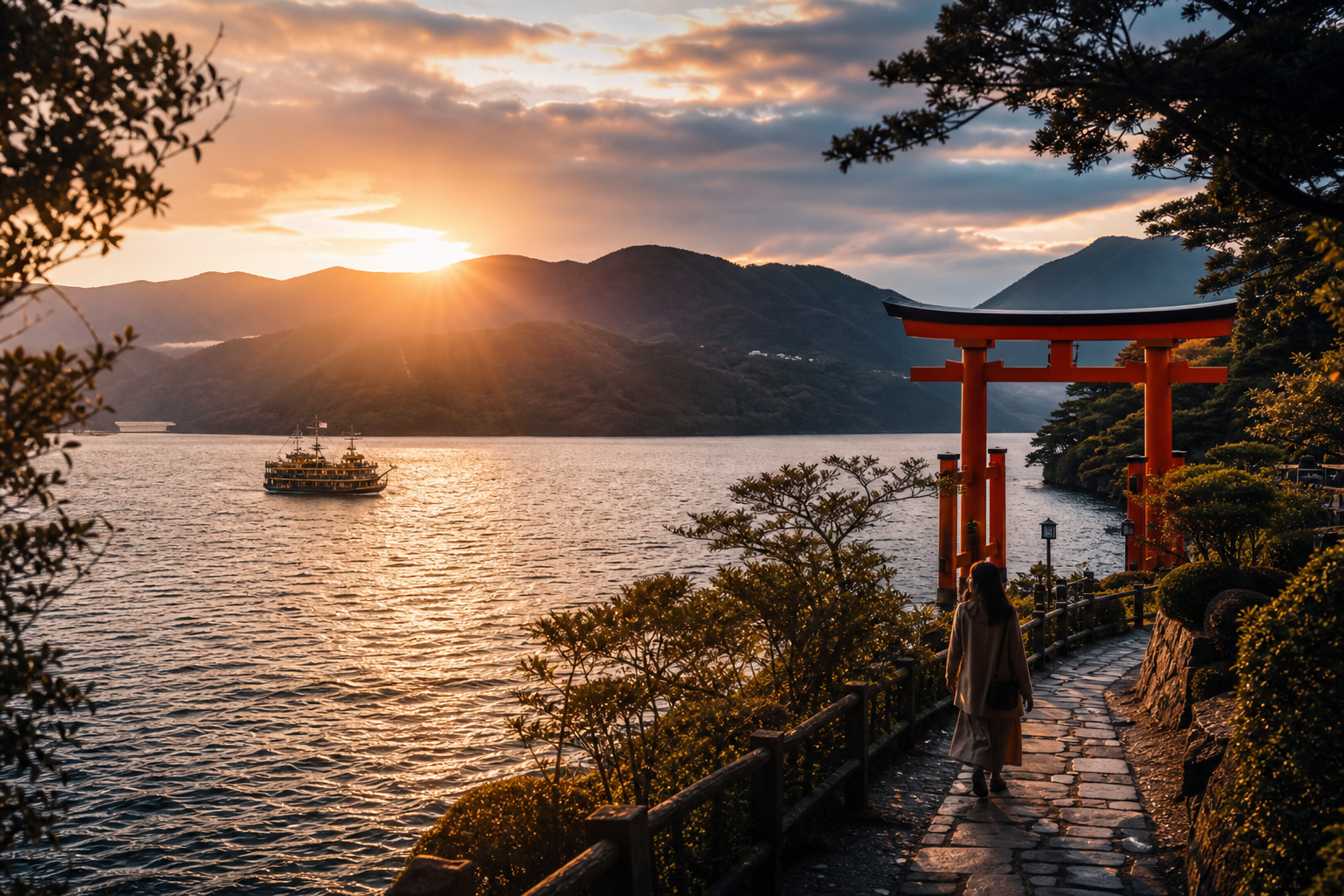
Lake Ashi is Hakone’s emotional centerpiece, a volcanic crater lake ringed by forested hills, with Mount Fuji appearing on the horizon on clear winter mornings. The Hakone Shrine and its famous waterside torii gate define the visual identity of Hakone sightseeing more than any other single image. Many visitors arrive by bus or on foot from Moto-Hakone, but arriving by boat from Togendai changes the whole experience. The lake opens up in front of you, the torii emerges from the water, and the scale of the landscape registers in a way it simply does not from a parking lot.
The shrine grounds are free to enter. The forested cedar approach path leading up from the lakeside is one of the quieter, more atmospheric corners of the entire area, worth walking slowly rather than skipping for the next photo spot.
Hakone Open-Air Museum: Japan’s first sculpture park
The Hakone Open-Air Museum surprises most visitors who expect a gallery you walk through in forty minutes. This is an outdoor sculpture park spread across a mountain slope, where the art and the landscape are designed to interact with each other. Moving between installations at your own pace, with the Hakone hills as a backdrop, is genuinely unlike any museum visit in Japan. The Picasso Pavilion alone holds over 300 works and justifies a significant portion of your time here.
Admission is ¥2,000 for adults (¥1,800 if you book online), and hours run 9:00 to 17:00 daily with last entry 30 minutes before closing. Budget 2 to 3 hours minimum. This is one Hakone attraction that most visitors rush through and almost everyone wishes they had lingered longer.
Owakudani: where the volcano is still talking
Owakudani is Hakone’s most dramatic sightseeing stop, an active volcanic valley with sulfur vents, steaming rock faces, and the famous kuro-tamago: black eggs hard-boiled in the sulfurous hot spring water. The geology here is spectacular and completely unlike anything else on the circuit. Many visitors spend only a short time, take a photo, and move on. Give it forty-five minutes and walk the accessible trail along the volcanic shelf to appreciate the scale of what you are actually standing on.
The ropeway-to-lake circuit: Hakone’s spine
The most iconic sightseeing route in Hakone is not a single attraction but a transport chain that doubles as a journey through the landscape. Understanding how it connects makes the whole trip easier to plan.
How the Gora-to-Togendai loop works
The chain connects four legs in sequence: Hakone Tozan Railway from Hakone-Yumoto to Gora (approximately 35 to 40 minutes), cable car from Gora to Sounzan (about 10 minutes), then the ropeway over Owakudani to Togendai on Lake Ashi (roughly 25 minutes total, with a stop at Owakudani mid-route). Total travel time from Hakone-Yumoto to the lakeside runs about 1 hour 15 minutes without stops.
The ropeway crossing deserves its reputation. Sulfur plumes rise below the gondola, the volcanic valley stretches out beneath you, and Lake Ashi appears in the distance as you clear the ridge. It is one of the most visually arresting experiences in Japanese sightseeing, and treating it as mere transit would be a genuine mistake.
The Lake Ashi boat cruise
The sightseeing cruise is the final leg of the loop, crossing from Togendai toward Moto-Hakone or Hakonemachi. Boats run approximately every 30 to 40 minutes, operating from around 9:30 a.m. to 5:00 p.m., with the crossing taking roughly 25 to 40 minutes depending on your destination port and route. On a clear morning, this ride offers the most unobstructed Mount Fuji views of any point on the Hakone circuit. Arriving at the Hakone Shrine torii gate by water, rather than road, is one of those moments that justifies the whole trip; for schedules and boarding points see the Hakone sightseeing cruise.
Onsen culture and the case for staying overnight
Here is the part most day-trippers miss entirely. Hakone’s onsen culture is not a bonus feature. Ask anyone who stayed overnight and the onsen almost always comes up first.
What a ryokan stay actually means
A ryokan stay is not a hotel alternative with Japanese decor. Picture tatami rooms, a multi-course kaiseki dinner served in your room, yukata to wear between meals and the bathhouse, and bathing at a pace dictated by the hot spring schedule rather than a tour bus. An overnight stay is the single best upgrade any Hakone visitor can make. The main onsen towns are Hakone-Yumoto (most accessible from Tokyo), Miyanoshita (quieter, mid-mountain), and Gora (closest to the ropeway), each with a distinct atmosphere.
For independent travelers who want privacy, look for rooms or properties offering kashikiri-buro (private reserved baths) or in-room rotenburo (private open-air baths). Properties in Gora such as Hakone Kyuan and Hakone Kowakien Tenyu offer private baths as standard in every room, which is practical for solo travelers who want complete autonomy over their bathing schedule.
Onsen culture for first-timers
A few basics before you arrive: bathing is done completely without clothing, you wash thoroughly at the shower stations before entering the bath, and tattoos are still restricted at many traditional public bathhouses. If you have tattoos or skin sensitivities, check the property’s policy before booking. The difference between a public communal bath and a kashikiri-buro is simply whether you share the space, both are worth experiencing. Soaking in a mountain onsen in winter, with cold air on your face and hot spring water (typically around 40°C) surrounding you, is one of Japan’s great seasonal pleasures and not something you can replicate on a rushed day trip.
The Hakone Free Pass: what it covers and whether it’s worth it
The Hakone Free Pass is the practical backbone of any independent visit to the area. Understanding what it covers saves you from buying individual tickets for every leg of the circuit.
What the pass includes
The pass covers the Hakone Tozan Railway (Odawara to Gora), the Hakone Tozan Cable Car (Gora to Sounzan), the Hakone Ropeway (Sounzan through Owakudani to Togendai), and the Lake Ashi sightseeing cruise. It also includes the Hakone Tozan Bus network connecting Moto-Hakone and Hakonemachi, plus discounts at major Hakone attractions including the Open-Air Museum. The pass is available as a 2-day (¥6,000 from Odawara, ¥7,100 from Shinjuku) or 3-day option (¥6,400 from Odawara, ¥7,500 from Shinjuku). If you want to travel on the Romancecar from Shinjuku, add a seat reservation surcharge of approximately ¥1,200 per adult each way.
Is it worth buying for a day trip vs. an overnight?
For a full day trip doing the ropeway circuit, a museum stop, and the lake cruise, the pass typically covers its own cost. For an overnight stay with multiple transport legs across two days, the value is stronger. The 2-day pass is the right choice for most independent travelers doing a slow, thorough visit. The 3-day pass makes sense only if you plan to move between areas repeatedly or visit more remote parts of the Hakone bus network.
When to visit for Mount Fuji views (and what to do when clouds win)
This is the most searched question about Hakone sightseeing, and it deserves a direct answer rather than diplomatic hedging.
The best months and time of day
December through February gives the clearest Fuji views. October and November are close behind. Cooler, drier air means less atmospheric haze and fewer low clouds obscuring the summit. The best viewing window is early morning, specifically 6 to 8 a.m., before clouds begin to build. Midday is the weakest window even in peak winter. If seeing Fuji is a priority, book a ryokan the night before so you wake up already in Hakone rather than arriving from Tokyo at 10 a.m. hoping for clear skies. For a broader seasonal breakdown and planning tips, see Tokyo’s weather by season: the slow traveler’s guide.
The best specific viewpoints for photography are Taikanzan Observatory for the classic panoramic lake-and-mountain composition, the Hakone Shrine torii gate area for the iconic floating gate framing, and Owakudani on the ropeway for elevated, unobstructed alpine-style views. On the lake itself, position yourself on the top deck of the sightseeing cruise for the clearest horizon line.
What to do when visibility is zero
Cloud cover is common, even in winter. The Open-Air Museum, the Hakone Shrine cedar approach path, Owakudani’s volcanic landscape, and a ryokan onsen evening are all fully worthwhile regardless of weather. The ropeway can close in high winds or severe conditions, a real practical consideration for day-trip planning; check the Hakone status information if you’re planning around a tight schedule. If you are doing the circuit as a day-tripper and the ropeway closes, you lose the centerpiece of the itinerary. The Lake Ashi cruise still runs in light rain and carries a different, moodier quality that is worth experiencing on its own terms.
Building your Hakone itinerary: 1-day vs. 2-day plans
Here is how to put all of this together into a realistic schedule, depending on how much time you have.
The 1-day Hakone itinerary: the classic circuit done right
This works as a 6 to 8 hour day trip from Tokyo or Odawara, but only if you leave early. Departing Tokyo by 8 a.m., via Romancecar from Shinjuku or a standard express connection, puts you at Hakone-Yumoto around 9:30 a.m. Take the Tozan Railway to Gora and go directly to the Open-Air Museum for two hours. Board the cable car and ropeway, stopping at Owakudani for 45 minutes to walk the viewing path and eat a black egg. Continue by ropeway to Togendai and board the Lake Ashi cruise toward Moto-Hakone or Hakonemachi. Spend 30 to 45 minutes at the Hakone Shrine and walk part of the cedar path before returning by bus to Hakone-Yumoto for the train back. This is a full day. Do not try to add more stops.
The 2-day itinerary for slow travelers
This is the version that does Hakone justice. On Day 1, arrive mid-morning and spend the afternoon at the Open-Air Museum, then complete the ropeway circuit and check into a ryokan in Gora or Hakone-Yumoto by late afternoon. Spend the evening in the onsen. On Day 2, wake early for the best Fuji views from a lakeside viewpoint or Taikanzan Observatory, then visit Hakone Shrine at leisure, take the lake cruise in the morning light, and consider a stop at the Lalique Museum or Hakone Glass Museum before your afternoon return. This schedule leaves breathing room, and that is exactly the point.
Hakone responds to exactly the same unhurried approach that transforms slow travel through the Yucatan into something worth remembering. Any great destination opens up when you stop treating it as a logistics problem to be solved.
Take Hakone seriously and it will return the favor
The travelers who leave Hakone with the clearest memories are not the ones who arrived at 10 a.m. and caught the 5 p.m. shinkansen back to Tokyo. They are the ones who bought the 2-day Free Pass, woke up before the clouds formed, and spent an evening in the water listening to the mountain air outside. That combination of patience and curiosity is what makes great travel anywhere.
To experience the best Hakone, Japan attractions, the practical formula is straightforward: buy the Free Pass, target winter mornings for Fuji views, stay overnight if you can, and treat the ropeway circuit as an experience rather than a transfer. These are the tactical takeaways, but the deeper one is simpler: give Hakone the time it deserves. For more slow-travel guides built on the same philosophy, including deep dives into destinations most travelers rush past, explore the full archive at The Curious Atlas, and see our 14-Day Japan Itinerary: Culture, Food & Hidden Gems or, if you’re planning from abroad, the guide on How to Plan a Japan Trip from Canada in 2026.
Leave a Reply