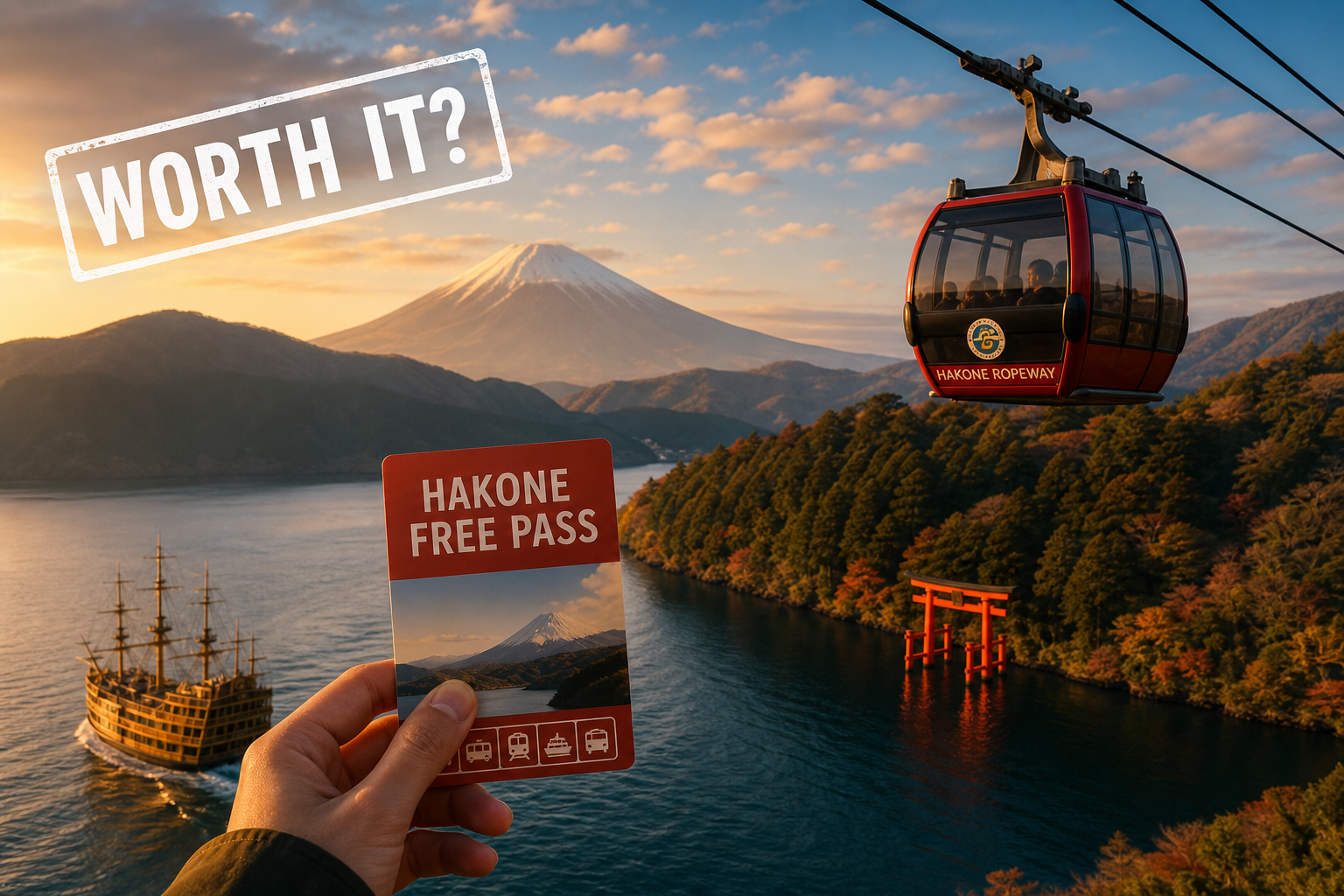
There is a particular kind of travel anxiety that strikes when you arrive at a foreign ticket machine, a queue forming behind you, and realize you have no idea whether to buy a pass or just pay as you go. Hakone is one of those places where that question actually matters, and the Hakone Free Pass benefits are specific enough to answer it clearly. The Hakone Free Pass is not a souvenir or a tourist gimmick. It is a network key that unlocks eight separate transport modes, dozens of attraction discounts, and the freedom to reroute your day when the weather turns or the Ropeway queue looks absurd. Read this guide and you will walk away knowing exactly what the pass covers, whether it saves money for your specific itinerary, where to buy it, and how to stack every discount it offers. At The Curious Atlas, we apply this same value-stacking thinking to every destination we cover, from Hakone’s ropeways to Mexico’s ADO bus routes, and the mental model travels just as well.
The short answer to the title question is: yes, for most travelers doing the classic Hakone loop, the pass pays for itself on transport alone. The long answer is worth reading, because the details determine whether you buy 2-day or 3-day, from Shinjuku or Odawara, and whether you squeeze the maximum out of 70-plus partner discounts.
What the pass actually covers in Hakone
Eight modes, one pass: full Hakone Free Pass inclusions
The Hakone Free Pass covers eight transport categories under a single price. The rail and aerial modes are: the Odakyu Line round trip between Shinjuku and Hakone-Yumoto or Odawara, the Hakone Tozan Train between Odawara and Gora, the Hakone Tozan Cable Car between Gora and Sounzan, the Hakone Ropeway from Sounzan through Owakudani to Togendai, and the Hakone Sightseeing Cruise on Lake Ashi. Three designated bus networks round out the pass: Hakone Tozan Bus routes within the free area, the Odakyu Highway Bus section between Togendai and Odawara, and the Tokai Bus (Numazu Tozan Tokai Bus) between Mishima and Moto-Hakone. The key phrase is “designated sections.” Not every bus route is included, so check the Odakyu route map before boarding an unfamiliar line.
One important exclusion: the Romancecar limited express surcharge is not covered. The pass includes your seat on the standard Odakyu Line, but the Romancecar is a premium service requiring a separate add-on, typically ¥1,000 to ¥1,300 each way, that you can purchase at Odakyu counters or via the EMot app. Taxis fall entirely outside the pass.
The classic round course explained in plain English
The golden loop follows a clean sequence. You start at Hakone-Yumoto and ride the switchback Hakone Tozan Train up to Gora. From Gora, the cable car climbs to Sounzan, where the Ropeway takes over, drifting over the sulfurous Owakudani valley to Togendai on Lake Ashi. The Lake Ashi cruise then carries you south to Moto-Hakone or Hakonemachi, from where buses return you toward Hakone-Yumoto or Odawara. Because every leg is covered, you can linger at Owakudani, double back to a viewpoint, or add a museum stop without watching the fare meter in your head. That freedom from fare anxiety is the real product you are buying.
One practical caveat: the Ropeway closes for maintenance and occasionally for volcanic activity advisories at Owakudani. Before you activate your pass, check the Hakone Ropeway status and closure notices for your travel dates. If the Ropeway is down, the pass still covers the rest of the loop, but the classic route requires a bus detour that many travelers find less satisfying.
Prices and versions made simple
Current fares and child prices at a glance
From October 2025 onward, the official Hakone Free Pass prices are as follows. From Shinjuku, adults pay ¥7,100 for 2 days and ¥7,500 for 3 days. Children pay ¥1,600 for 2 days and ¥1,850 for 3 days. Starting from Odawara or within the Hakone area, prices drop to ¥6,000 for a 2-day adult pass and ¥6,400 for 3 days, with child fares of ¥1,500 and ¥1,750 respectively. The ¥1,100 premium on the Shinjuku-origin pass reflects the Odakyu Line round trip already built in. At these price points, the Hakone Free Pass benefits become easy to calculate before you even board a single train.
2-day vs 3-day: how to choose without second-guessing
The rule of thumb is simple. Choose the 2-day pass if you plan to complete the main loop plus one or two focused stops. Choose the 3-day pass if you want to add museum visits, an onsen afternoon, or a weather buffer day. At The Curious Atlas, we favor the 3-day version for slow travelers. The ¥400 difference from Shinjuku is negligible, and an extra day lets you revisit the Ropeway on a clearer morning if clouds socked in on your first attempt.
Starting in Tokyo or Odawara: which purchase point wins
If you are traveling from Tokyo with no other rail pass, the Shinjuku-origin version makes sense because the round-trip Odakyu fare to Hakone-Yumoto alone costs roughly ¥2,380. That nearly offsets the ¥1,100 premium over the Odawara price. However, if you hold a JR Pass and plan to ride the Shinkansen to Odawara, the JR Pass already covers that leg. In that case, buy the Odawara-origin Hakone Free Pass at ¥6,000 for 2 days and save meaningfully.
Fuji-Hakone Pass: when to consider the upgrade
If your itinerary includes the Fuji Five Lakes area or Kawaguchiko, look at the Fuji-Hakone Pass instead. It is a 3-day pass priced at roughly ¥9,340 for adults, and it bundles Hakone coverage with Fujikyu buses and railways in the Fuji area. For a Hakone-only trip, it is over-priced. For a Hakone-plus-Fuji swing, it removes the need to buy separate tickets at every transfer point.
Hakone Free Pass benefits: will it save you money?
Transport math: the 1-day golden route from Shinjuku
If you bought every leg of the classic loop individually from Shinjuku, you would spend roughly ¥8,322 in transport fares. The 2-day Hakone Free Pass from Shinjuku costs ¥7,100, over ¥1,200 saved before you step into a single attraction. Add the Romancecar upgrade and the comparison shifts slightly: the pass with the Romancecar add-on costs around ¥9,400, against a build-it-yourself cost of roughly ¥10,622 for the same comfort level. Either way, the pass wins on transport math for anyone doing the full loop. These Hakone Free Pass benefits make the 2-day option attractive for most Tokyo-origin travelers even before attraction discounts enter the picture.
Overnight 2-day itinerary savings with admissions stacked
Transport savings are just the floor. Gora Park entry is free with the pass, saving ¥550. The Hakone Open Air Museum drops ¥100 off its ¥2,000 admission. Yunessun onsen saves ¥500 off the standard rate. The Hakone Sekisho Checkpoint and the Venetian Glass Museum each offer ¥100 reductions. Stack four or five of those across two days and you add another ¥700 to ¥1,000 in real savings on top of the transport arbitrage. For a 2-day stay with an overnight ryokan, the Hakone Free Pass benefits almost always deliver net positive value.
When to skip the pass and buy single tickets
Honest advice: the pass is not automatically right for everyone. If you arrive in Hakone in the afternoon, skip the Ropeway entirely, and plan only one or two stops before heading back, single tickets are likely cheaper. Map out your exact stops, add up individual fares, and compare. The break-even point for most Tokyo-origin day-trippers is crossing at least three or four of the eight covered transport modes. If your day tops out at two, keep the cash in your pocket.
Perks beyond transit: discounts you can actually use
Hakone sightseeing pass discounts worth stacking
The roughly 70 partner facilities range from useful to forgettable. The ones worth targeting are Gora Park (free entry, ¥550 saved), the Open Air Museum (¥100 off a ¥2,000 ticket), Yunessun and Mori no Yu onsen (¥500 off each), Hakone Yuryo (¥200 off), and the Sekisho Checkpoint Exhibition Hall (¥100 off). The Venetian Glass Museum discount is modest but adds up when combined with others. The trick is to cluster your discounted stops on a single day so you flash the pass repeatedly without detours. Understanding which facilities honor the pass is one of the more practical Hakone Free Pass benefits that many first-time visitors overlook.
Keep a short list in your phone with the venues you plan to visit. Many travelers forget to present the pass at cafes and shops offering 5 to 10 percent off because the signs are small and the instinct is to reach for cash. That habit change alone is worth a few hundred yen across a 2-day stay.
Build a loop that works in any weather
On clear days, prioritize the Ropeway early for Fuji views and the Lake Ashi cruise in the afternoon when light is softer. On overcast or rainy days, shift toward the Open Air Museum, Gora Park (still beautiful in the mist), and an onsen afternoon at Yunessun or Hakone Yuryo. Your pass does not change. Your discount mix does. That flexibility is exactly why the pass functions more like a freedom tool than a fixed itinerary.
Digital vs paper: your Hakone transport pass in practice
Where to buy and how to activate
You have two main purchase routes. The digital Hakone Free Pass is available through the Odakyu website and the EMot online ticketing platform. No physical ticket redemption is needed: once purchased, you activate it in the app or through the voucher link in your confirmation email. Open the ticket details, tap “Activate this ticket,” and the app displays a live QR code with an animated icon. Screenshots are not accepted, so keep your phone charged and screen brightness up. Present that live screen at station gates, to bus drivers, or to staff at attraction entrances. One phone holds one pass, so each traveler needs a separate purchase and separate device.
For a physical pass, visit an Odakyu Sightseeing Service Center at Shinjuku or Odawara, or use station vending machines. Note that vending machines only sell passes valid from the day of purchase. If you want to buy in advance or avoid queues, the digital route is cleaner.
For official purchase and detailed product pages see Odakyu’s Hakone Free Pass information at Odakyu Global, Hakone Freepass and the direct EMot purchase flow at EMot online ticketing.
Activation timing and refund rules
Do not activate the digital pass until you are ready to start riding. Once activated, the clock runs on consecutive calendar days, not 24-hour windows. A 2-day pass activated at 8 p.m. expires at midnight the following day, not 48 hours later. Time your activation to the morning of your first full sightseeing day. For refunds, check the current fee schedule on Hakone Navi before purchasing, as a handling fee applies to electronic ticket cancellations. If you are traveling during a season when Ropeway maintenance is scheduled or volcanic advisories are common, the digital version is the safer choice, you can delay activation until you confirm conditions on the ground. See Hakone Navi’s Hakone Free Pass page for current rules and notices: Hakone Navi, Free Pass details.
The value-stacking playbook for independent travelers
A mental model that travels everywhere
The Hakone Free Pass teaches a transferable lesson. When a destination offers a network pass, the real question is never just “does it save money on transport?” It is whether the pass buys you freedom to move without friction, stacks discounts automatically, and lets you adapt your itinerary without financial penalty. When the answer is yes, the pass is almost always worth it. That logic applies in Kyoto, Osaka, Taipei, and across European rail networks just as cleanly as it does in Hakone, and the Hakone Free Pass benefits serve as a useful benchmark for evaluating any regional transport pass.
The Mexico analog: ADO buses and Yucatan routes
We spend a lot of time in the Yucatan Peninsula, and the parallel to Hakone is closer than it looks. ADO buses connect Cancun, Playa del Carmen, Tulum, and Bacalar with frequent, reliable, air-conditioned service at fares that rival any train pass for value. A Tulum-to-Bacalar leg runs under $10 CAD. The network is the backbone of independent travel in the region, much like the Hakone Free Pass network anchors a day in the mountains. The fare structure rewards travelers who understand the routes, and our detailed ADO guides on The Curious Atlas walk you through exactly how to use it.
The broader point is this: every great travel region has a network spine. Hakone has eight modes on one pass. The Yucatan has a bus grid covering the coast from Cancun to Belize. Learning to read and use those networks is what separates travelers who feel free from travelers who feel lost. The Curious Atlas exists to hand you that map, whether you are riding a ropeway over a volcano or a bus through the jungle.
Your next step
For Hakone, the math is clear. The Hakone Free Pass benefits anyone doing the classic loop from Tokyo: transport savings kick in from the very first transfer, attraction discounts at onsen and museums add up fast, and the cognitive load of paying at every gate simply disappears. Choose 2-day for a focused loop, 3-day for a slower stay. Buy from Shinjuku unless you already hold a JR Pass to Odawara. Activate the digital version on the morning of your first full day. Flash the pass at every partner venue.
Frequently asked questions
What are the main Hakone Free Pass benefits?
The core Hakone Free Pass benefits are unlimited rides across eight transport modes (including the Ropeway, Lake Ashi cruise, and Tozan Train), discounts at 70-plus partner facilities, and the flexibility to reroute your day without buying additional tickets. For travelers doing the classic loop from Shinjuku, the pass typically saves over ¥1,200 on transport alone.
Is the Hakone Free Pass worth it for a day trip?
It depends on how many transport modes you use. If you plan to complete at least three or four legs of the classic loop, the 2-day pass pays for itself. If your day involves only one or two legs, individual tickets are likely cheaper. Run the numbers against your actual itinerary before deciding.
Can I use the Hakone Free Pass on my phone?
Yes. The digital Hakone Free Pass is available via the Odakyu website and the EMot platform. Once activated, it displays a live QR code in the app. Screenshots are not accepted, so keep your phone charged throughout the day.
What is not covered by the Hakone Free Pass?
The Romancecar limited express surcharge, taxis, and bus routes outside the designated free area are not included. The Ropeway is covered, but check for maintenance closures on your travel dates before activating the pass.
Leave a Reply