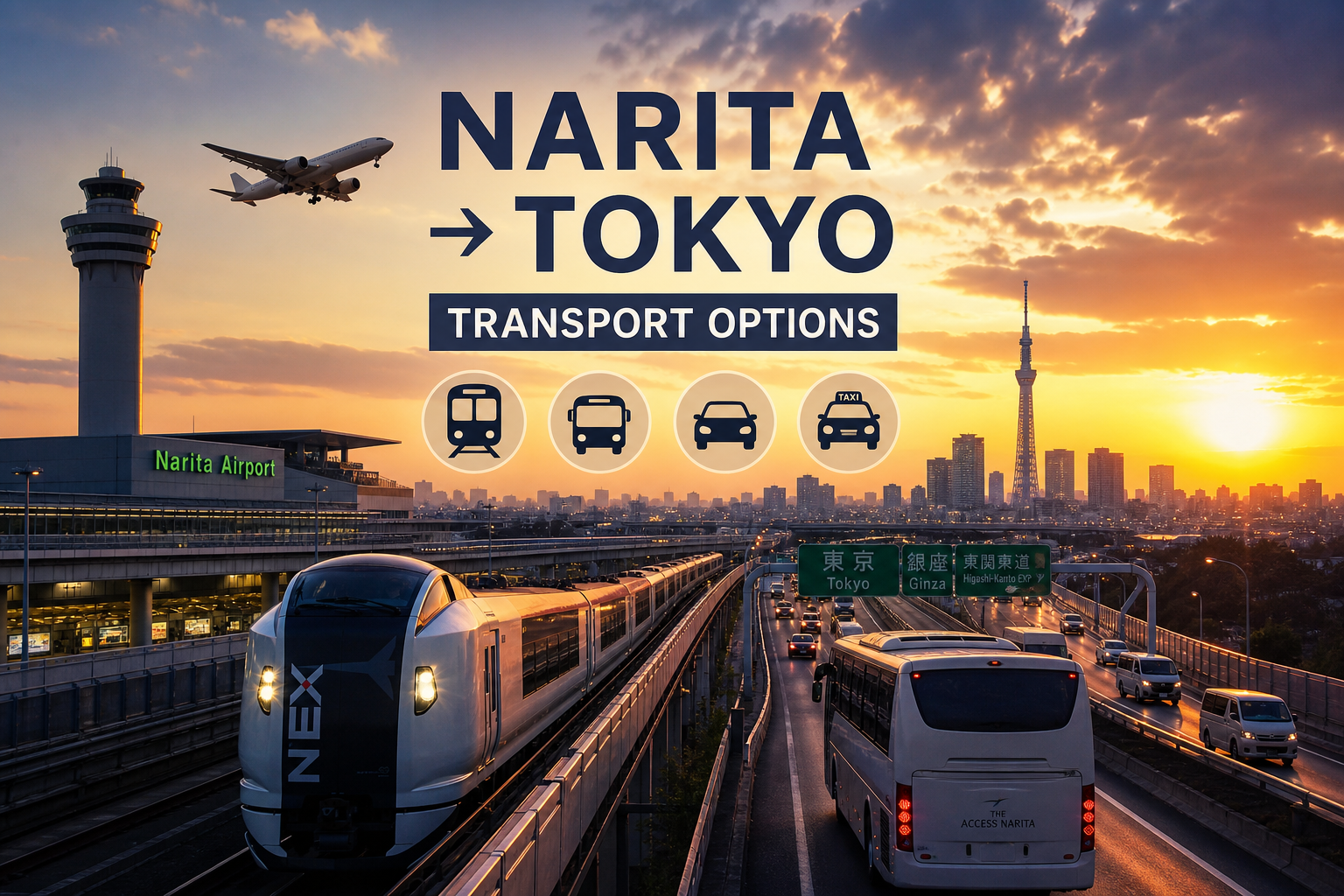
You’ve cleared customs at Narita, your suitcase is heavier than you remembered, and you’re standing under a wall of signs pointing in four different directions. One says ¥3,140. Another says ¥1,100. A third mentions a bus that could take two and a half hours. All of them look equally official, equally confusing. This moment, the fifteen minutes after you step out of arrivals, is the first real decision of your Tokyo trip. This guide covers the best public transport options from Narita Airport to central Tokyo so you can make that decision before you ever leave home.
The honest truth: there is no single “best” option. The right choice depends on where your hotel is, how much you’re carrying, and whether you’d rather save money or save time. What you need is a clean comparison, not a vague recommendation. That’s what this guide delivers. At The Curious Atlas, we believe the first hour of any trip shouldn’t be wasted on confusion you could have resolved before leaving home.
Best public transport options from Narita Airport to central Tokyo, at a glance
Before anything else, here is the full picture. If you already know what you’re looking for, this table tells you everything. If you want the reasoning behind each choice, keep reading.
The comparison table
| Option | One-way fare | Door-to-door time | Key feature |
|---|---|---|---|
| Narita Express (N’EX) | ¥3,140, ¥4,480 | 75, 110 min | Reserved seating, large luggage space |
| Keisei Skyliner | ~¥2,580 | 55, 85 min | Fastest overall, overhead rack storage |
| Keisei Access / Local | ~¥1,100, ¥1,400 | 80, 120+ min | Budget rail, some direct services |
| Airport Limousine Bus | ~¥3,200, ¥3,600 | 90, 150 min | Undercarriage luggage, hotel drop-offs |
| Low-cost bus (TYO-NRT) | ~¥1,500, ¥2,500 | 90, 160 min | Cheapest ground option, limited stops |
What “door-to-door” actually means
Every time you see a train schedule that says “53 minutes to Tokyo Station,” that number starts at the platform, not at the arrivals hall. Factor in the walk from customs to ticketing, the queue, and the wait for the next departure, and you’re typically looking at an extra 10, 20 minutes on top (allow more if you expect long immigration queues or have a long walk from your specific terminal). The times in this guide reflect that reality: arrivals hall to your destination, including realistic walking time and typical waits.
The two fastest trains: Narita Express and Keisei Skyliner
For most first-time visitors, the decision comes down to these two. Both are premium rail options that get you into the city faster than any bus. The choice between them usually comes down to one thing: where your hotel is located.
Narita Express (N’EX): best for Shinjuku, Shibuya, and Tokyo Station
The N’EX costs around ¥3,140 to Tokyo Station and ¥3,330 to Shinjuku or Shibuya. It runs approximately every 30 minutes, with the first departure at 7:37 a.m. and the last at 11:42 p.m. One important catch: it’s a reserved-seat-only train, meaning you must book your seat before boarding. No reservation means no boarding, full stop.
For JR Pass holders, the N’EX is fully covered and seat reservations are free. You can make them at JR counters or self-service machines at the airport. The JR East Tohoku and Nagano/Niigata regional passes also cover the N’EX for the Tokyo-to-Narita leg, provided the route falls within the pass’s validity area. If you’re staying west or south of Tokyo Station, the N’EX is your single-train solution with no transfers needed.
Keisei Skyliner: best for Ueno, Nippori, and northeast Tokyo
The Skyliner costs ¥2,580 and is, by raw speed, the fastest of all the best public transport options from Narita to central Tokyo. It reaches Ueno in 41, 55 minutes (ride time) and runs between 7:30 a.m. and 11:00 p.m. with one to three departures per hour. Unlike the N’EX, no advance reservation is required, though you can reserve if you prefer a specific seat.
The Skyliner is not covered by any JR Pass. It’s a Keisei-operated service, so you pay separately at the Keisei ticket counter or machines. For travelers staying in Ueno, Asakusa, Nippori, or Akihabara, this is unambiguously the fastest and most cost-effective premium option. For everyone else, one subway transfer from Ueno, on the Ginza Line, for example, typically adds only 10, 15 minutes and still keeps the total journey competitive with the N’EX.
Note that the Skyliner’s overhead racks have a 120 cm total dimension limit (length plus width plus height) at 20 kg maximum. Standard suitcases usually fit fine, but oversized ski bags or large travel trunks won’t.
Budget rail: Keisei Access and local trains
The budget rail option isn’t a compromise for travelers who missed the better train. It’s the deliberate choice of someone who’s done the math and decided the fare difference is worth more than the time difference.
How much slower is it, really?
Keisei Access and local trains cost ¥1,100, ¥1,400 and take 80, 120 minutes depending on the service. Compare that directly to the Skyliner: you save roughly ¥1,400 and lose 30, 45 minutes. For a solo traveler on a week-long trip who values that money more than that half-hour, the calculation is easy. The Keisei Main Line runs every 15, 20 minutes, and some services reach central Tokyo without requiring a transfer.
Who should take the budget rail route
The ideal candidate here is a light packer, flexible on time, and traveling to Ueno or northeast Tokyo. It’s also a solid choice for anyone already comfortable navigating Tokyo’s subway system, since the transfers involved are straightforward once you know them. JR Pass holders can also access local JR lines from Narita at no additional cost, making the slow train a genuinely free option for pass holders who’d rather save the N’EX reservation for a longer trip.
When the bus is actually the right call
Trains win on speed. Buses win on two specific fronts: luggage handling and price. For the right traveler, a bus from Narita isn’t settling for less, it’s actively the smarter choice.
Airport Limousine Bus: the underrated option for luggage-heavy travelers
At ¥3,200, ¥3,600, the Limousine Bus costs roughly as much as the N’EX, but it offers something no train can match: your bags go under the coach. You don’t wrestle a 25 kg suitcase through ticket gates, cram it into an overhead rack, or block the aisle while other passengers wait. You hand it over at check-in and collect it at your stop. For anyone traveling with two large bags, that alone is worth the slower journey time of 90, 150 minutes.
The Limousine Bus serves Tokyo Station, Shinjuku, Shibuya, and Ginza, and drops directly at or near major hotels. Buses run every 10, 30 minutes depending on the route, and no advance reservation is needed. If your hotel happens to sit on a Limousine Bus route, this is genuinely the lowest-stress airport transfer available. Check the route listings before you travel to confirm your hotel area is covered.
Low-cost coaches: when cheapest matters most
Budget buses like TYO-NRT run ¥1,500 during daytime hours (rising to ¥3,000 for late-night departures) and serve Tokyo Station, Ginza, and Shinonome. The on-bus ride time is roughly 62, 70 minutes to central stops under normal traffic, though door-to-door, factoring in waiting and the walk to the bus stop, is typically closer to 90, 160 minutes as shown in the table above. That number can also stretch significantly during peak hours. Frequency is reasonable, with multiple departures per hour during the day and service running from around 7:30 a.m. to 11:30 p.m.
The limitation is reach: low-cost buses serve far fewer stops than the Limousine Bus network. They’re the right call for travelers whose accommodation is near Tokyo Station or Ginza, who have light luggage, and who want to spend as little as possible on the transfer.
How to choose the best public transport from Narita Airport to central Tokyo
Once you’ve chosen your option, the practical questions start. Below is everything you need to know before you reach the platform.
Does the JR Pass cover the Narita Express?
Yes, fully. The Japan Rail Pass covers the N’EX end to end, and seat reservations are free for pass holders. The key step is making that reservation: head to a JR East counter or reserved-seat machine before approaching the platform. As noted above, no reservation means no boarding, regardless of how valid your pass is. Regional JR East passes (Tohoku area and Nagano/Niigata area) also include the N’EX, as long as the Narita-to-Tokyo leg falls within the pass’s validity zone. The Keisei Skyliner, Limousine Bus, and all budget coach options are not covered by any JR Pass. Confirm covered services on the trains included with the Japan Rail Pass page.
Luggage storage and carriage on each mode
Each transport mode handles bags differently, and knowing this before you arrive saves a lot of platform-side frustration:
- Narita Express: dedicated large-luggage areas at the ends of carriages, spacious and purpose-built for airport travelers
- Keisei Skyliner: overhead racks only; max 120 cm total dimensions, 20 kg weight; oversized bags won’t fit
- Keisei local trains: standard overhead shelf space; manageable for one standard suitcase
- Airport Limousine Bus: generous undercarriage storage, generally more accommodating than train racks, though operators do apply size and weight guidelines, so check with your specific service for oversized items
- Low-cost bus (TYO-NRT): undercarriage storage similar to the Limousine Bus
If you’re traveling with oversized luggage, ski bags, large hard-shell trunks, consider using the takkyubin forwarding service available in the Narita arrivals hall. For roughly ¥2,000, ¥3,700 depending on bag size and delivery speed (check current rates with Yamato TA-Q-BIN at the airport), a courier delivers your suitcase to your hotel the next day while you travel light. For more on using luggage shipping services in Japan, read this guide to takkyubin luggage shipping.
Choosing the right option for your situation
Every option has been laid out. Match your situation to the right route and the decision makes itself.
Match your option to your destination
- Tokyo Station, Ginza, Marunouchi: N’EX (direct, no transfer needed) or TYO-NRT budget bus
- Shinjuku or Shibuya: N’EX (direct)
- Ueno, Nippori, Asakusa: Keisei Skyliner, then one subway stop if needed
- Ikebukuro: Skyliner to Nippori, then Yamanote Line (one clean transfer)
- Hotel with no easy rail access: Limousine Bus (check if your hotel sits on a route first)
- Budget stay, flexible on timing: Keisei Local or TYO-NRT low-cost bus
Match your option to your priority
- Speed above all: Keisei Skyliner if heading to the Ueno area; N’EX for everywhere else
- Lowest cost: Keisei local trains at roughly ¥1,100
- Lowest stress with heavy luggage: Airport Limousine Bus
- JR Pass holder: Narita Express with a free seat reservation at the JR counter
The hardest part is over before you leave the airport
Narita’s transport options only feel overwhelming before you understand the logic. The moment you know your hotel neighborhood and your priority, the right choice becomes obvious. Grab your reserved seat, stow your bag, and watch Tokyo appear through the train window. The part you actually planned for starts the moment you walk out of the station.
Knowing the best public transport options from Narita Airport to central Tokyo before you land removes stress and gets your trip started right. At The Curious Atlas, this is exactly the kind of practical groundwork we lay before every destination. The airport decision is just the first one. After that comes the slower, richer work of figuring out which neighborhoods to wander, which markets to eat at, and how to move through the city at a pace that actually lets you see it. Need tips on electronics and charging? See our Japan Power Outlet Guide: Adapters, Voltage & What to Pack.
From Tokyo neighborhoods to Yucatán markets, our guides are built for the independent traveler who wants depth, not just distance covered. Explore the full Japan content on The Curious Atlas and start planning what happens after you land. Starting from Canada? Read How to Plan a Japan Trip from Canada in 2026. Looking for a ready-made route, see our 14-Day Japan Itinerary: Culture, Food & Hidden Gems.
Leave a Reply