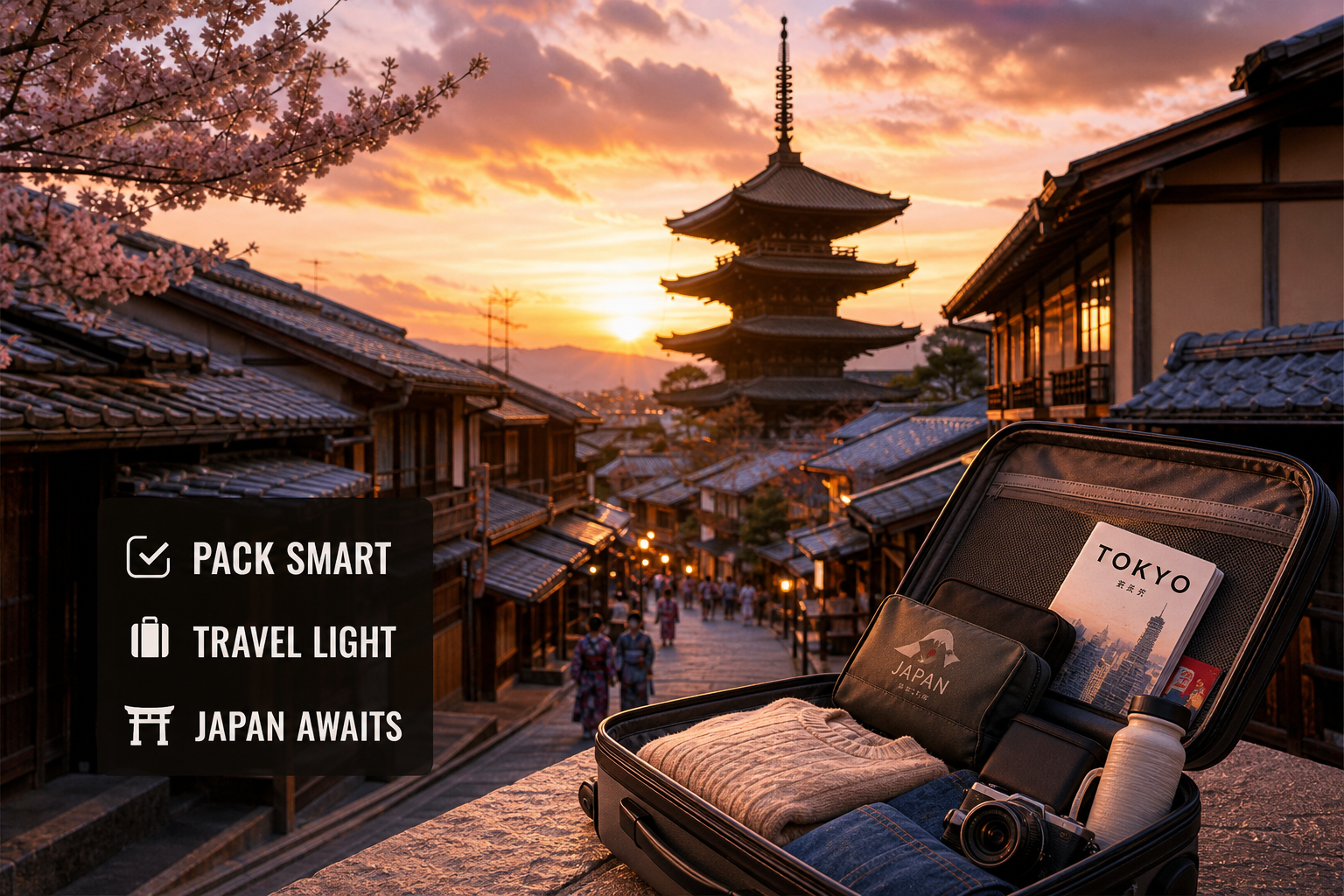
Most travelers overpack for Japan for the wrong reason: they treat it like any other destination. Japan has convenience stores in cities and most towns, coin laundries widespread across urban and residential areas, and a luggage forwarding system so seamless it almost feels like cheating. This essential packing list for a solo trip to Japan is built around one core idea: knowing how little you actually need.
This guide is built around the slow, intentional style of travel, moving between cities by shinkansen, staying in a mix of hostels and ryokans, and spending more time exploring than hauling gear. Before finalizing this list, the Japan travel guides at The Curious Atlas served as a useful reference point. For route ideas and a sample itinerary, see our 14-Day Japan Itinerary: Culture, Food & Hidden Gems. Destination and itinerary shape your bag, not the other way around.
Japan rewards the light packer. Every item in your bag should earn its space.
Quick Packing Checklist: Japan Solo Trip Essentials
- 5, 6 versatile outfits built for layering
- One packable outer jacket or rain jacket
- Two pairs of shoes (one supportive walking shoe, one casual flat)
- eSIM or pocket Wi-Fi device
- Compact multi-port USB charger and portable power bank
- Plug adapter (required for UK, European, and Australian travelers)
- Minimal toiletries (travel-sized; restock at konbini on arrival)
- Small coin purse
- Crossbody bag with secure closure
- Packing cubes and a foldable daypack
- Travel laundry kit
- Copies of passport and any prescriptions
Essential Packing List for a Solo Trip to Japan: Clothing & Layers
Japan’s climate varies dramatically, not just between seasons but between regions and even between morning and evening on the same day. The goal isn’t to pack for every scenario. It’s to pack for layering, which is the most versatile strategy regardless of when you’re traveling.
Spring (March to May) and autumn (September to November) are excellent times to visit, the weather is often pleasant and layering works particularly well in both. The same approach applies: a base layer, a mid-layer sweater or cardigan, and one packable outer jacket. Long pants, a mix of short and long-sleeve tops, and a compact rain jacket cover most situations. Resist the urge to pack for worst-case weather. Pack for the average day and layer up when the temperature dips.
Summer (June to August) is hot and humid across most of the country. Lightweight, breathable fabrics are non-negotiable, but keep a thin cardigan in your bag for air-conditioned trains and shops, which can drop to genuinely uncomfortable temperatures. Winter travel, especially in northern regions like Tohoku or Hokkaido, shifts the strategy entirely: thermal base layers, a proper insulated coat, gloves, and a beanie become the core of your wardrobe. One pair of waterproof shoes earns its weight in colder months.
For more details per season, read our What to Pack for Japan: A Season-by-Season Guide
Footwear for Japan’s Walking Days
Shoes deserve their own calculation. Japan involves a serious amount of daily walking, prioritize comfortable, well-worn shoes above almost everything else in your bag. Many temples and traditional accommodations require removing shoes at the entrance, so easy slip-on options are worth considering. Two pairs maximum: one supportive walking shoe, one casual or packable flat.
Tech and Connectivity: Decisions to Make Before You Board
Connectivity in Japan isn’t something to figure out on arrival. The infrastructure exists to make it easy, but the decision needs to be made before you leave home. Japan’s transit systems, restaurant menus, and neighborhood navigation all benefit from reliable internet access in a way that makes spotty public Wi-Fi a real inconvenience.
Plugs, Voltage, and Chargers
Japan uses Type A plugs at 100V. Many modern small electronics, phones, and most travel gadgets, are dual-voltage (check the device label to confirm before you travel). Travelers from the UK, Europe, and Australia will generally need a plug adapter (see our Japan Power Outlet Guide: Adapters, Voltage & What to Pack) and it’s worth verifying each device’s voltage rating regardless of where you’re traveling from. Beyond the adapter, common recommended tech items include a compact multi-port USB charger and a portable power bank. The power bank earns its weight on long travel days and day hikes where outlets are nowhere in sight.
eSIM vs. Pocket Wi-Fi
For solo travelers with an unlocked, eSIM-capable phone, a Japan eSIM is the lightest and most seamless connectivity option. Providers like MobiMatter offer 20GB for around $13.99 USD and 50GB for roughly $29.99, which covers two to three weeks of maps, messaging, and translation apps comfortably. Pocket Wi-Fi devices are a solid alternative for travelers connecting multiple devices, but they add one more item to charge and carry. Either is far preferable to relying on café Wi-Fi at critical navigation moments. For an overview of options and practical tips, read our Mobile Internet Options in Japan for Tourists.
Toiletries: Pack Far Less Than You Expect To
Japan’s pharmacy and convenience store network is one of the most reliable in the world for travelers. FamilyMart, Lawson, and 7-Eleven stock shampoo, conditioner, body wash, face wash, sunscreen, razors, and basic skincare at prices that are genuinely affordable. Packing full-sized versions of these from home wastes space for nothing you can’t pick up within the first hour of landing.
A few items are worth bringing in your preferred version: prescription medications (carry a copy of your prescription and a doctor’s note for anything unusual), contact lens solution in your preferred brand, and high-SPF sunscreen matched to your skin type. Tampons are commonly available in cities; in smaller towns availability can vary, so consider bringing your preferred supplies, or a cup or disc, if you have a strong preference. Most airlines and airports follow the 100ml/3-1-1 rule for liquids in carry-on bags; check your specific airline and departure airport for any variations. Anything else you forgot can almost certainly be solved at the nearest konbini.
What that actually looks like is a toiletry bag that fits inside a single packing cube: a small tube of your preferred face wash, a few days of any specialized skincare, your prescriptions, and whatever personal care items you genuinely prefer over the Japanese equivalents. Everything else waits until arrival.
Slow-Travel Gear That Actually Solves Problems
Beyond clothing and tech, there’s a short list of gear that transforms the experience of solo slow travel in Japan. Every item here solves a specific problem rather than just adding comfort weight.
A lightweight, packable tote or small foldable backpack is one of the most practical additions to any Japan solo travel packing list. Japanese public spaces lean toward neatness and organization, and a structured daypack keeps you sorted on day trips, shrine visits, and market browsing. It also handles shopping overflow without forcing you to carry a separate reusable bag around all day.
A few smaller items do real work here:
- A small coin purse: Japan remains largely cash-dependent in many restaurants, vending machines, and smaller shops, and coins accumulate quickly from every transaction.
- A travel laundry kit: a small sachet of detergent or a laundry bar handles hand-washing in a ryokan sink and reduces how much clothing you need to carry across a two-week trip.
- A packing cube set: compression cubes are the difference between a messy carry-on and one that stays organized through a multi-city itinerary.
- A crossbody bag with a secure closure: a practical choice for solo travelers who want to keep essentials close and accessible in crowded transit.
Also worth noting: save the local emergency numbers in your phone before arrival. In Japan, 110 reaches police and 119 connects to fire and medical services. A digital and paper copy of your passport rounds out the practical safety layer without adding any meaningful weight to your bag.
The Luggage Strategy That Makes Japan Work
Japan’s transit infrastructure is extraordinarily efficient, but it wasn’t designed for travelers hauling oversized suitcases. Understanding how to move through the country shapes what you should pack in the first place. This is where most first-time visitors make their biggest strategic error.
Carry-On Only: The Right Default for Most Solo Itineraries
Carry-on only is the right default for most solo trips. Japan’s train stations, particularly older ones, involve stairs, narrow corridors, and crowded platforms where large suitcases create genuine friction. Many travelers find a 40L bag or standard carry-on sufficient for a two-to-three week trip when combined with Japan’s easy access to laundry facilities. On the Shinkansen, bags with total dimensions (length plus width plus height) under 160 cm can be brought aboard normally. Bags between 160 and 250 cm require a reserved seat with designated luggage space. Anything larger than 250 cm is not permitted on the train at all.
Using Takuhaibin: Japan’s Luggage Forwarding System
Takuhaibin, the luggage forwarding service operated by companies like Yamato Transport, is one of the most underused tools for solo travelers moving between Japanese cities. Typical intercity fares run around 3,000, 3,700 JPY; airport or same-day options can be higher, sometimes 5,000 JPY or more depending on route and timing. You can have your main suitcase sent directly from one hotel to the next, arriving within one to two business days. This means traveling between Tokyo, Kyoto, and Osaka with only a small backpack, arriving at shinkansen stations and morning markets without managing a large bag. Hotel front desks handle the logistics; you fill out a simple form, pay at drop-off, and your bag meets you at the next destination. Learn how to ship your luggage between destinations in Japan via takkyubin. For shorter day trips, coin lockers at most major train stations, typically a few hundred yen per day depending on size and station, let you store your main bag while you explore.
What to Leave at Home and Buy When You Arrive
The best Japan packing list is one with deliberate gaps. Solo travelers most often overpack in two areas: clothing and toiletries. Beyond five or six outfits for a two-week trip, extra clothes just add weight, laundry runs 600 to 1,000 yen per wash-and-dry cycle at most coin laundries, which is far cheaper than hauling a second week’s worth of clothing. Full-sized toiletries replaceable within minutes of landing are the other consistent waste of space. Bulky accessories like full-sized pillows, excessive electronics, or travel towels are rarely needed on a trip where hotels and ryokans already provide them.
Lightweight packable umbrellas are cheap, high-quality, and sold everywhere in Japan. There’s no reason to carry one from home. Sunscreen, snacks, and last-minute pharmacy needs are better handled at the airport convenience store or a nearby konbini on day one. Treating Japan’s convenience stores as a genuine part of your packing strategy, rather than a backup plan, changes how efficiently you can move through the country.
The pattern worth internalizing: Japan’s infrastructure is so well-designed for travelers that most “just in case” items become redundant before you even need them. Every space saved in your bag is less weight on your back and one fewer decision to make in transit.
Pack Light, Trust the Country, Travel Further
Use this essential packing list for a solo trip to Japan as a starting point, then edit it down. Seasonal layering, a reliable internet connection, a short toiletry list, and a clear luggage-forwarding strategy are the actual framework. Everything else is noise.
What you pack for Japan changes significantly depending on whether you’re spending three weeks in Tokyo or moving through six cities in two weeks. The Japan travel guides at The Curious Atlas break down how to move through the country by region and pace, which directly shapes what gear makes sense for your specific trip. Your bag should always be a response to the trip, not the other way around. If you’re planning from Canada, you may find our How to Plan a Japan Trip from Canada in 2026 guide helpful.
Start with less than you think you need. Add one item back only if you can articulate the specific problem it solves. Then book the ticket.
Leave a Reply