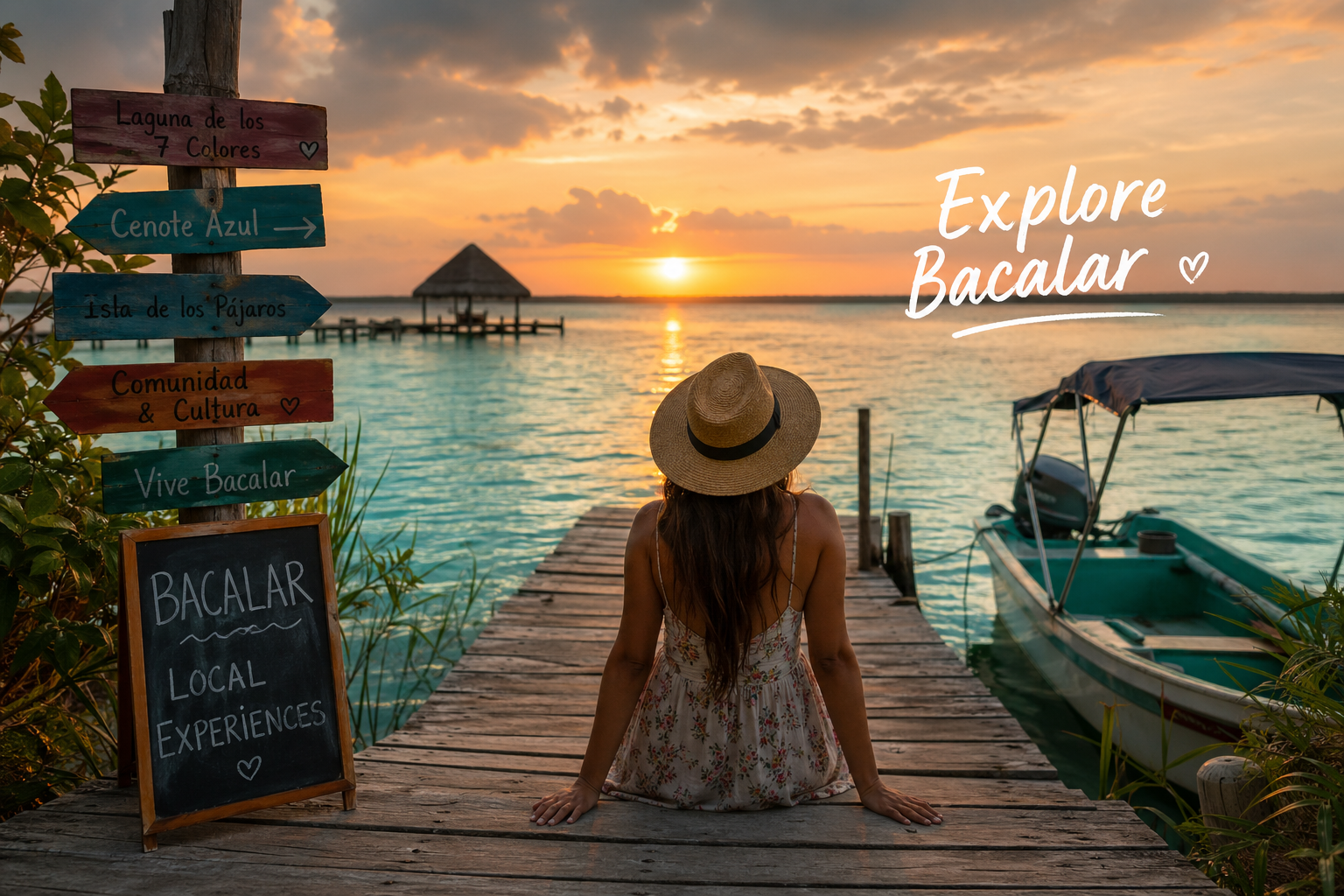
Laguna Bacalar is everywhere online. The seven-color gradients, the drone shots at golden hour, the impossibly blue swimming holes, it’s one of the most photographed bodies of water in Mexico, and rightfully so. But here’s the paradox that every thoughtful traveler notices within the first twenty-four hours: the town wrapped around that lagoon remains almost invisible. Visitors arrive, board a boat, and leave without ever stepping into the mercado, without ever sitting at a plastic chair beside a fisherman eating his lunch, without ever wandering the streets that face away from the water.
If you’re looking for tips for finding authentic local experiences in Bacalar, the first one is deceptively simple: step away from the waterfront. Bacalar isn’t hiding. It’s just quiet enough to reward people who slow down. This guide covers where to eat like a local, how to get on the lagoon with the right people, where craftsmanship still lives, and how to carry yourself in a town with deep Mayan roots.
Why the best of Bacalar reveals itself slowly
Most visitors follow the same circuit: check in, swim off the dock, order a sunset cocktail, repeat. There’s nothing wrong with that rhythm; the lagoon earns every bit of the attention it gets. But following that circuit exclusively means missing the version of Bacalar that actually exists outside the waterfront zone, the one with a social pulse, a culinary identity, and a living cultural tradition that predates the boutique hotels by several centuries.
Authentic local life in Bacalar runs on different hours than the tourist economy. Market mornings start early. Midday is the main lunchtime period at the comedores. Evening walks happen along streets that don’t face the lagoon at all. The tips for finding authentic local experiences in Bacalar that follow only work if you approach the town with enough patience to move between those rhythms rather than around them.
Think about the difference between hiring a flashy aggregator tour boat versus asking a small, locally run operator where the guide swims on his day off. One gives you a route; the other gives you a relationship with the place. That distinction is the underlying principle behind every recommendation below.
Tips for finding authentic local experiences in Bacalar: eating where locals eat
Mercado Municipal de Bacalar, located on Avenida 9 near the center of town, is the social and culinary nerve center of daily life. By eight in the morning, the juice bar is already running at full speed, fresh produce, handmade tortillas, fish, and eggs all around it. This is where Bacalar actually shops. The market opens early and runs until around 5 PM, which means a morning visit slots naturally into a slow, unhurried day. Starting here rather than at a waterfront café recalibrates the whole trip. You see how the town functions before the tourist economy switches on.
Local spots worth knowing
Beyond the market, a handful of small spots reflect how locals actually eat. Albahaca is the local favorite for fresh breakfasts and smoothies. Madre Masa does pastries and coffee in a cozy setting that draws as many residents as visitors. Mi Burrito Bacalar is a straightforward staple, the kind of place that’s been feeding people long before the design hotels arrived. Parque Nacional Maracuyá, a cluster of food trucks by the lagoon, offers casual street-style eating at accessible prices.
A useful heuristic for separating a genuine Bacalar food stall from a tourist-facing restaurant: look for handwritten menus, plastic chairs, and locals eating. When all three are present, you’re likely in the right place. That filter alone will save you from a dozen mediocre meals and point you toward the ones worth remembering.
Getting on the lagoon with the right people
Not all lagoon tours offer the same relationship with the place. Large aggregator-style operations move groups quickly from stop to stop, treating the stromatolites, the ancient living organisms responsible for the lagoon’s extraordinary oxygenation, as a backdrop rather than a subject. Smaller, locally rooted operators tell a different story.
Questions to ask before booking
Before booking any lagoon experience, it’s worth asking a few direct questions: How many people are on this tour? Does the guide talk about the lagoon’s ecosystem, specifically the stromatolites? Are any of the stops community-run or privately operated? These questions reveal whether you’re booking a transport service or an actual guide. Shared collective pontoon tours typically run between 349 and 399 MXN per person; private options start around 3,500 MXN for groups of up to twelve. Both can work well, what matters most is the person leading you through the water. For an overview of organized tour options in the area, checking major listings can help you compare offerings and formats before you contact a local operator directly.
Self-guided kayaking is a slower alternative worth considering. Balneario Municipal, a free public dock about ten minutes from the town center, gives independent travelers direct lagoon access. Balneario Cocalitos, less than four kilometers from town and reachable by bike or taxi, offers quieter shoreline access with grassy areas for sitting between swims. Kayaking or paddleboarding from these points lets you set your own pace, choose your stops, and engage with the shoreline at a scale no motor tour can match.
Meeting the makers: artisan culture and Mayan craft traditions
Bacalar’s identity is deeply Mayan, and the most visible living expression of that heritage isn’t the fort or the festival calendar. It’s in the hands of the people selling it. Mayan women in traditional dress selling handmade textiles and prepared food, furniture makers along the local highways, craft vendors at the market complex on Calle 30 and Avenida 11, these are not performances for visitors. They are continuations of a craft culture that has outlasted every wave of outside attention the region has ever received.
Several boutiques in central Bacalar specialize in locally made goods with genuine Mayan and Mexican influences. What distinguishes them collectively is that each is a small, owner-operated business where the people behind the counter actually made or sourced what they’re selling. La Casita Azul carries handcrafted gifts and textiles. Corazón de Piña focuses on locally made, eco-friendly clothing. El Manatí Bacalar combines an artisan shop with a café. These aren’t tourist traps; they’re small operations run by people who care about what they’re selling and why.
The etiquette of buying directly from artisans is straightforward. Take real time to look, ask about the craft even in broken Spanish, and avoid haggling aggressively on handmade goods, the exchange is cultural before it’s commercial. Money spent with individual makers is more likely to remain in the local economy rather than flowing outward to resort chains or aggregator platforms. That distinction matters more in a town like Bacalar, where the line between tourism’s benefits and its costs is drawn at exactly this level of transaction.
How to find authentic local experiences in Bacalar: the quieter shores
The most photographed sections of Laguna Bacalar are also the most crowded, which is not a coincidence. What those photographs don’t show is the longer, quieter shoreline that locals actually use. Cenote Azul, fifteen minutes south of town by taxi or bike, offers deep open-water swimming in a setting that draws far fewer people than the main tourist docks. Cenote Negro (also called Cenote La Bruja), the deepest point in the lagoon at over one hundred meters, sits near the Rojo Gómez school in a small bay and is best accessed by kayak from nearby public shores.
The most reliable way to find these spots is also the simplest: ask. Guesthouse owners and market vendors know where they go on weekends, and those places almost never appear in any published guidebook. This kind of hyperlocal knowledge is exactly what our growing Bacalar content specializes in surfacing, for travelers who want to go beyond the standard route and into the genuinely local geography of the place.
When you reach those quieter spots, the basics of respectful access are non-negotiable. No sunscreen in the water: the stromatolites are living organisms, not decorations, and chemical sunscreen damages them directly. Stay on designated paths around sensitive zones. Visit during early morning or late afternoon, when foot traffic is lowest and the light is better anyway. These aren’t arbitrary rules, they’re the natural extension of genuine respect for a lagoon that locals have lived beside and depended on for generations.
Showing up with respect: customs, etiquette, and a few words of Spanish
Bacalar is not simply a resort destination with a pretty lake attached. It is a small town with deep Mayan roots, a functioning civic life, and residents who notice how visitors carry themselves in daily interactions. The way you move through the market, the way you ask for directions, even the way you acknowledge someone selling food by the road, all of it shapes the experience on both sides of the exchange.
A few behaviors define respectful presence in town. Always ask permission before photographing people or private property. Dress modestly when walking through the town center rather than the waterfront zone. And respect quiet hours in residential streets, particularly in the early morning and evening. None of these are difficult, and all of them signal that you’re a guest who actually sees the community rather than uses it as a backdrop.
A few Spanish phrases change the dynamic entirely. “¿Dónde come la gente de aquí?” (Where do locals eat around here?) opens more doors than any guidebook recommendation. “Buenos días” said first, before any transaction or question, establishes basic human acknowledgment. “¿Me permite?” before photographing or entering a space shows awareness of boundaries. “¡Qué rico!” after a meal is the simplest form of gratitude in the local food culture. Language effort is itself a form of respect, and in a town like Bacalar, it is noticed and returned in kind.
The lagoon will always be beautiful, but that’s not the whole story
The seven colors of the lagoon will be there regardless of how you travel. What changes depending on how you move through Bacalar is everything else: the conversations, the meals, the sense of having actually met the place and the people who live inside it. The practical steps above, eating at the mercado, getting on the water with a locally rooted guide, buying directly from artisans, asking where locals swim, learning a few phrases before you arrive, are not complicated. They just require a certain willingness to slow down and pay attention.
This article covers the surface of what Bacalar offers to intentional travelers. For readers who want to go deeper, into specific multi-day itineraries, locally run options that don’t appear on aggregator platforms, and food discoveries from the town’s quieter corners, our growing library of Bacalar content is built around exactly this kind of community-first, curiosity-driven exploration. The guides are there when you’re ready to use them.
The best souvenirs from Bacalar aren’t things you buy at the market. They are the meal where nobody else at the table spoke your language, the quiet kayak hour before the tour boats started their engines, and the conversation with a local captain who showed you a stretch of shoreline that doesn’t have a name on any map. These tips for finding authentic local experiences in Bacalar all point toward the same thing: slow travel is what makes those moments available. Everything else is just logistics.
Leave a Reply