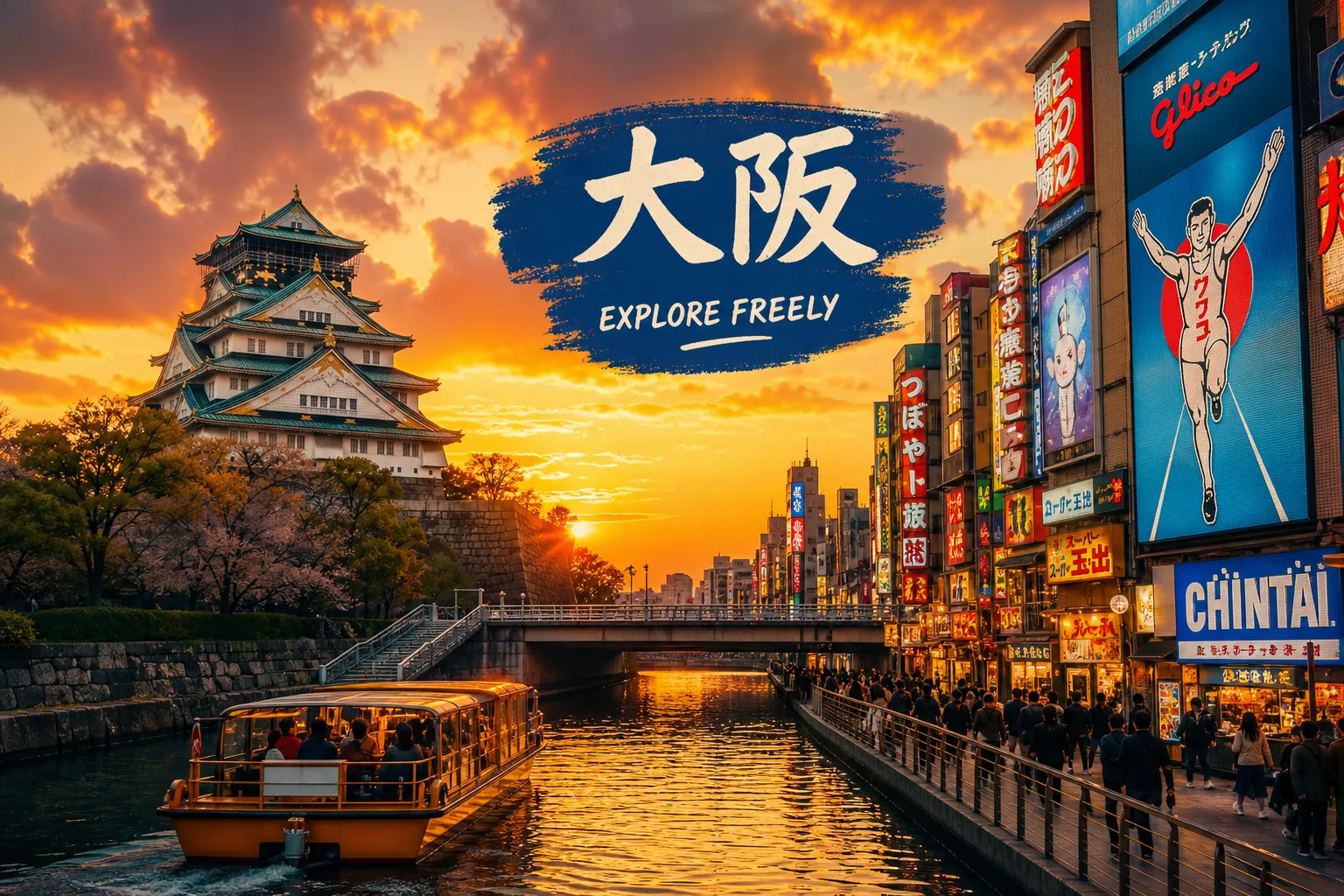
Osaka doesn’t ease you in. Before you’ve figured out which exit to take from the station, the city has already handed you a skewer of something fried, wrapped you in neon, and dropped you into a crowd moving at a pace that suggests everyone has somewhere more important to be. It’s loud, generous, and completely unapologetic about both. This Osaka travel guide is built for independent travelers who want to move through that energy with some orientation, not a rigid checklist, but a clear enough framework to make confident decisions from day one.
The approach here is the same one The Curious Atlas uses for destinations like Bacalar or the Yucatan backroads: slow down enough to understand what you’re actually looking at. Osaka rewards that instinct more than most cities. The food is better when you’re not rushing past it. The neighborhoods reveal different textures when you give them more than an afternoon. By the end of this guide, you’ll have a neighborhood choice locked in, a transport strategy that requires almost no thinking, a food plan built around the places that matter, and an itinerary scaled to however many days you actually have.
Osaka travel guide: choosing the right neighborhood for how you travel
The neighborhood you pick shapes the entire trip. Osaka is not one city with one energy; it’s several distinct zones stitched together by subway lines, and the wrong base costs you time and mood every single day. The good news is that the choice narrows quickly once you know how you travel.
Namba and Minami for first-time visitors and food lovers
Namba is the default answer for most first-timers, and it earns that status. You’re walking distance from Dotonbori, surrounded by restaurants at every price point, and sitting on one of the best-connected transit nodes in the city. Budget hostels here run roughly US$14 to $35 per night, while mid-range hotels average around US$83 to $113, though both ranges shift with season and availability, so treat them as a planning benchmark rather than a guarantee. The tradeoff is noise: Namba is loud well into the early hours, especially on weekends. For travelers who want to be inside the city’s energy rather than adjacent to it, that’s a feature, not a flaw.
Kita and Umeda for travelers who want seamless transport
Umeda is the practical choice for anyone planning day trips to Kyoto, Nara, or Kobe. It’s the city’s main JR hub, which means less time navigating connections on busy day-trip mornings. The area runs calmer in the evenings and skews slightly more business-oriented, which translates to less atmosphere but more efficiency. Accommodation prices sit in a similar range to Namba, but the vibe is noticeably quieter. If your Osaka itinerary includes two or three serious day trips, base yourself here.
Tennoji and Shinsekai for budget-conscious slow travelers
Shinsekai has a local, slightly rough-around-the-edges quality that feels more honest than Namba’s tourist-polished streets. It’s cheaper, calmer, and comes with one of Osaka’s strongest kushikatsu scenes built right into the neighborhood. Tennoji Park sits nearby, and the whole area rewards the kind of traveler who’s content to walk without a fixed destination. For anyone stretching a budget without sacrificing character, this is the base worth considering.
Osaka travel guide, getting around without stress
Osaka’s public transit looks complicated on a map and operates on a simple logic once you understand the two-layer system. Subway lines handle the city center and most tourist zones. JR lines connect major hubs and serve as the gateway to day trips. Once that distinction is clear, most navigation decisions make themselves.
The ICOCA card: tap in, tap out, don’t think about it
Pick up an ICOCA card the moment you arrive at Kansai International Airport. The JR ticket office at Kansai Airport Station sells them at the IC card machines, the process is straightforward, though queues can vary by time of day and season, so budget a few extra minutes during peak hours. It’s a rechargeable card: tap on entry, tap on exit, and the fare is deducted automatically. No calculating distances, no queuing for tickets between every stop. The ICOCA card guide is a useful primer on where to buy, top up, and which trains accept it. The ICOCA works across subways, JR lines, many buses, and even convenience stores throughout the Kansai region.
Subway vs. JR lines: the distinction that actually matters
Most inner-city rides between tourist zones fall on the subway. Fares typically run in the ¥180 to ¥300 range, Namba to Umeda comes in around ¥180 to ¥280, and Namba to Tennoji around ¥180 to ¥230, though exact costs depend on your specific origin and destination. Check the Osaka Metro fare table for precise figures. JR lines serve bigger cross-city hops and are the backbone of day-trip logistics: Osaka to Kyoto on the JR Special Rapid takes about 30 minutes and costs ¥580. Osaka to Kobe runs 20 to 30 minutes; Osaka to Nara takes roughly 50 minutes on the JR Yamatoji Rapid. Both systems accept your ICOCA card without issue.
Tourist passes: when they make sense and when they don’t
Tourist passes are only worth buying when your itinerary lines up precisely with the covered routes and the timing is right. For most independent travelers doing a mixed city-and-day-trip itinerary, the ICOCA card is the more flexible default. The JR Kansai Area Pass becomes genuinely useful if you’re doing a cluster of Kyoto, Nara, and Kobe trips within a few days; for a single day trip, the math rarely works in your favor.
The food you actually came for: Kuromon Ichiba, Dotonbori, and Osaka’s street eats
Osaka calls itself Japan’s kitchen, and it backs the claim with decades of culinary obsession. The city’s food identity runs deep: two key zones, three dishes worth understanding, and one operating philosophy. Eating well here means making small, deliberate decisions rather than one big reservation. For first-time visitors, this section of the Osaka travel guide is where the trip really starts to take shape.
Kuromon Ichiba market: grazing as a philosophy
Arrive at Kuromon Ichiba before 11 a.m., when the market is running at full selection but hasn’t yet hit the lunch-rush density. This is a working market where locals and visitors eat side by side, and the right approach is to build a meal across multiple stalls rather than sitting down once. Maguroya Kurogin is known for high-quality fresh tuna and seafood at prices well below what the quality would suggest. Takoyaki Wanaka turns out some of the best octopus balls in the city, and Hananoki is the stop for authentic konamon, the flour-based dishes that define Osaka’s food culture. Many stalls begin closing in the late afternoon, with most wrapping up by around 5 to 6 p.m., so earlier in the day is always the better call. Exact vendor hours vary, so check with individual stalls on the day. For a practical slow-travel approach to markets, see How to Explore Japan Markets Like a Slow Traveler.
Dotonbori’s street food and where to actually focus
Dotonbori is best after dark, when the Glico Man sign reflects off the canal and every stall is fully operational. The overwhelm is real, so narrow your focus before you arrive. Start with takoyaki from a dedicated stand rather than a chain. Follow that with okonomiyaki at a sit-down spot like Chibo, where the griddle-table experience is a different thing entirely from the fast stall version. Add kushikatsu at Kushikatsu Daruma if you still have room. Don’t try to eat everywhere; pick two things and eat them properly.
The three dishes that define Osaka’s food identity
Takoyaki are golf ball-sized octopus dumplings, crisp on the outside and molten in the center, served with a specific sauce and bonito flakes. A quality version has a defined char on the outside and a filling that isn’t just batter. Okonomiyaki is a savory cabbage-and-egg pancake with proteins folded in; the sit-down version, made to order at a griddle table, is a different experience from the fast stall variety. Kushikatsu is deep-fried skewers of meat, seafood, and vegetables served with a shared dipping sauce. The one rule that everyone enforces: no double-dipping.
Top sights and how long they actually take
Osaka rewards attention but doesn’t punish efficiency. Most landmarks here are genuinely worth visiting without requiring a full day, and pairing them logically means you can cover a lot of ground without the burnout that kills the second half of a trip. These are the Osaka sightseeing priorities worth building your days around.
Osaka Castle deserves 1.5 to 3 hours depending on whether you enter the museum inside the main keep. The grounds alone justify the visit, and the park context makes the castle feel situated in its history rather than extracted from it. Admission to the main tower runs about ¥1,200, and weekday mornings before 10 a.m. are the least crowded. Pair it with Sumiyoshi Taisha, one of Japan’s oldest Shinto shrines and significantly less visited than anything in Kyoto. Budget 45 to 60 minutes there. The shrine uses a pre-Buddhist architectural style, no Chinese or Korean stylistic influences, which makes it visually distinct from most shrines you’ll encounter elsewhere in Japan. That context is worth having before you arrive.
For evenings, Dotonbori earns 1.5 to 2.5 hours after dark. Separate from that, the Umeda Sky Building’s Floating Garden Observatory is worth timing for the late-afternoon-to-dusk transition, when the skyline shifts from daylight to city lights, check the official Umeda Sky Building site for current hours and admission before you go. For a slower afternoon option, Osaka Aquarium Kaiyukan earns 2 to 3 hours. The central tank with the whale shark is the main draw, but the layered exhibit design means the whole visit moves naturally without rushing. It sits in the bay area, so allow extra transport time from the city center; visit the Kaiyukan official site for up-to-date entry fees and hours.
Day trips worth the train ride: Kyoto, Nara, and Kobe
Day trips from Osaka are genuinely easy, but trying to do more than one in a day kills both. Pick your day trips based on what’s missing from your Osaka experience, not simply because the destinations are close.
Kyoto on a single day works best with a specific sequence: start at Fushimi Inari early, before the crowds arrive around late morning, then move through Kiyomizudera and the Higashiyama streets, and finish in Arashiyama or Gion in the evening. The JR Special Rapid from Osaka Station reaches Kyoto in about 30 minutes for ¥580. One honest note about Kyoto: one day is a taste, not a complete picture. If your itinerary allows two or three days there, use them.
Nara is the lowest-friction day trip on this list. The JR Yamatoji Rapid from Osaka takes around 50 minutes and is covered by ICOCA; if you’re departing from Namba, the Kintetsu Nara Line is worth comparing, it’s often faster and cheaper for travelers not using a JR pass. Either way, you arrive at a walkable center with one concentrated experience: Todai-ji and the free-roaming deer in Nara Park. It works as a half-day and pairs well with an early return to Osaka for dinner. Kobe is the day trip for travelers who want a break from historical density. The harbor area, the beef, and the more cosmopolitan feel make it a useful contrast after several days of sightseeing; treat it as a full day to justify the travel time.
Planning your days: Osaka travel guide itineraries for 1, 3, and 5 days
The itineraries below are built around a simple principle: doing fewer things with more attention produces better trips than cramming more into every hour. Each version is designed for how independent travelers actually move, not how highlight reels suggest they should. These are the things to do in Osaka that consistently deliver, structured to fit the time you have.
One day in Osaka should follow a tight sequence: morning at Osaka Castle, a food crawl at Kuromon Ichiba, Dotonbori from late afternoon into the evening, and the Umeda Sky Building as a final stop. This is the transit-traveler or cruise-visitor version. It won’t give you Osaka, but it delivers an honest sample of what the city does differently.
Three days is the recommended pace for most solo travelers (Solo Travel Archives, The Curious Atlas). Day one: Osaka Castle, Sumiyoshi Taisha, and an evening in Dotonbori. Day two: Kuromon Ichiba in the morning, a neighborhood walk through Shinsekai or Tennoji, and Kaiyukan in the afternoon. Day three: a day trip to Nara, with an easy return to Osaka for dinner. This structure builds rhythm without over-scheduling.
Five days adds Kyoto and Kobe to the three-day structure, one as a full day trip each. The most important addition to a five-day itinerary isn’t a fifth attraction, it’s keeping one full day with no fixed plan. This is the principle The Curious Atlas applies across every slow-travel guide: the unplanned hours are where the trip actually happens. A market you stumble into, a neighborhood you walk through without a reason, a meal you eat because the smell pulled you in. Those are the moments that make a trip worth remembering. For how that five-day, slow-travel structure works in a very different city, see How to Spend 5 Days in Tokyo Like a Local.
The city gives more the slower you move through it
Osaka keeps revealing itself to people who don’t rush. The food improves when you’re not chasing the next landmark. The neighborhoods show their real character when you have time to walk without a destination. Use this Osaka travel guide as a starting point, not a script, the best version of your trip will deviate from it in ways you can’t plan for.
If slow travel through a city built on sensory overload is what you’re after, the Yucatan Peninsula delivers a completely different version of the same feeling: open skies and street food instead of neon and packed alleys, cenotes and lagoon towns instead of canal lights, a pace that asks more of your patience and returns more when you give it. The Curious Atlas covers that region in depth, from the backstreets of Playa del Carmen to the lake towns of Bacalar. For independent travelers who’ve caught the slow-travel habit in Osaka, it’s worth the detour.
Leave a Reply