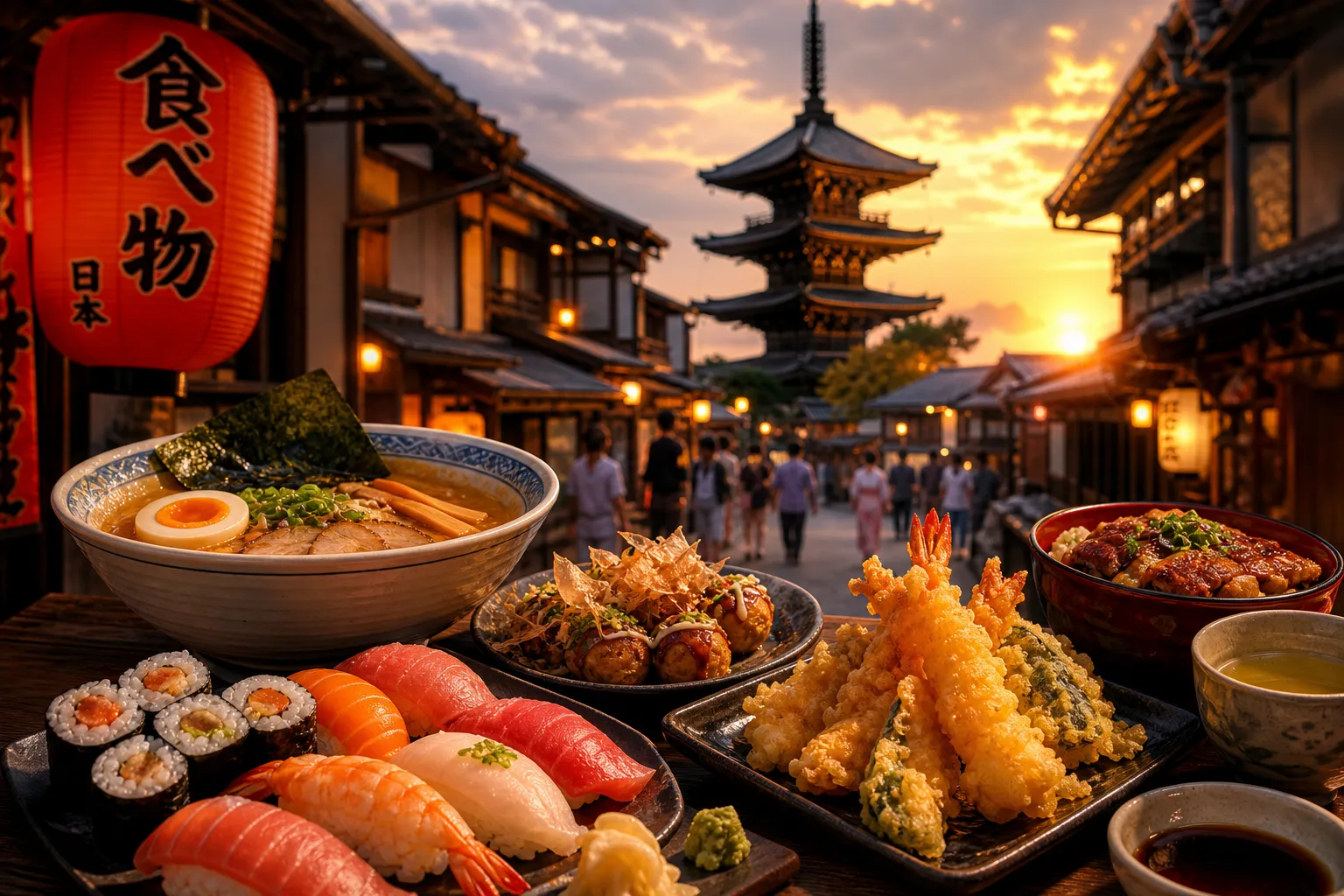
Japan doesn’t just feed you. It reframes how you think about food entirely. Here at The Curious Atlas, food is the front door to every culture we explore, whether that’s a bowl of smoky tacos de canasta in Mexico City or a lacquered box of unagi over steamed rice in Nagoya. The real story of any place lives in what its people eat, and Japan tells that story more seriously than almost anywhere else. If you’re mapping out what food to try in Japan, this guide walks you through 15 essential dishes across every price range, organized by category so you can build your meals around cities, cravings, or budget.
The gap between the tourist version of Japan and the real version is surprisingly small, because the real version is already everywhere. It’s an editorial observation more than a provable fact, but it holds up: the food is in the convenience store at 7 a.m. and in the standing noodle bar outside the train station at midnight. What you need isn’t a reservation at an impossible restaurant. You need to know which dishes are worth stopping for, where to find them, and what they’ll cost you.
Must-try Japanese street food worth stopping mid-stride for
1. Takoyaki
Takoyaki is where most food-curious travelers fall in love with Osaka, and it deserves every bit of that reputation. These octopus-filled batter balls are cooked on a cast-iron griddle, finished with a smoky Worcestershire-style sauce, a drizzle of Japanese mayo, and katsuobushi (dried bonito flakes) that literally dance from the heat. Dotonbori is the neighborhood to find them, and you’ll smell the stalls before you see them. Expect to pay around 500, 700 yen for six pieces.
2. Gyoza
Pan-fried gyoza arrive crisp on the bottom and juicy inside, usually pork and cabbage, and they’re staples at izakayas and dedicated gyoza bars across Tokyo and Osaka. They’re one of the most satisfying Japanese dishes to try when you want something quick, hot, and deeply savory.
3. Yakitori
Yakitori, skewered chicken grilled over charcoal, comes salted or glazed in a sweet-savory tare sauce. Prices typically run around 100, 300 yen per skewer depending on the cut and the venue, making it one of the most approachable pieces of Japanese street food you’ll encounter.
4. Onigiri
Don’t overlook onigiri from convenience stores. A triangle of seasoned rice wrapped in nori, filled with salmon or pickled plum, at 100, 200 yen, is not a compromise. It’s legitimately one of the best cheap bites you’ll find anywhere.
Noodle bowls that deserve their own travel day
5. Ramen
Ramen is regional in a way that surprises most first-time visitors. Eating a bowl in Fukuoka and eating a bowl in Tokyo are genuinely different experiences, not just variations on a theme. Fukuoka’s tonkotsu ramen is built on a creamy, intensely savory pork-bone broth that takes hours to reduce into something almost opaque. Tokyo’s shoyu ramen is lighter, clearer, and soy-forward. Sapporo’s version leans on miso and often includes corn and butter. A standard bowl at a proper ramen shop runs 900, 1,200 yen, and it’s almost always worth it. Ramen alone is a reason to move between regions rather than stay rooted in one city.
6. Udon
Udon is one of the top foods in Japan that true food travelers plan entire detours around. Kagawa Prefecture, on the island of Shikoku, is the spiritual capital of Sanuki udon: thick, chewy, deeply satisfying noodles in a clean broth. A basic bowl runs 500, 900 yen.
7. Soba
Soba, thin buckwheat noodles with a nutty earthiness, is best eaten cold with a dipping sauce. You’ll find standing soba bars at most major train stations across the country. If you’re avoiding gluten, look specifically for 100% buckwheat soba, since many shops blend wheat flour into their noodles. Like udon, a basic bowl runs 500, 900 yen.
Rice dishes that define Japanese comfort food
8. Gyudon
Gyudon is Japan’s answer to the fast, filling, and genuinely satisfying meal. Thinly sliced beef and sweet onion simmer in a soy-mirin broth and land on a bowl of steamed white rice, commonly inexpensive at major gyudon chains like Yoshinoya or Sukiya. It’s humble, quick, and good enough that many travelers eat it multiple times in a single trip without apology.
9. Katsudon
Katsudon takes that base idea and adds a breaded, fried pork cutlet (tonkatsu) with egg cooked just barely set on top. Expect to pay approximately 700, 1,000 yen at a sit-down spot, though prices vary by restaurant.
10. Japanese curry
Japanese curry surprises almost every first-timer. It’s thick, mildly sweet, and nothing like Indian-style curry. Served over rice with your choice of protein and a side of pickled vegetables (fukujinzuke), it’s widely available at curry specialty chains and home-style restaurants throughout the country, typically around 700, 1,000 yen.
11. Karaage
Karaage, Japanese fried chicken marinated in soy and ginger, coated and fried until crisp outside and juicy inside, shows up everywhere from convenience stores to late-night izakayas. Both Japanese curry and karaage are reliable entry points for travelers still getting comfortable with Japanese dishes to try. Karaage typically runs 400, 800 yen for a portion depending on the venue.
Seafood and sushi, essential food to try in Japan
12. Sushi and sashimi
Sushi in Japan exists on a spectrum wider than most travelers expect. At one end: kaiten-zushi, the conveyor-belt format where plates spin past your seat and you grab what looks good, at roughly 100, 300 yen per plate. It’s accessible, fun, and genuinely good. At the other end: counter omakase, where a chef makes every decision and the bill can easily reach ¥15,000, ¥30,000 or more per person at higher-end establishments. Both are valid depending on what you want from the experience. For something in between, Tsukiji Outer Market in Tokyo remains one of the better places to eat fresh sushi at honest prices, with energy to match. Sashimi, raw fish sliced and served without rice, can be ordered alongside sushi at almost any restaurant and is the most direct way to taste Japan’s seafood quality on its own terms.
13. Tempura
Tempura gets overlooked in favor of sushi, and that’s a mistake. Lightly battered, fried seafood and vegetables are best at specialist restaurants in Tokyo, where the chef fries one piece at a time, adjusting the oil temperature between each, and the batter comes out almost translucent.
14. Unagi
Unagi (grilled freshwater eel glazed with sweet soy sauce) is a regional specialty in Nagoya and Tokyo’s older neighborhoods. A proper unaju, eel over rice in a lacquered box, often runs several thousand yen, commonly in the ¥2,000, ¥4,000 range at mid-tier restaurants, and is worth every yen.
Where to find each dish and what it’ll cost you
15. Okonomiyaki
Before the city map, there’s one more must-try Japanese food worth flagging: okonomiyaki, Osaka’s savory cabbage pancake loaded with toppings and finished with the same smoky sauce you’ll know from takoyaki. It’s a regional specialty that defines the city’s food identity as much as anything on this list.
No single city covers all 15 dishes, which is itself a reason to move between regions rather than plant yourself in Tokyo for a week. How to Spend 5 Days in Tokyo Like a Local is a helpful read if you’re short on time and want to prioritize food-focused neighborhoods.
- Osaka: takoyaki, okonomiyaki, gyoza
- Tokyo: Edomae sushi, ramen variety, tempura, karaage
- Fukuoka: tonkotsu ramen
- Kyoto: kaiseki (multi-course seasonal cuisine), tofu-based dishes, shojin ryori
- Kagawa: Sanuki udon
- Nagoya: unagi, miso katsu
Japan offers exceptional value for the quality of its casual food. A day built around a convenience store onigiri for breakfast, a ramen bowl for lunch, and a gyudon for dinner can often come in under ¥2,500 depending on your choices, and that’s a satisfying day of eating by any standard.
- Street food and convenience stores: roughly 200, 600 yen per item
- Casual sit-down restaurants: roughly 650, 2,000 yen per meal
- Specialty and destination restaurants: 3,000, 10,000+ yen per meal
How to order, what to expect, and eating around dietary needs
First-time visitors often overcomplicate the ordering process. Many ramen shops use ticket vending machines at the entrance. Find a dish you recognize (or press the top-left button, which is usually the house recommendation), hand the ticket to staff, and sit where you’re directed. Plastic food displays outside most restaurants make ordering by pointing entirely viable, even without any Japanese. Slurping noodles is normal and expected; it signals enjoyment. Tipping is not practiced in Japan and can cause genuine confusion, skip it entirely.
Japan is honest about its limitations for strict vegetarians and vegans: dashi, a broth made from fish and kelp, appears in many dishes that look plant-based on the surface. Miso soup, udon broth, and even some rice seasonings often contain it. The most reliable fully plant-based option is shojin ryori, the Buddhist temple cuisine served in Kyoto and at some traditional inns. Tofu-focused restaurants in Kyoto are another strong option for plant-based what to eat in Japan questions.
For cold soba, ask specifically for zaru soba (cold, no broth), and confirm whether the shop uses kombu-based dashi. Apps like HappyCow are useful for locating dedicated vegan restaurants in Tokyo and Osaka, where the options have grown significantly in recent years. Always carry a written dietary explanation in Japanese if your restrictions are strict, because what a server might assume is vegetarian often isn’t. And if you’re planning what to bring for different seasons and food-focused days, check out What to Pack for Japan: A Season-by-Season Guide.
Build your days around meals, not monuments
Japan is the rare destination where the food-first approach doesn’t require any sacrifice. The best things to eat here aren’t locked behind reservations or restaurant week lists. They’re in the standing bar near the train platform, the covered market arcade in Osaka, the konbini at the corner of the block. Most of these dishes can be found across multiple price points and in many of the major cities on the standard travel circuit.
Pick two or three dishes from each section, map them to the cities you’re visiting, and let the meals give your days their shape. You’ll understand Japan faster through its food than through any museum or guidebook summary. That’s not a metaphor. It’s the actual mechanism. A bowl of tonkotsu ramen at a Fukuoka yatai stall at 10 p.m. can reveal more about that city than a full afternoon at any landmark. If you need tips for planning on your own, How to Plan a Solo Japan Trip on Any Budget covers budgeting and logistics for food-first itineraries.
These are the kinds of must-try Japanese foods that make up the backbone of what to eat in Japan, no matter your budget, your city, or how many days you have. That food-first philosophy is what drives every guide we write at The Curious Atlas, whether we’re mapping the street food corridors of the Yucatan Peninsula or pointing you toward the most satisfying bowl of noodles in Kyushu. The world makes more sense when you approach it hungry and curious. Start eating.
Leave a Reply