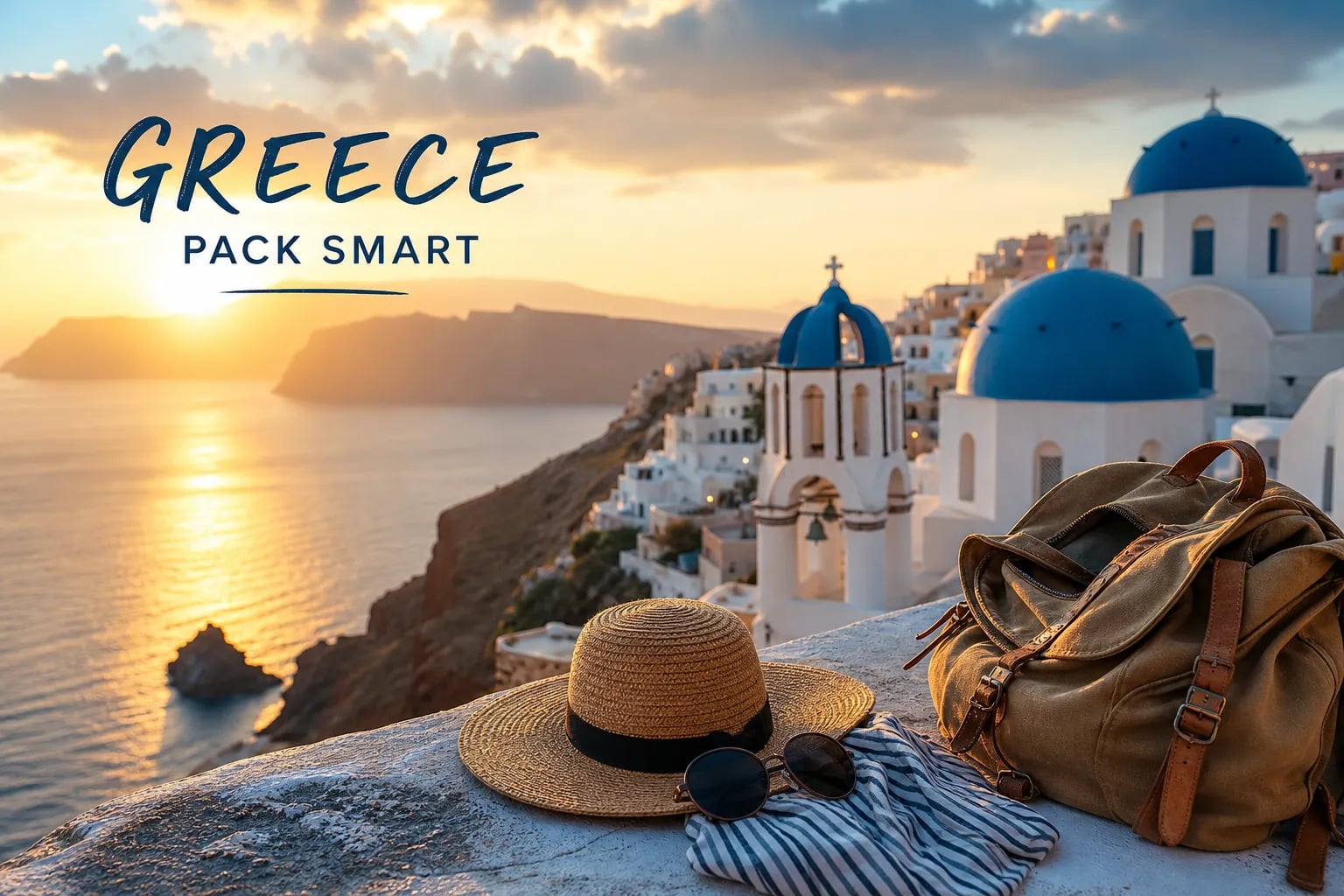
When you’re figuring out Greece what to pack, the answer arrives with a particular kind of humility on your first morning in Santorini. You’ve booked the charming whitewashed room perched above the caldera. You’ve imagined the light. What you didn’t fully imagine were the steep stone staircases, common on islands like Santorini, where cliffside accommodations sit hundreds of steps above ferry ports, or a rolling suitcase catching on every uneven edge while your backpack doubles as personal climate change. The slow traveler’s paradox is real: the more you pack, the less freely you move. Many Greek islands feature uneven cobblestones and steep staircases that make heavy luggage and weak footwear genuinely problematic at every turn.
Knowing Greece’s climate, terrain, and transport logistics before you build your packing list is what separates a smooth island hop from a sweaty, overstuffed ordeal. The decisions you make at home, about fabrics, bag size, and footwear, echo through every ferry departure and monastery visit for the rest of your trip. At The Curious Atlas, this Greece packing list reflects years of watching sun-drenched destinations reward the light packer and quietly humble everyone else.
Here’s how this guide is structured: climate first, because weather drives fabric choices. Then clothing, footwear, ferry and flight logistics, and finally the small practical essentials that Greece travelers routinely underestimate until they’re standing in a pharmacy on a tiny island hoping for SPF 50 sunscreen.
Why Greece’s climate should drive everything you pack
Greece is not a single climate. Athens in August sits around 28.5°C with humidity near 50%, which feels manageable compared to tropical destinations but still demands genuinely breathable clothing. Crete runs comparably warm but tends to dip a few degrees cooler at peak summer, with July and August averaging closer to 26°C in southern Crete. The Cyclades, home to Santorini and Mykonos, track similarly, Santorini averages around 29°C in June and July before dropping to a pleasant 23°C by September and a cooler 19°C in October.
Summer heat vs. shoulder season surprises
Peak summer, June through August, is legitimately hot across all of Greece. Lightweight, breathable fabrics are non-negotiable rather than a preference. Shoulder season in April, May, September, and October shifts the equation considerably: Athens averages between 16°C and 24°C during these months, and evenings on the islands can feel genuinely cool, especially near the water. A single packable mid-layer, a light linen shirt or a thin cotton wrap, covers the gap without adding real weight or filling valuable space.
The island wind factor that changes everything
The Cyclades are well known for the Meltemi, a strong northerly wind that locals and travel guides consistently warn peaks in mid to late summer. On a 30°C afternoon, this wind feels like a gift. On a ferry deck at sunset or standing at the edge of a hilltop village in Oia, that same wind turns cold fast. A layer you can grab quickly matters more here than it does in Athens, where the air stays still and heat stays predictable. Pack the layer; you’ll reach for it more than you expect.
Greece what to pack: clothing and the island-hopping capsule wardrobe
The island-hopping slow traveler’s clothing challenge isn’t really about warmth or cold. It’s about versatility across beach days, cobblestone town exploration, rooftop dinners, and monastery visits, all packed into a single carry-on. The answer is a tight capsule built around neutral tones and breathable natural fabrics. Linen and cotton outperform synthetics in Greek summer heat because they wick moisture without trapping it, at 29°C, the difference in comfort between natural and polyester fabrics is noticeable enough that most long-haul travelers come to prefer them for warm-weather destinations. Brands like MagicLinen, Quince, UNIQLO, and J.Crew earn strong marks from frequent travelers for linen basics that hold up over weeks of daily wear.
The five-piece formula that works from Athens to the islands
Two lightweight tops, one loose linen shirt that doubles as a layer, one versatile dress or pair of lightweight trousers, and one swimsuit cover-up that reads as a skirt or wrap. This Greece packing formula covers nearly every scenario on the itinerary while occupying a surprisingly small fraction of a carry-on. Neutral tones in cream, white, and tan also tend to photograph well against Cycladic whitewashed architecture, worth considering if you’ve come this far. Pieces that transition from beach to dinner without a full outfit change are the practical goal; a linen shirt over a swimsuit is both appropriate and genuinely comfortable for most Greek island evenings.
The one layer every visitor to churches and monasteries needs
Modest dress is expected at Greek Orthodox churches and monasteries across the country. Covered shoulders and knees are the standard requirement, and many sites may refuse entry or ask visitors to use a provided wrap if you arrive underdressed. Men in shorts and women in sleeveless tops should plan for this before walking up to a site unaware. A lightweight cotton or linen scarf takes up almost no space and solves the problem entirely. Keep it in the top of your daypack rather than buried at the bottom, because you won’t always know in advance that you’re approaching a monastery.
Footwear: the decision that genuinely makes or breaks your trip
The terrain in Greece is unforgiving to bad shoe choices. Santorini’s famous caldera path is steep, uneven stone. Mykonos’s narrow alleys are ancient cobblestone with irregular gaps between blocks. Crete’s old towns mix smooth marble with broken pavement that shifts underfoot. The right footwear is the difference between a full day of confident exploration and cutting the afternoon short with blisters or a rolled ankle.
What actually grips cobblestones and steep stairs
Supportive walking sneakers or lightweight trainers with rubber grip soles are the safest all-around choice for Greek terrain. Brands like Keen, Teva, Ecco, and Birkenstock have earned strong reputations among seasoned travelers for their arch support, thick soles, and non-slip tread on uneven stone. Supportive sandals with proper sole structure work as a secondary option for easier days and beach towns, but only if they offer real arch support and grip. A sandal that’s just a flat strap will not protect you on a descending path in Oia at dusk.
What to leave home, no exceptions
Flip-flops, smooth-soled slip-ons, wedge sandals, and heels are impractical on Greek terrain and actively dangerous on wet marble or steep descent paths. Two pairs total is the practical limit for a carry-on packer: one supportive walking shoe and one proper sandal. Everything else is weight you’ll resent by day three, space you needed for that linen shirt, a problem you’ll carry up four flights of stairs before you register the mistake.
Greece what to pack: flying between islands and boarding ferries
Greece’s domestic island flights, operated primarily through carriers like Aegean Airlines and Sky Express, come with tight size restrictions on regional and turboprop aircraft. Sky Express caps carry-on bags at 8 kg and 55 × 40 × 23 cm on economy fares, smaller than most international overhead bins, which becomes a real problem if you’ve packed for two weeks without thinking through each travel segment. Aegean generally allows about an 8 kg cabin bag plus a personal item; check the airline directly for current size and weight limits, as policies can update. These limits aren’t theoretical; they’re enforced.
The case for packing to the domestic flight limit
If your Greece itinerary involves island hopping by plane, packing to the strictest limit means you’ll move freely between every mode of transport: taxi, ferry, turboprop, and that final cobblestone uphill to your accommodation. A bag sized for domestic Greek flights is also small enough to keep in your cabin on overnight ferries and carry up four flights of stairs to an Airbnb without needing help. The bag that fits everywhere is the bag worth having.
Why ferry flexibility doesn’t mean you should pack heavy
Greek ferries, operated by companies like Blue Star Ferries, SeaJets, and Minoan Lines, have no formal luggage enforcement in the way airlines do. You keep your bags with you, and no one is weighing them at the gangway. This relaxed environment tempts slow travelers into overpacking, and that temptation is worth resisting. A large suitcase is manageable on a calm Blue Star crossing, but it becomes a genuine obstacle on a small high-speed catamaran, a crowded island pier at peak season, or a narrow cobblestone path up to your accommodation. Minimalism isn’t just a philosophy in Greece, it’s a logistical advantage.
Documents, adapters, and the small essentials Greece travelers routinely forget
The practical checklist for Greece runs shorter than most travelers expect, but a few items are almost universally forgotten and disproportionately painful to source once you’re on a smaller island. Getting these sorted before departure takes ten minutes at most and saves real frustration once you’re actually there.
Plugs, voltage, and the one adapter Greece actually needs
Greece runs on 230V/50Hz and uses Type C and Type F plugs: two round-pin sockets standard across most of Europe. Most modern phones, laptops, and cameras are dual-voltage, labeled 100, 240V on the device or its charger, which means you need only a plug adapter rather than a voltage converter. A universal adapter with Type C/F compatibility covers Greece and most of the European continent in a single compact piece. Single-voltage devices, most commonly older hair tools and certain appliances, require a separate voltage converter; without one, you risk damaging them on first use.
The documents and pharmacy items worth checking off before you leave
For travel documents: a valid passport (valid for at least three months beyond your planned departure from Greece), travel insurance confirmation, accommodation confirmations, and a digital or physical copy of your return flights. Both American and Canadian citizens can enter Greece visa-free for stays up to 90 days in any 180-day period, though travelers should verify ETIAS requirements before departure, as the EU authorization system for visa-exempt visitors was expected to come into force in 2026. On the pharmacy side: SPF 50+ sunscreen, blister plasters for cobblestone days, oral rehydration salts for hot-weather hiking, and any prescription medications in clearly labeled packaging. These items are available in Greek pharmacies, but smaller islands stock limited quantities and run out fast in high season.
Greece what to pack: a quick checklist before you leave
- 2 lightweight breathable tops (linen or cotton)
- 1 loose linen shirt (doubles as a layer)
- 1 versatile dress or lightweight trousers
- 1 swimsuit cover-up that works as a skirt or wrap
- 1 lightweight scarf for churches and monasteries
- 1 packable mid-layer for shoulder season or island evenings
- 1 pair of supportive walking sneakers with grip soles
- 1 pair of supportive sandals with arch support
- Type C/F universal adapter
- SPF 50+ sunscreen
- Blister plasters
- Oral rehydration salts
- Valid passport and travel insurance confirmation
- Accommodation and flight confirmations
- Prescription medications in labeled packaging
Planning a similar warm-weather slow travel trip?
Greece and the Yucatan Peninsula share more than sunshine. Both destinations reward the traveler who arrives light, stays longer, and moves at the rhythm of the place. The same principles that make your Greece packing list work, breathable natural fabrics, one versatile layer, two pairs of shoes maximum, and a carry-on-only commitment, translate directly to any sun-soaked destination where terrain rewards light movement.
If your next warm-weather trip takes you to Mexico instead of the Mediterranean, The Curious Atlas has full packing and destination guides built around the same minimalist, slow travel approach. Guides covering Tulum, Bacalar, and Playa del Carmen address the same core questions: which fabrics survive high humidity, what documents you need crossing into Mexico, and how to move between destinations without checking a bag. The insight is consistent across destinations, the best packing list is the one that eventually fades into the background and lets the place take over.
Greece and the Yucatan are different worlds, but the traveler who thrives in both tends to be the same kind of person: curious, intentional, and carrying exactly what’s needed.
A smart Greece what to pack checklist comes down to five decisions made before you leave home. Know your season and pack fabrics that match it. Build a capsule wardrobe around versatility rather than volume. Solve the footwear problem with two pairs that actually grip Greek stone. Pack to the domestic flight carry-on limit so every mode of transport stays frictionless. And don’t forget the Type C/F adapter, the SPF 50, and the linen scarf that gets you into every monastery on the itinerary. Get those five things right, and the bag starts taking care of itself, which means you can spend your attention on the ferry crossing, the hilltop village, and wherever you’re headed next.
Leave a Reply