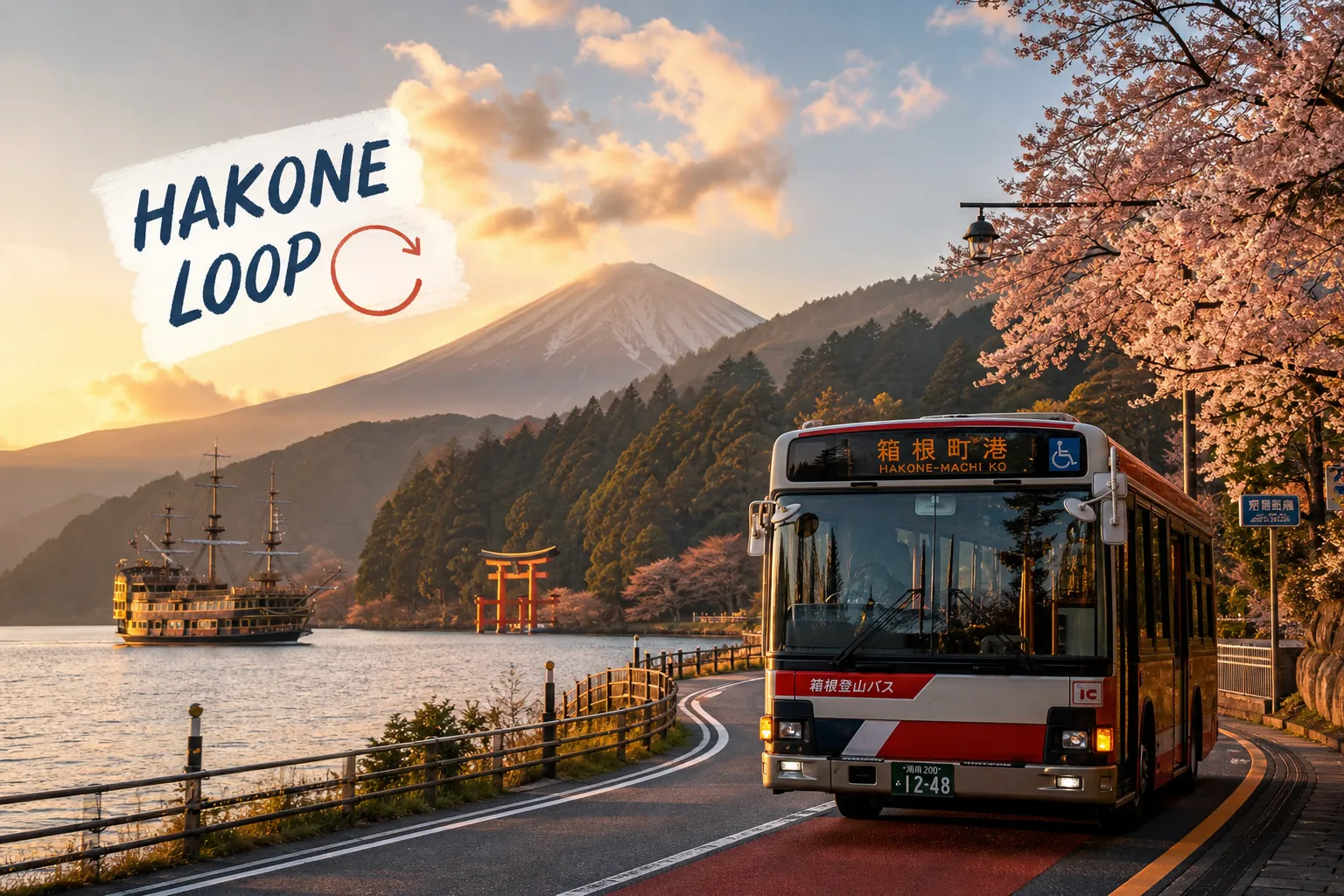
Figuring out how to get around Hakone trips up almost every first-time visitor, and for good reason: the area runs on five completely different transport modes that only make sense when you understand how they connect. You’re not choosing between a train or a bus. You’re navigating a circuit, and every link in that circuit depends on the one before it.
The good news is that once you see the Hakone Loop as a single, continuous route rather than a menu of independent options, the whole system clicks. This is the kind of layered transport puzzle The Curious Atlas loves to untangle. The same approach behind our guide to Mexico’s ADO bus network applies here: understand the structure first, then the logistics fall into place. This guide gives you a plain-English explanation of how the loop works, a clear answer on whether the Hakone Freepass is worth your money, a step-by-step route you can follow on the day, and a plan for when things go sideways.
How Hakone’s transport network actually fits together
The Hakone Loop is made up of five consecutive transport modes, each one handing you off to the next. They aren’t interchangeable. Think of them as five links in a chain: remove one, and the whole circuit breaks.
The sequence works like this: The Hakone Tozan Train runs from Hakone-Yumoto up to Gora, taking roughly 35 to 40 minutes with trains departing every 15 to 20 minutes. From Gora, the Hakone Tozan Cable Car climbs a short steep section to Sounzan. The Hakone Ropeway then takes over from Sounzan, carrying you over volcanic terrain through Owakudani before descending to Togendai on the shore of Lake Ashi. The full ropeway ride runs about 30 minutes and costs ¥2,000 one-way if you’re paying out of pocket. At Togendai, you board the Hakone Sightseeing Cruise to cross the lake toward Moto-Hakone or Hakonemachi, a crossing that takes 25 to 30 minutes. Finally, Hakone buses bring you back toward Hakone-Yumoto or Odawara to close the loop.
Most travelers arrive via Odawara, reached by Shinkansen or JR from Tokyo, or direct from Shinjuku on the Odakyu Romance Car. Hakone-Yumoto is the gateway station where the loop begins. The Odakyu Line from Shinjuku to Odawara takes roughly 75 to 90 minutes, and the short hop from Odawara to Hakone-Yumoto adds another 15 minutes on a local train.
The Hakone Freepass: what it covers and whether it’s worth it
The Hakone Freepass gives you unlimited rides on all five loop modes for either two or three consecutive days. Covered transport includes:
- Hakone Tozan Railway
- Tozan Cable Car
- Hakone Ropeway
- Sightseeing Cruise on Lake Ashi
- Hakone Tozan Bus (designated areas)
- Odakyu Highway Bus (designated areas)
- Tokai Bus (designated areas)
- KANKO SHISETSU-MEGURI tourist bus
If you buy the pass from Shinjuku, it also includes a round-trip on the Odakyu Line between your departure station and Odawara, a meaningful addition for anyone coming from Tokyo. The pass does not cover the Romance Car express surcharge, non-designated bus routes, or attraction admission fees.
Current adult prices for 2026 break down like this:
- From Shinjuku: ¥7,100 for 2 days, ¥7,500 for 3 days
- From Odawara or inside the Hakone area: ¥6,000 for 2 days, ¥6,400 for 3 days
Verify exact fares on the Odakyu website before purchasing, since prices can shift and vary by whether the Odakyu Line portion is included. You can buy the pass at Odakyu station offices and ticket machines, Odakyu Sightseeing Service Centers, major stations inside Hakone including Hakone-Yumoto, Gora, and Odawara, and through Odakyu’s digital EMot ticketing platform.
The 2-day pass is almost always the right call if you’re doing the full loop from Tokyo on a single strong day with one travel day on either side. The 3-day pass makes sense only if you’re staying multiple nights and want to revisit specific spots. If you plan to stay overnight, see our Hakone Japan Ryokan Experience: A Complete First-Timer’s Guide for accommodation tips and what to expect at ryokan in the area. As for break-even math: the ropeway alone costs ¥2,000 one-way, the cruise runs ¥1,200 one-way, the Tozan Train from Hakone-Yumoto to Gora is ¥460 one-way, and the cable car and buses add more on top. Do the full loop once and the 2-day pass from Shinjuku pays for itself with room to spare.
How to Get Around Hakone: Step-by-Step Through the Hakone Loop
The counterclockwise direction is the standard recommendation for a reason. Going counterclockwise means your ropeway ride heads toward Owakudani with the volcanic landscape unfolding below you, and the cruise from Togendai toward Moto-Hakone puts you in position for the most iconic Mt. Fuji sightlines over the lake when skies are clear.
The route runs like this: Hakone-Yumoto to Gora on the Tozan Train, Gora to Sounzan by cable car, Sounzan through Owakudani to Togendai on the ropeway, Togendai to Moto-Hakone or Hakonemachi on the cruise, and then back to Hakone-Yumoto or Odawara by bus. You can technically do this clockwise, starting with a bus to Lake Ashi and riding the ropeway back toward Gora, but you lose some of the scenic sequencing and the Mt. Fuji framing on the cruise.
Half-Day vs. Full-Day: How Much Time Do You Need?
Budget your time honestly before you leave:
- Half-day loop (4 to 5 hours): Move efficiently, limit stops to Owakudani and the cruise, skip museum detours. This works if you’re arriving midday or connecting onward in the afternoon.
- Full-day loop (6 to 8 hours): Includes real time at Owakudani for the sulfur vents and black eggs, the cruise crossing, a visit to Hakone Shrine near Moto-Hakone, and any museum stops near Gora.
Timing Your Start
On a full-day loop, aim to start at Hakone-Yumoto by 9:00 a.m. The ropeway operates from 9:00 a.m. to 4:45 p.m. between February and November, and until 4:15 p.m. in December and January. Getting to Owakudani early means fewer crowds and more time before the afternoon tour buses arrive at the lake.
If you’re basing yourself at Moto-Hakone rather than Hakone-Yumoto, a half-loop focused on Hakone Shrine, the cruise, and the ropeway is a strong 4-hour option that cuts out the mountain rail section entirely.
How to Get Around Hakone When the Ropeway Shuts Down
The Hakone Ropeway suspends service when wind speeds hit 25 m/s or above, and closes for scheduled annual maintenance in early November. Elevated volcanic activity alerts at Owakudani have also caused closures and access restrictions in the past. This is one transport link where checking status the morning of your visit is non-negotiable.
Check the official Hakone Ropeway operator page before you head out. Both post current operating status and suspension notices. A quick check at breakfast takes less than two minutes and saves you arriving at Sounzan to find a closed gondola.
When the ropeway is suspended, operators run substitute buses on two segments: Sounzan to Owakudani (about 10 minutes one-way) and Owakudani to Togendai via Ubako (about 15 to 20 minutes one-way). These buses operate at roughly 15-minute intervals within the ropeway’s normal operating hours. Critically, the substitute buses are included in the Hakone Freepass, so your transport plan stays financially intact even if the experience changes. You lose the aerial views of the volcanic landscape, but you still reach Lake Ashi on schedule. One additional consideration: if the closure is weather-related, check whether conditions on the lake will also affect the cruise before you commit to the full loop.
Luggage, coin lockers, and getting around without a heavy bag
Dragging a rolling suitcase onto a steep mountain train and then onto a ropeway gondola is exactly as unpleasant as it sounds. The Hakone Baggage Transfer Service solves this cleanly. Drop your luggage at Hakone-Yumoto Station in the morning, and it gets delivered directly to your accommodation the same day. The reverse works on checkout: your hotel sends bags back to the station so you can pick them up after finishing the loop.
Size limits are practical: regular luggage up to 140 cm total dimensions and 15 kg; large luggage up to 200 cm and 30 kg. Items over 2 meters or 30 kg aren’t accepted, and valuables, strollers, fragile goods, and hazardous materials are excluded. If you’re arriving with a rolling suitcase on the same day you plan to do the full loop, use this service. It’s the single most underrated logistics move for a Hakone day trip. For advice on bathing etiquette, recommended hot springs, and what to expect at local baths, see our Hakone Onsen Guide: Best Hot Springs, Tips & What to Expect.
Coin lockers are available at Hakone-Yumoto and Odawara stations, with large lockers running around ¥700 and medium lockers around ¥600. The honest reality is that Hakone-Yumoto has only a handful of lockers, and they fill up fast on weekends and holidays. Treat them as a backup option, not a plan. Odakyu Service Centers at Odawara and Hakone-Yumoto also offer temporary bag storage, which works well if you need a flexible few-hour solution. For travelers with mobility needs or particularly heavy luggage, taxis operate from the stand at Hakone-Yumoto Station and can be arranged through hotels.
The one decision tree you need before you go
Getting around Hakone stops being confusing the moment you see it as a loop with a fixed sequence rather than a scattering of transport options. The system was designed to be followed in order, and it rewards anyone who maps it out first.
Here’s the practical summary: buy the 2-day Hakone Freepass from Shinjuku if you’re coming from Tokyo. Check the ropeway status the morning of your trip. Drop your bag at the Hakone-Yumoto transfer service before boarding the Tozan Train. Go counterclockwise. Start by 9:00 a.m. if you want a full day. That’s the entire decision tree for how to get around Hakone without friction.
If this kind of step-by-step transport breakdown is useful to you, The Curious Atlas applies the same logic to overland travel in Mexico. The guide on how to use the ADO bus system covers everything you need to move confidently between Tulum, Playa del Carmen, and Cancun on your own terms, no tour required. For broader trip planning across Japan, see How to Plan an Immersive Japan Trip on Any Budget.
Frequently Asked Questions
How long does the Hakone Loop take?
A full-day loop takes 6 to 8 hours, including time at Owakudani, the Lake Ashi cruise, and a stop at Hakone Shrine. If you’re moving efficiently and skipping museum detours, a half-day loop can be completed in 4 to 5 hours.
Is the Hakone Freepass worth it?
For most visitors doing the full loop from Tokyo, yes. The ropeway alone costs ¥2,000 one-way, the cruise is ¥1,200 one-way, and the Tozan Train from Hakone-Yumoto to Gora is ¥460 one-way. Add the cable car, buses, and the included Odakyu Line round-trip from Shinjuku, and the 2-day pass at ¥7,100 pays for itself on a single complete loop.
What is the best direction to do the Hakone Loop?
Counterclockwise is the standard recommendation. It puts you on the ropeway heading toward Owakudani with the volcanic terrain unfolding ahead, and positions you for the best Mt. Fuji views over Lake Ashi during the cruise from Togendai to Moto-Hakone.
What happens if the Hakone Ropeway is closed?
Operators run substitute buses between Sounzan, Owakudani, and Togendai via Ubako. These buses are covered by the Hakone Freepass and run at roughly 15-minute intervals. Check the official ropeway operator page for current status before heading out.
Where do I start the Hakone Loop?
The loop starts at Hakone-Yumoto Station, which is the main gateway into the Hakone area. From Tokyo, take the Odakyu Line to Odawara and transfer to a local train for the 15-minute ride to Hakone-Yumoto, or ride the Romance Car direct from Shinjuku.
Can I do Hakone as a day trip from Tokyo?
Yes. Getting around Hakone on a day trip from Tokyo is straightforward with the Hakone Freepass. Leave Shinjuku early, start the loop at Hakone-Yumoto by 9:00 a.m., and you’ll have enough time to complete the full circuit and return to Tokyo the same evening.
Leave a Reply