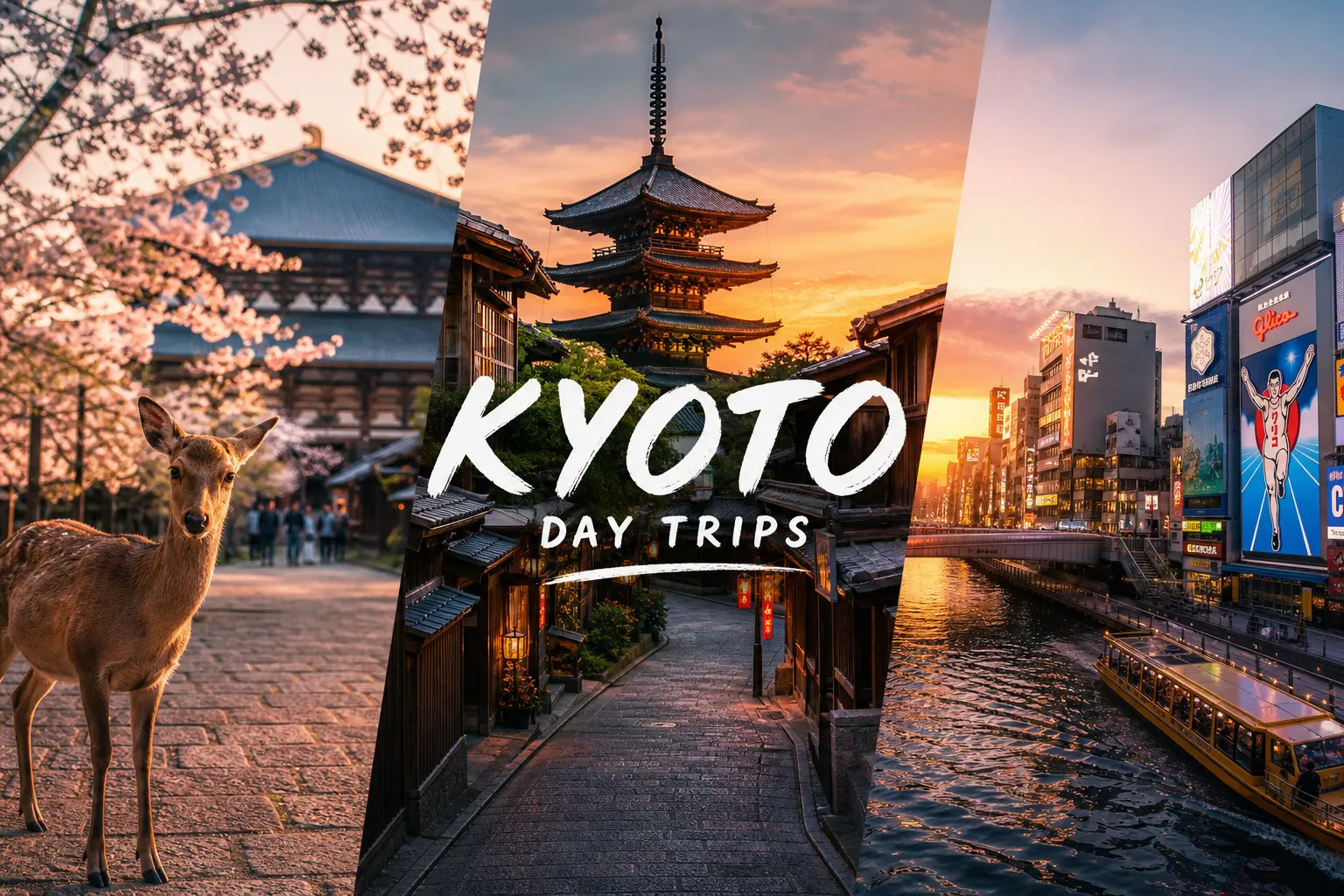
Some cities earn their greatness not just from what they hold inside their borders, but from what surrounds them. Kyoto is exactly that kind of city, and this guide covers the best day trips from Kyoto you can reach by train, from ancient deer parks to castle towns to Japan’s most electrifying street food scene. It sits at the center of a rail network that places all of this within reach of a single morning departure.
The smartest way to experience central Japan is what seasoned independent travelers call the base-and-explore approach: pick one well-positioned city, settle into it deeply, and use it as a launch pad rather than a check-in point. Kyoto is an especially convenient base for central Japan day trips because so many worthwhile destinations cluster within an hour by train, with frequent service that removes the need for rigid scheduling. By the end of this guide, you’ll know exactly which day trip fits your interests, how to get there cheaply, and when to leave so you beat the crowds.
Why Kyoto is the ideal base for exploring central Japan
Kyoto’s position on the JR and Kintetsu rail networks is what makes it rare among Japanese cities. Unlike Tokyo, where day-tripping often requires longer distances and exhausting commute windows, Kyoto’s neighboring destinations are genuinely close. Most classic day trips from Kyoto land somewhere between 20 minutes and 2 hours by train, with destinations like Uji at 20, 30 minutes, Nara at 35, 45 minutes, and Osaka at 45, 55 minutes. Service frequency is high enough that you don’t need a rigid departure schedule for any of them. A handful of destinations, such as Kanazawa or Amanohashidate, sit further out and require shinkansen or limited-express services, but those are longer journeys in a different category.
The train network that works in your favor
The two main arteries for Kyoto day trips are the JR network and the Kintetsu lines. Together they cover the key Kansai destinations most travelers are after, Nara, Osaka, Uji, and parts of Lake Biwa, though longer or more remote destinations require additional lines or shinkansen connections. For most solo travelers, the simplest tool is an ICOCA card: load it once, tap on and off, and it handles both networks without forcing you to calculate pass breaks in advance. Note that a small number of private operators may charge surcharges not covered by ICOCA, but for standard Kansai routes it works seamlessly. A JR Pass only makes financial sense if you’re combining these Kansai day trips with long-distance shinkansen travel elsewhere in Japan (see JR Pass for Osaka, Kyoto & Nara).
How to time your departures smartly
The single most effective crowd-avoidance tactic for any train day trip from Kyoto is straightforward: leave between 7:30 and 8:30 AM. Tour groups and visitors arriving from Osaka and Tokyo typically reach popular sites between 10 AM and noon, which means an early Kyoto departure puts you at your destination a full two hours ahead of peak foot traffic. It costs nothing extra and changes the quality of the experience entirely.
Best day trips from Kyoto, Nara, Arashiyama, and Osaka
These three destinations form the core of any Kyoto day-trip circuit. Each one is distinct in character, reachable within an hour, and rewarding enough to justify a full day on its own.
Nara: the best half-day trip and why most people rush it
Nara Park is the definitive first day trip from Kyoto: close, cheap, and genuinely rewarding if you resist the urge to speed through it. Yes, the deer are the famous draw, but Nara Park is one of the few places in Japan where wildlife, ancient temples, and forest atmosphere overlap in a single walkable area. The cliché doesn’t diminish the reality.
Best day trip to Nara: timing and trains
Two routes connect Kyoto to Nara. The Kintetsu Limited Express from Kyoto Station takes about 35 minutes and costs approximately ¥1,280 one way; it drops you closer to the park entrance, which matters if you’re working a tight half-day. The JR Miyakoji Rapid is slower at around 45 minutes but costs approximately ¥720 one way and is covered by the JR Pass. For practical route details, see traveling from Kyoto Station to Nara. For budget solo travelers, the JR route is the practical default, especially since the walk from JR Nara Station to the park is entirely manageable on foot.
A realistic morning in Nara
Todai-ji opens at 7:30 AM from April through October (hours shift to 8:00 AM from November through March, so check the seasonal schedule before you go). A 9 AM arrival gives you a solid window before the main crowds appear. Allow 90 minutes for the Great Buddha Hall and the deer zone immediately surrounding it, then push up to Kasuga Taisha for another 45 minutes. The park’s open layout means a 3, 4 hour visit never feels rushed; it rewards slow walking and sitting still far more than a checklist approach. Crowds peak between 11 AM and 2 PM, so arriving early isn’t just a preference; it’s the strategic move.
What solo travelers love about Nara
Nara removes virtually every logistical friction that solo travelers worry about. The entire circuit from train station to temple to shrine is walkable, English signage is clear throughout, and the mood is quieter and less performative than central Kyoto. There is something about Nara that makes slowing down feel natural, more so than almost anywhere else on the Kyoto day-trip circuit. That quality makes it an ideal first independent stop.
Arashiyama: Kyoto’s bamboo escape, best before 8 AM
Arashiyama sits only 20, 30 minutes from central Kyoto on the JR Sagano Line or the Randen tram, technically still within the city’s limits. But its scale, its atmosphere, and its complete shift in character from Kyoto’s historic center make it function like a separate destination entirely. Treat it that way, and it rewards you generously.
The crowd reality and how to beat it
The bamboo grove is one of the most photographed spots in Japan, and by 10 AM it’s packed in a way that genuinely changes the experience. Arriving before 8 AM is the only way to see it as it was meant to be seen. The grove is accessible 24 hours a day, and the pre-9 AM light is dramatically better for photography. If you’re staying in central Kyoto, this means catching the earliest available morning train rather than treating Arashiyama as a casual afternoon add-on.
What to pair with the bamboo grove
After the grove, walk directly to Tenryu-ji gardens and plan 45, 60 minutes there. The Hozu River trail extends the morning further without adding crowds. Combining the grove with the Iwatayama Monkey Park or a boat ride on the Oi River transforms a rushed 45-minute loop into a comfortable half-day. Return to central Kyoto for lunch, and consider using the afternoon for a secondary destination or a quieter Kyoto neighborhood you haven’t explored yet.
Osaka: street food, Dotonbori, and 55 minutes on the JR
Osaka operates at a completely different frequency from Kyoto. It’s louder, faster, and organized around eating rather than contemplation. For solo travelers who’ve spent a few quiet days in temple corridors and moss gardens, a full day in Osaka delivers exactly the urban contrast that resets perspective and renews energy.
The train and what it costs
The JR Special Rapid from Kyoto Station to Osaka Station takes approximately 45, 55 minutes and costs around ¥580 one way. It’s covered by the JR Pass and significantly faster than most first-time visitors expect. Once in Osaka, the subway system is efficient and your ICOCA card handles it seamlessly without any additional setup.
A half-day Osaka itinerary that doesn’t waste time
Arrive by 10 AM and head directly to Osaka Castle; allow 90 minutes for the grounds and interior. From there, move to Kuromon Ichiba market for lunch. It’s one of Japan’s most concentrated street food corridors and worth at least an hour of slow grazing. Aim to reach Dotonbori by 3 PM, when the neon district begins waking before its evening peak. This sequence covers Osaka’s three most distinct registers in a single day: history, food, and pure spectacle.
Why Osaka works especially well for solo travelers
Solo diners are not just accepted in Osaka, they’re the norm. Standing ramen counters, kushikatsu bars, and takoyaki stalls are built for one person eating with full attention. Dotonbori itself is self-contained and entirely walkable, which lowers the social barrier that solo travelers sometimes feel in unfamiliar urban environments. Arriving around 6 PM and eating your way through the evening is one of the simplest and most satisfying solo travel experiences anywhere in Japan. If you’re planning a trip focused on independent travel, check out How to Plan a Solo Japan Trip on Any Budget for additional practical tips.
Three more Kyoto day trip ideas worth the extra train time
Not every excursion from Kyoto needs to be a quick sprint. For travelers with a flexible schedule, three additional destinations offer distinct experiences that justify a longer journey without requiring overnight stays.
Uji: 20 minutes for matcha obsessives
Uji sits just 20, 30 minutes from Kyoto on the JR Nara Line and remains one of the most underrated half-day options on the entire circuit. It’s Japan’s matcha capital and home to Byodoin Temple, a UNESCO World Heritage site featured on the 10-yen coin. Allow an hour for the temple grounds, then take your time along the main street’s lineup of matcha tea houses and specialty shops.
Himeji: Japan’s most complete castle
At 1.5, 2 hours from Kyoto by JR Special Rapid, Himeji is the furthest option on this list and also the most visually dramatic. Himeji Castle is widely regarded as the finest surviving feudal castle in Japan, and the adjacent Koko-en garden fills a comfortable half-day without feeling rushed. This destination suits travelers who prioritize historical architecture over food or nature experiences.
Choosing based on your travel style
The decision framework is straightforward. Choose Uji for slow, sensory experiences centered on a single culinary specialty. Choose Himeji for architecture and history with minimal logistical complexity. Choose Lake Biwa, about 1, 1.5 hours by JR, if you want water, cycling, and open space rather than more temple circuits. Each of these Kyoto day trip ideas works as a standalone day without much advance planning, checking the train schedule the evening before is usually enough, though during peak holiday periods it’s worth confirming capacity or reservation requirements for popular castle sites.
The base-and-explore approach: a smarter way to travel
Using one well-positioned city as a base and radiating outward is not simply practical logistics. It’s a fundamentally different way of experiencing a place. You settle in, you stop performing tourism, and the surrounding region reveals itself in layers rather than as a series of blurs seen through a train window.
The same logic applies across every region, whether you’re navigating the Kintetsu Line toward Nara or planning around a different base city entirely. If you’re considering an alternate anchor, see How to Spend 5 Days in Tokyo Like a Local for ideas on choosing and using a different home base.
At The Curious Atlas, every destination guide is built on this principle: pick the right home base, understand the transport links, and let your anchor city do the work.
These are the best day trips from Kyoto for independent travelers who want depth over distance. Use what’s here to plan your itinerary, then go further than you thought you had time for. For broader planning resources, consult How to Plan an Immersive Japan Trip on Any Budget.
Leave a Reply