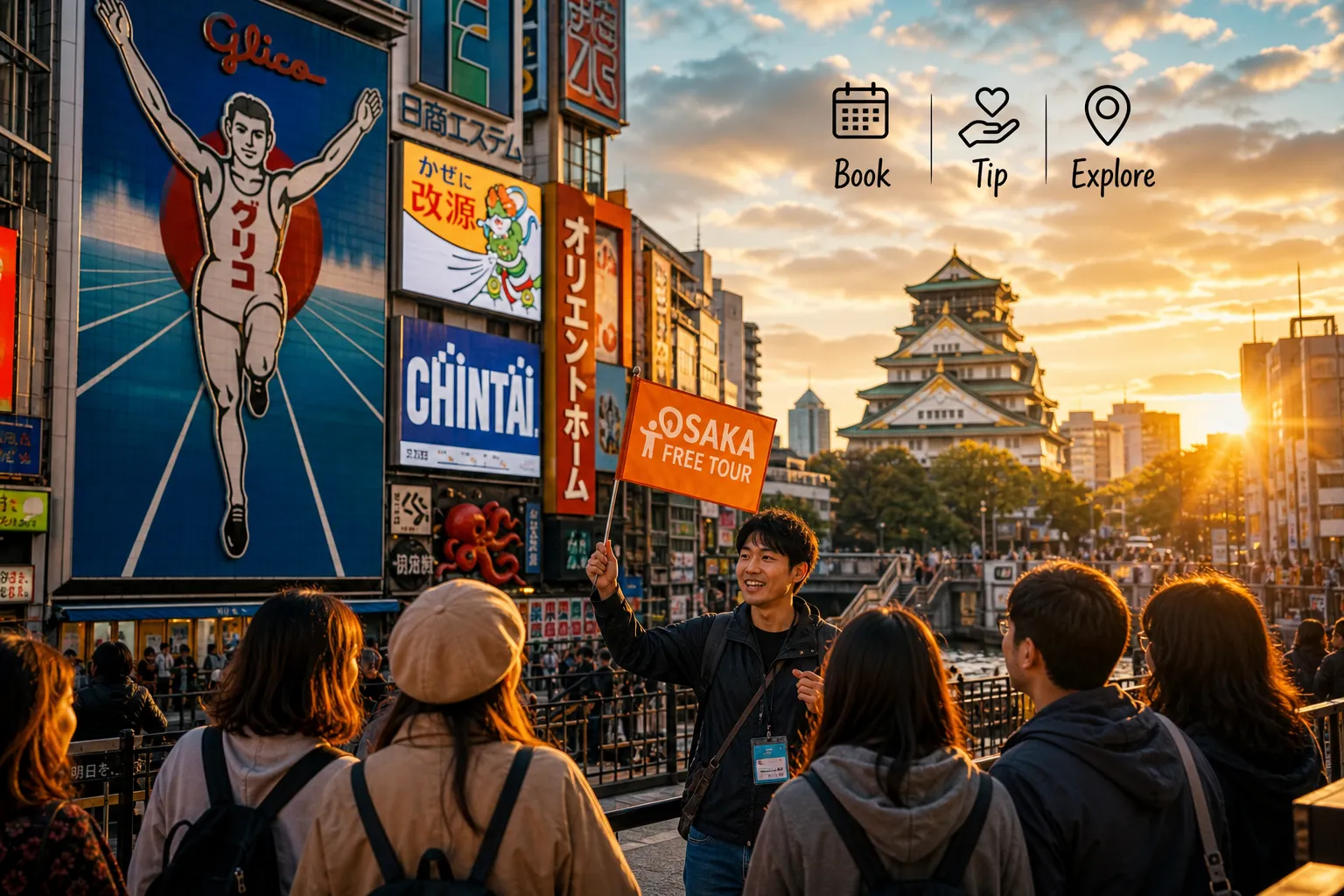
The best cities reveal themselves at walking pace, and Osaka proves this more than almost anywhere in Japan. An Osaka free walking tour is one of the smartest first moves you can make here, it orients you to the canals, covered arcades, and market lanes before you strike out on your own. The moment you step off the train in Namba and catch the first thread of yakitori smoke drifting through the station exit, you understand that no bus tour or overview map is going to give you what this city is actually offering. Osaka is built for street-level attention, and its retro neighborhoods reward the person who slows down and pays attention.
A knowledgeable local guide covers ground efficiently and provides the cultural context that turns a walk through Dotonbori into something you’ll actually remember. This guide covers the major operators, what “free” really means in practice, which neighborhoods the tours cover, how much to tip, and how to build your own self-directed exploration of Shinsekai and Nakazakicho on top of it.
What “free” actually means on an Osaka walking tour
The pay-what-you-want model, explained
Osaka’s free walking tours are not charity, and they’re not a marketing hook with a hidden fee at the end. They operate on a tip-based model: joining costs nothing upfront, you walk for roughly 2.5 to 3 hours, and at the end you pay what you feel the experience was worth. The guide’s income depends entirely on those voluntary contributions, which means your tip is their wage for the morning. There’s no invoice, no credit card terminal, and no minimum charge. Many operators ask that you hand cash directly to the guide or place it in an envelope at the close of the tour, check your specific operator’s booking notes for their preferred method.
How much to tip your guide in Osaka
The standard tip range in Osaka is ¥1,000 to ¥2,000 per person, which works out to roughly $7 to $14 USD. Tripadvisor reviews for the main operator note that many participants tip ¥1,000 or more when they feel the tour delivered. Decide based on quality: if the guide spent three hours giving you context, food recommendations, and local stories you couldn’t have found in a guidebook, tip accordingly. GuruWalk, as an international reference point, suggests a broader contribution range of €15 to $50 per participant for free tours globally, but that figure applies across all cities, the Osaka-specific norm skews toward the ¥1,000 to ¥2,000 range. Bring cash in yen. Most pay-what-you-want listings, including GuruWalk and Osaka Free Walking Tour®, request cash for tips rather than card payment, so check each operator’s payment notes and come prepared.
Best Osaka free walking tour operators
Osaka Free Walking Tour® (the original)
Osaka Free Walking Tour® is the purpose-built operator for this city, with a 4.9 out of 5 rating from more than 1,592 Tripadvisor reviews. That volume of feedback over years of operation tells you something real about consistency. To book, visit the Osaka Free Walking Tour® website, browse the event schedule, choose a tour that fits your dates and interests, and sign up. You receive a confirmation email immediately after registration. Because this is the operator’s own platform rather than a marketplace, you get better coordination and a more consistent guide experience. Reviewers specifically praise guide Masa for being knowledgeable, conversational, and generous with local food and sightseeing tips. See the operator’s Tripadvisor profile for guest feedback and ratings: Tripadvisor reviews.
GuruWalk and FREETOUR.com: what each platform offers
GuruWalk lists an Osaka free walking tour with a meeting point in front of a Family Mart convenience store in Naniwa Ward. The platform operates on a pay-what-you-want model, accepts cash only, and offers free cancellation. FREETOUR.com also lists tip-based Osaka tours with free online booking. Both platforms are useful if the main operator’s schedule doesn’t align with your travel window, or if you want a backup option. The tradeoff is that marketplace listings vary more in guide quality and group organization than booking directly through a dedicated operator.
Osaka free walking tour routes and landmarks
The Dotonbori and Namba circuit: food, neon, and history
Most popular free walking tour routes in Osaka anchor themselves in the southern downtown core. Expect to walk through Dotonbori, Ebisu Bridge (the Glico sign), Shinsaibashi, Hozenji Yokocho, Kuromon Market, and Namba Yasaka Shrine. This is Osaka’s dense, photogenic, food-saturated heart, and a good guide connects the visual spectacle to actual history: why the canal exists, what the neon culture reveals about the city’s merchant roots, and where to eat after the tour ends. After the route, the food stops become obvious rather than random. Takoyaki Wanaka and Kushikatsu Daruma along the Dotonbori stretch are two specific spots worth noting before you go.
Shinsekai and old Osaka: the grittier, more revealing side
Some routes extend south into Shinsekai, the retro entertainment district anchored by Tsutenkaku Tower. This neighborhood tells a different story from Dotonbori: postwar Osaka, working-class culture, and the city’s deep love of kushikatsu. A few tours also touch Shitennoji, one of Japan’s oldest Buddhist temples, and Tennoji Park. These sections tend to generate the most interesting conversations with guides about how Osaka’s identity differs from Tokyo, and why the city’s residents take visible pride in what other cities might consider unfashionable. If your route includes Shinsekai, stay engaged during this section. The context the guide provides here is harder to find on your own.
Self-guided walking by neighborhood: where the real discoveries live
Dotonbori on your own: what to seek beyond the obvious
After a guided tour orients you, returning to Dotonbori independently changes the experience completely. You know where to look. Walking the canal-side streets before 9 a.m. is a practical tip rather than a rule: the crowds are thin at that hour and the vendors are still setting up, which makes for a calmer experience. Try takoyaki from a street stall rather than the branded restaurants on the main strip, and duck into the covered Namba Walk for a look at how locals actually shop and eat lunch. The famous Glico sign photographs well at night; the neighborhood reveals itself in the early morning.
Shinsekai: the neighborhood that rewards slow walkers
Shinsekai is short on Instagram backdrops but long on character. Walk the grid of low-rise streets around Tsutenkaku, order a beer at a standing bar, and notice the kushikatsu shops with their strict no-double-dipping rules posted at the counter. This is the neighborhood most rushed travelers skip, which is precisely why it deserves a dedicated hour on your second or third day. The standing bars and retro signage here feel genuinely lived-in rather than preserved for tourism.
Nakazakicho: Osaka’s quietest, most livable neighborhood
Nakazakicho sits just north of Tenjinbashisuji and operates at a completely different frequency from Dotonbori. Independent coffee shops occupy renovated Showa-era rowhouses, and secondhand bookstores share alleys with ceramics studios. The kissaten culture here survives in a way that feels less like nostalgia and more like genuine preference, these old-style cafes serving hand-brewed coffee and fruit sandwiches are popular with residents who actually prefer them, not just visitors looking for atmosphere. Salon de AManTo, housed in a 100-year-old folk house, and the Book Cafe Arabiq, a coffee shop and bookstore combined, are two anchors worth finding. This neighborhood doesn’t appear on most guided tour routes, which makes it a reward for the self-directed traveler. Nakazakicho is where you understand that Osaka is a city people actually want to live in, not just visit.
Booking logistics, cancellation policies, and what to know before you show up
How to reserve your spot and what happens after
For Osaka Free Walking Tour®: sign up through the event schedule on their site and watch for a confirmation email. For GuruWalk listings: booking and cancellation are both free, but the platform asks that you cancel promptly if your plans change so the guide isn’t standing at the meeting point waiting for no one. No credit card is required on either platform for standard tip-based tours. Groups can run large during peak season, particularly in spring and fall; showing up a few minutes early helps you position yourself close enough to hear the guide clearly without crowding the front.
What to bring and how to prepare
Wear comfortable walking shoes. The typical route covers 3 to 4 km, which feels short until you factor in Osaka’s summer heat, serious and humid from June through September. Carry cash in yen for the tip and for any street food along the route. Download an offline map before you leave your accommodation, because cell service in covered markets and underground passages can be inconsistent. Bring water and drink it. One Tripadvisor review specifically noted that a group of 19 in hot weather was a challenge for both the guide and the participants, so plan accordingly if you’re visiting between June and September. For broader packing and planning guidance, see our Japan trip advice for first-time visitors.
How to turn a free walking tour into a full day in Osaka
Extending the guided route on your own
The tour ends around midday in most cases, which leaves the full afternoon open. Use the guide’s food recommendations immediately: they know which ramen shop nearby opens at lunch, which market stall won’t be there by 3 p.m., and where to find the less-photographed canal views that didn’t fit into the tour. A useful post-tour move is to retrace one section of the route at your own pace and step into the shops and alleyways you passed too quickly the first time. The second walk always reveals more than the first.
Building your own Osaka walking itinerary for the following days
One guided free walking tour is a foundation, not a ceiling. Map out Nakazakicho for your second morning, when the kissaten are quiet and the streets are unhurried. Add Osaka Castle Park for late afternoon light. Consider Tenjinbashisuji Shopping Street, the longest covered shopping street in Japan, for a final evening wander. If you’re exploring the broader Kansai region, the same curiosity-first approach works well across neighboring cities, but Osaka’s neighborhood variety makes it the strongest base. The city is built for layered, unhurried exploration, and each neighborhood adds a different dimension to the picture the guided tour started drawing.
Start with a guide, then go back alone
The guided tour is the best orientation tool Osaka offers. The self-guided neighborhood wander is the deeper, more personal follow-up. Both tracks matter, the tour gives you the map in your head; the solo walks give you the experience in your memory.
The tipping guidance is straightforward: bring ¥1,000 to ¥2,000 in cash, decide based on what the tour was worth to you, and be generous with a guide who woke up early and prepared for this. The booking is simple: pick a date on the Osaka Free Walking Tour® schedule, sign up before you leave home, and show up at the meeting point a few minutes early.
Dotonbori, Shinsekai, and Nakazakicho each reward a completely different kind of attention. A well-chosen Osaka free walking tour gives you the starting point for all three, and the confidence to go back on your own and find what the tour didn’t have time to show you. Start with a guide who knows the streets, then trust your curiosity. The city will show you the rest. That street-level, curiosity-first approach is exactly what The Curious Atlas brings to every neighborhood guide it publishes.
Leave a Reply