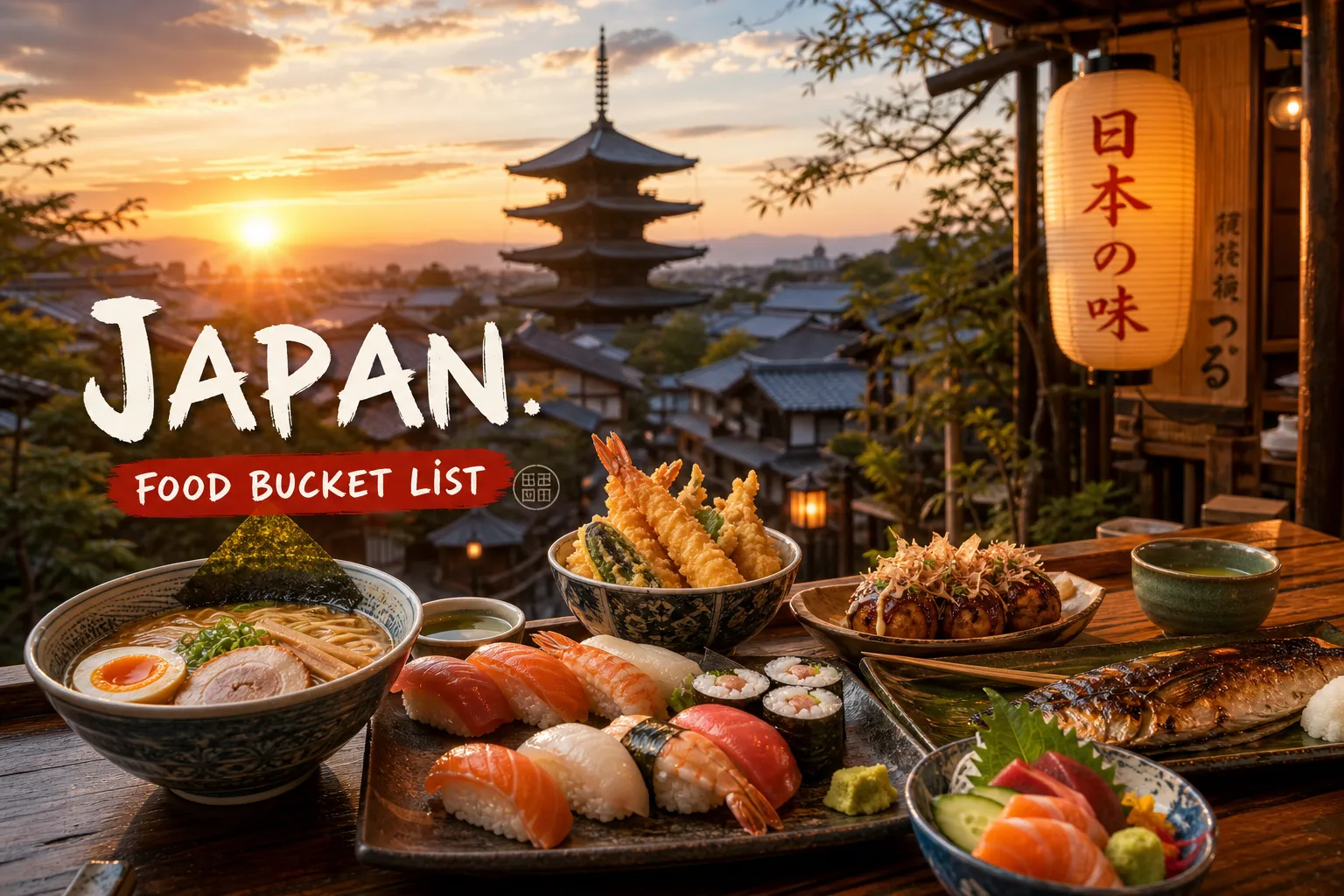
There’s a simple truth at the heart of every piece of travel writing here at The Curious Atlas: the most direct way to understand a place is to eat what its people actually eat. Not what’s been softened for tourists, not what shows up on the English menu at the hotel restaurant, but the real thing. That same philosophy shapes our guides to markets in Mérida and street food in Playa del Carmen. It applies just as powerfully to Japan.
For first-time visitors figuring out what to eat in Japan, the challenge isn’t finding good food. It’s knowing enough to recognize it when you’re standing in front of it. This guide covers the must-try traditional Japanese dishes every first-timer should know, the street food and izakaya classics worth planning your evenings around, the elevated dining experiences worth saving for a special night, where in Japan to find the best version of each dish, and how to order with confidence when you don’t share a language with the person behind the counter.
Must-Try Traditional Japanese Dishes for First-Time Visitors
These aren’t tourist dishes. Sushi, ramen, tempura, tonkatsu, soba, and udon are widely eaten across Japan, showing up in convenience store lunches, neighborhood noodle shops, and late-night counters after work. The fact that they’ve become globally famous doesn’t dilute them. Each one rewards real attention rather than being treated as a box to check on a food itinerary.
Sushi and ramen: the two dishes that demand your full attention
Sushi is not the California roll. Nigiri is a thumb-sized piece of rice topped with a single slice of fish or seafood, and it’s the format most serious sushi eaters default to. Sashimi skips the rice entirely and focuses on the raw fish alone. Omakase means you sit at a counter, hand control to the chef, and eat whatever they choose to serve you that evening. Kaiten-zushi, the conveyor belt format, is cheaper, more casual, and a perfectly reasonable starting point for first-time visitors, it’s the same tradition, just at a lower price point and a more relaxed pace. All of these are legitimately Japanese; they just represent different moments and budgets.
Ramen has four main broth styles, and knowing them before you order saves you from defaulting to whatever sounds familiar. Tonkotsu is thick, creamy, and pork-bone-based, most associated with Hakata in Fukuoka. Shoyu is a soy sauce broth, lighter and clearer, rooted in Tokyo. Shio uses salt as its primary seasoning, resulting in a clean, delicate broth historically tied to Hakodate in Hokkaido. Miso, the richest and most assertive of the four, originated in Sapporo and often comes topped with butter and corn. Each style tastes distinct enough that ordering one when you wanted another is a real difference.
Tempura, tonkatsu, and the everyday noodle decisions
Tempura’s appeal is textural: a thin, almost transparent batter coats seafood or vegetables, then fries quickly at high heat, producing a crisp shell around a tender interior. You’ll encounter it as a topping on soba or udon, as a standalone meal at a tempura specialty restaurant, or as part of a teishoku set lunch. Tonkatsu is simpler and more satisfying in an immediate way: a thick pork cutlet, breaded and fried, served at a counter lunch spot with shredded cabbage, rice, and a sweet, tangy sauce. It’s the kind of meal you eat quickly, efficiently, and happily.
Soba and udon will appear on almost every menu you encounter. Soba noodles are thin, earthy, made from buckwheat, and often served cold in summer with a dipping sauce on the side. Udon noodles are thick, soft, chewy, and broth-based. Both are cheap, fast, and genuinely excellent. Treat them as the default carb decision when you don’t want to think too hard about where to eat.
Street Food and Izakaya Dishes Every First-Time Visitor Should Try
The izakaya is a Japanese gastropub: a casual, after-work gathering place where food arrives in small plates, orders come in rounds, beer and sake flow freely, and no one is in a hurry for you to leave. It’s one of the most accessible entry points for first-time visitors who want to eat like a local without needing a reservation or any experience with formal Japanese dining. The communal rhythm of shared plates and unhurried rounds makes it easy to settle into; show up, point at things, and let the evening unfold.
Takoyaki and okonomiyaki: Osaka’s most personal exports
Takoyaki are golf-ball-sized rounds of wheat batter filled with octopus, cooked in a cast-iron pan with hemispherical molds, then topped with sweet sauce, mayo, and shaved bonito flakes that wave in the steam. Watching them get made is part of the experience: the vendor rotates each ball mid-cook with a metal pick in a practiced, continuous motion. They’re a street food ritual as much as a snack. Osaka is their spiritual home, though you’ll find them nationwide.
Okonomiyaki is a savory pancake built around cabbage and whatever proteins you want mixed in. Osaka-style folds everything into the batter and cooks it together into a soft, unified cake. Hiroshima-style layers the ingredients separately, with fried noodles and an egg added beneath the cabbage, creating a crispier, more textured result. They’re both called okonomiyaki, but they taste and feel different enough that trying both is worth the comparison.
Yakitori and the art of the izakaya evening
Yakitori is grilled chicken on bamboo skewers, cooked over charcoal until the edges caramelize. Different cuts are ordered by name: tsukune is minced chicken shaped into a meatball, negima alternates chunks of chicken with green onion, kawa is crispy chicken skin. You order a few skewers at a time, eat them as they arrive, and keep going until you’re done. Tokyo’s Ginza neighborhood is one of the better places to experience this, though yakitori is everywhere.
The izakaya format works because there’s no performance required. Small plates, shared ordering, no fixed menu. If you’ve had a long day walking through temples or markets, an izakaya in the evening is the exact right corrective. It’s how you decompress in Japan.
The elevated side of Japanese dining: kaiseki, shabu-shabu, and unagi
Not every meal needs to be casual. Japan has one of the most refined food cultures in the world, and skipping its formal dining traditions would be like visiting France and never sitting down for a proper bistro meal. These dishes are worth understanding before you encounter them, so they don’t feel intimidating.
What kaiseki is and why Kyoto is the place to experience it
Kaiseki is a multi-course traditional Japanese meal with roots in Zen Buddhist temple cuisine, now considered the pinnacle of Japanese fine dining. A full dinner runs between seven and fourteen courses, each one built around seasonal ingredients and served in a progression designed to balance flavors and textures. The visual presentation is as deliberate as the taste: lacquerware, ceramic vessels, and arrangement that reflects the current season. Mid-range kaiseki restaurants in Kyoto typically run somewhere between ¥10,000 and ¥30,000 per person for a full dinner, with the ¥15,000 to ¥25,000 range covering most reputable options. If budget is a concern, lunch kaiseki at the same caliber of restaurant is often available at a meaningfully lower price.
Kyoto is the canonical city for kaiseki because of its history, its proximity to traditional producers, and the concentration of chefs who have trained in this format for decades. If your itinerary includes Kyoto, one kaiseki dinner is worth budgeting for, book at least several weeks in advance for the better-known restaurants. It reframes everything you think you know about how a meal can be structured.
Shabu-shabu as interactive dining, unagi as a true Japanese delicacy
Shabu-shabu is thinly sliced beef or pork swished through simmering broth at the table, then dipped in ponzu or sesame sauce before eating. You cook in small batches, a few slices at a time, and the meal ends when you add noodles or rice to the remaining broth. Most restaurants walk you through the process at the start, so it’s beginner-friendly despite its somewhat formal reputation. Casual to midrange spots in Japan typically run ¥2,000 to ¥5,000 per person.
Unagi, grilled freshwater eel glazed with a sweet tare sauce and served over rice, is one of Japan’s oldest culinary traditions. It’s rich without being heavy, and worth seeking out at a specialty unagi restaurant rather than a general menu. Nagoya prepares it in a distinct style called hitsumabushi: the eel arrives over rice in a wooden box, and you eat it in three stages, first plain, then with toppings like wasabi and nori, and finally with dashi broth poured over the remaining rice.
Which city gives you the most authentic version of each dish
Japan’s culinary geography is specific and opinionated. Eating ramen in Kyoto is fine. Eating it in a Tokyo basement ramen shop at 11pm, or near Yokohama’s Shin-Yokohama Ramen Museum, which traces the dish’s regional origins, is something different. Many dishes have regional homes, and visiting those places increases the chance of encountering regionally distinctive preparations. Osaka for takoyaki, Kyoto for kaiseki, Hakata for tonkotsu, first-time visitors who plan even loosely around these regional associations tend to eat better for it.
Tokyo is strongest for tonkatsu (the Meiji-era restaurant Rengatei is credited with popularizing it), high-end sushi omakase, yakitori in Ginza, and sheer density of ramen options across all four broth styles. Osaka is the undisputed home of takoyaki and okonomiyaki; Kuromon Ichiba and Dotonbori are the right starting points for street food exploration. Kyoto is the place for kaiseki, soba in Arashiyama, and refined teishoku set lunches near temple districts.
Regional specialties reward any itinerary that ventures beyond the three main cities. Nagoya has miso katsu (tonkatsu finished with hatcho miso sauce instead of the standard sweet sauce), kishimen flat noodles, and hitsumabushi-style unagi. Takayama is worth knowing for Hida beef, a regional wagyu that rivals Kobe’s reputation at a fraction of the visibility. Sendai in Miyagi is the home of gyutan, grilled beef tongue, a dish with a devoted local following and almost no equivalent elsewhere in the country.
How to order in Japan without overthinking it
Japanese restaurant culture is engineered to make ordering as low-friction as possible. Plastic food models outside restaurant entrances closely approximate what each dish looks like, detailed enough to point at with confidence. Laminated picture menus serve the same purpose. Ramen and tonkatsu shops often use ticket vending machines: you buy your ticket before you sit, hand it to the chef, and the transaction is complete without a single word exchanged. The system assumes you might not share a language with the staff, and it accommodates that gracefully.
A handful of phrases will handle almost every situation. Say “sumimasen” to get a server’s attention. To order, use “[dish name] wo onegaishimasu” or simply point at a menu photo and say “kore wo onegaishimasu” (“this one, please”). To ask for a recommendation, “osusume wa nan desu ka” works in every restaurant. For the bill, “okaikei onegaishimasu” is the phrase to use.
Two etiquette notes matter more than people expect. Tipping is not customary in Japan; leaving money on the table can cause genuine confusion and awkwardness, so don’t. Eating while walking is generally considered impolite outside of well-known street food areas like Dotonbori, where the culture of eating on the move is broadly accepted, or festival stalls. Eat where the food is served, and you’re already ahead of most visitors.
Managing allergies and dietary restrictions in Japanese restaurants
Japanese cuisine has a deceptively complex allergen profile. The dishes look clean and simple, but the base layer of almost every savory preparation involves ingredients that regularly trigger common food allergies. A loose awareness that “there might be soy in some things” is not sufficient preparation.
The hidden allergens work like this: soy sauce is the foundational seasoning in nearly every savory dish, from ramen broth to teriyaki to pickled vegetables. Gluten appears in ramen and udon noodles, tempura batter, the breadcrumbs on tonkatsu, and a significant number of sauces. Dashi, the foundational stock in Japanese cooking, is made from katsuobushi (dried bonito flakes) or kombu (dried kelp), which makes it a fish allergen hiding inside broths and simmered dishes that look completely unrelated to seafood. Japanese mayo, made with egg, shows up on okonomiyaki, takoyaki, and in many sauces. These aren’t edge cases; they’re the architecture of the cuisine.
The most practical solution is a laminated or phone-saved allergy card written in Japanese that states your specific restrictions clearly. Allergy translation cards are available through several apps and travel resources. When restrictions are severe, specialty restaurants are generally a safer choice than busy izakayas: a dedicated soba restaurant or a kaiseki house can exercise more control over individual ingredients than a fast-moving kitchen turning out dozens of different small plates. Vegan and vegetarian options have improved meaningfully in major Japanese cities, and shojin ryori, Buddhist temple cuisine, remains the most historically grounded fully plant-based option in the country.
Eat with intention, not just appetite
The best travel eating isn’t about trying everything on a list. It’s about arriving somewhere with enough knowledge to make intentional choices. Knowing the difference between a tonkotsu broth and a shio broth before you sit down changes the experience entirely. Knowing to head to Osaka for okonomiyaki, or to Kyoto for kaiseki, means you’re working with Japan’s culinary geography rather than against it. Knowing to say “sumimasen” before pointing at a menu is a small thing that signals real respect.
The must-try traditional Japanese dishes covered in this guide are a starting framework, not a ceiling. Japan rewards curiosity and return visits in equal measure. The more you know before you arrive, the more you’ll discover once you’re there. At The Curious Atlas, that’s the philosophy behind every food guide we write, whether we’re navigating the street food of Playa del Carmen, the lake town markets of Bacalar, or the layered culinary geography of a country like Japan. The place reveals itself in ways that no itinerary can manufacture, but only if you show up ready to pay attention.
Explore more food-focused travel writing on The Curious Atlas, where the same curiosity-first approach applies whether you’re ordering at an izakaya counter in Osaka or tracking down the best panuchos in Mérida.
Leave a Reply