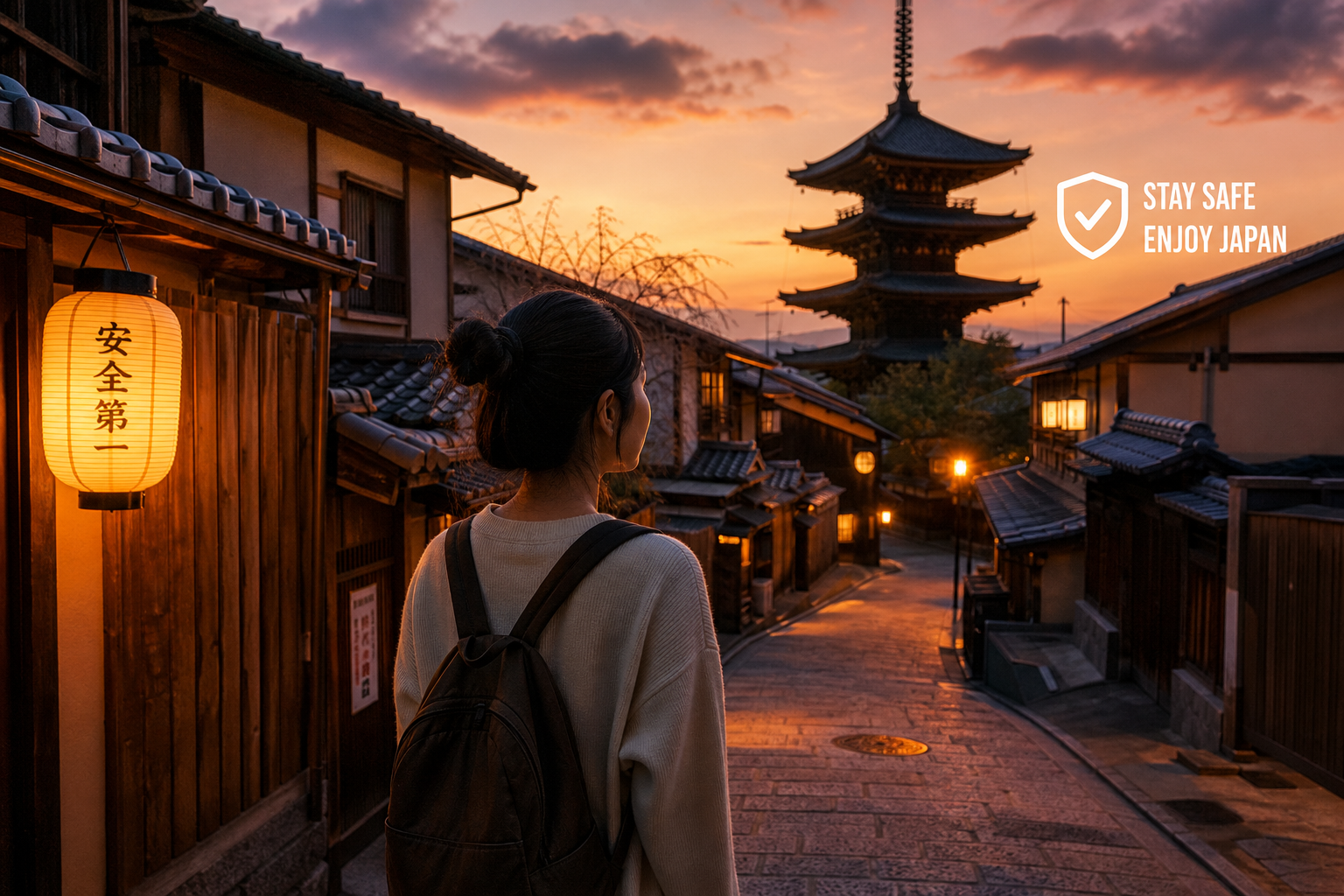
If you’re researching solo female traveler safety tips for Japan, start here: Japan is widely regarded as one of the safest destinations in the world for women traveling alone, and that reputation is grounded in how the country actually operates. Japan’s low violent crime rate, its cultural emphasis on public order, and its well-organized transport infrastructure create conditions that genuinely favor independent women travelers. This isn’t a travel marketing claim, it’s visible in the streets, the transit system, and the daily rhythms of city life.
That said, “safe” doesn’t mean “risk-free.” A few specific situations carry real risks worth understanding: crowded rush-hour trains, late-night nightlife districts, and unfamiliar neighborhoods after dark. Many of these risks can be substantially reduced with the right information and some targeted preparation.
This guide gives you a practical, honest safety framework. Whether you’re planning your first solo trip or returning with more confidence, the goal is to help you move through Japan with clarity rather than anxiety.
Why Japan Is Genuinely One of the Safest Countries for Women Traveling Alone
Japan’s public culture is built around group harmony, social restraint, and minimal confrontation. Petty theft is rare, street harassment is generally lower than in many major global cities, and violent crime targeting tourists is genuinely uncommon across Tokyo, Kyoto, and Osaka. All three cities score well on global safety indexes, and the cultural norms that create that environment don’t disappear when you step off the train.
The risks that do exist concentrate in specific, predictable places: certain nightlife districts, crowded commuter trains during peak hours, and situations involving alcohol. Understanding where risk concentrates is far more useful than generalized fear. According to National Police Agency figures, there were approximately 939 groping-related prosecutor referrals on trains in 2023 alone, and those figures reflect only reported cases. Nightlife areas like Kabukicho and Roppongi are among the most frequently flagged areas for tourist-facing scams, based on police and tourism advisories. These are real issues, but they’re also navigable ones.
Women who move slowly, build routines, and integrate into local rhythms tend to avoid the highest-risk tourist circuits naturally. It’s a deliberate approach to travel that changes your entire risk profile from the start.
Solo Female Traveler Safety Tips for Japan: Choosing Where to Stay
In Tokyo, the most practical neighborhoods for solo female travelers are Ginza, Shinjuku, Asakusa, and Shibuya. All four offer dense transport connections, well-lit streets, and high pedestrian flow even late at night. The key isn’t finding the quietest area, it’s finding somewhere central enough that you’re never isolated on a side street after dark. Ginza and Asakusa are particularly strong first-timer bases because they combine easy navigation with a genuine neighborhood feel rather than purely commercial energy.
Kyoto rewards slower movement more than almost any other city in Japan. The safest bases cluster around central Kyoto and the Kyoto Station area. Kyoto Station is a major JR, Kintetsu, and subway hub, and central Kyoto is well served by Hankyu (terminating at Kawaramachi/Shijo) and Keihan lines via nearby stations, check operator maps for the line closest to your accommodation. Women-only train cars operate on several of these lines during weekday rush hours, adding a layer of comfort on transit-heavy days. The city is broadly very safe, with low crime and a compact layout that makes it easy to navigate on foot.
In Osaka, Umeda and Namba are the most practical and consistently safe choices. Both sit on the city’s main subway lines, stay busy well into the evening, and keep you close to everything you need. Dotonbori is energetic and generally safe, but treat it as a place to pass through in the evening rather than a late-night anchor. Osaka’s subway runs frequently and reliably, which means you’re rarely stranded in a situation where you have to walk long distances alone at night.
Solo Female Traveler Safety Tips for Japan: Trains and Women-Only Cars
Women-only train cars exist on many major lines across Tokyo, Osaka, and Kyoto, typically marked with pink signage on the platform and doors. They operate during rush hour on weekday mornings, generally from around 6:00 to 9:00 AM, and on some lines during evening peak hours as well, though hours and coverage vary by operator, so check the relevant line’s official guidance before your trip. Using them isn’t mandatory, but they remove one category of stress entirely, especially on packed commuter trains where personal space disappears.
Chikan, or groping on trains, is a recognized and persistent public safety issue in Japan. The 2023 NPA data mentioned above reflects only reported cases; embarrassment and uncertainty suppress reporting significantly, so the actual rate is higher.
What to Do If Someone Crosses a Line
If something happens, speak loudly and directly the moment it occurs. Attract attention from other passengers without hesitation. Use the onboard emergency button or report to station staff at the next stop. Staff are trained to respond to these situations, and CCTV footage can support a formal report if needed. The worst thing you can do is stay silent out of embarrassment, the system is set up to help you, but only if you use it. This isn’t a reason to avoid trains; it’s a reason to know your options before you need them.
Female-Friendly Accommodation: What to Look for Before You Book
Where you sleep affects more than comfort. Female-only floors and women-only properties offer controlled access, communal spaces with other female travelers, and staff who are accustomed to solo women. These environments let you decompress, ask questions, and build the kind of informal community that makes solo travel genuinely enjoyable rather than exhausting.
Japan has a strong tradition of women-only accommodation, from budget capsule hotels to boutique-style properties in central neighborhoods. Some mixed-gender capsule hotels also offer women-only floors with separate elevator access, which provides a middle ground if your preferred location doesn’t have a fully women-only property.
Booking.com, Agoda, and Hostelz all list female-only properties. Search with a filter for women-only or female-only, read the listing description carefully, and confirm it explicitly states female-only rather than simply “women’s floor available.” Always review the cancellation terms before paying, and cross-check the same property across platforms since pricing and policies can differ. Female-only capsule hotels in Tokyo’s Akihabara area are worth researching directly on the property’s official site for the clearest booking conditions.
Navigating Nightlife, Cultural Etiquette, and the Risk of Moving Too Fast
Tokyo’s Kabukicho and Roppongi are the two areas most frequently flagged in safety reporting for tourists. Both are associated with drink spiking, aggressive touting, and overcharging, and, in some cases, false modeling or scouting approaches designed to isolate young women from safer public spaces. That doesn’t mean they’re off-limits entirely, but going with a group, keeping your drink in hand, and leaving before the late hours removes most of the risk. Never accept drinks from strangers in these areas, and never follow a tout into a bar you didn’t choose independently.
Japan’s public etiquette norms work quietly in a solo traveler’s favor. Keep your voice low on trains and in public spaces, avoid prolonged eye contact, and keep your bag close to your body. Dressing conservatively isn’t required everywhere, but it’s commonly suggested as a way to blend into local expectations and reduce the chance of standing out in crowded transit. These norms signal awareness, and in Japan, that generally invites warmth rather than unwanted attention.
Travelers who move quickly through a destination tend to concentrate their time in the highest-traffic tourist zones, which are also where most incidents occur. Slowing down naturally steers you toward community-oriented neighborhoods, local rhythms, and quieter experiences that carry far less exposure to the risks that come with rushed, circuit-style tourism. Slow travel isn’t just philosophically appealing; it’s structurally safer.
Your Emergency Toolkit: Numbers, Apps, and Contacts to Save Before You Land
Save these in your phone before you leave home. These are standard Japanese numbers and work nationwide:
- 110, Police
- 119, Fire and ambulance
- #7119, Non-urgent medical advice
- #9110, Non-emergency police consultation
- 171, Disaster voice-message board (earthquakes and major disruptions)
For a concise reference to official Japanese emergency numbers, including when and how to use them, consult that guide and save the numbers in your contacts before you depart.
Apps Worth Installing
Download Google Maps with offline maps for your destinations so you can navigate during transit disruptions without data. Add Google Translate for real-time camera translation of menus, signs, and written instructions. Japan Transit Planner handles complex train routes more accurately than general mapping apps. For safety, TripWhistle maps emergency numbers to your GPS location, and bSafe adds SOS and GPS tracking features. GeoSure provides neighborhood safety scores that include a specific women’s safety metric, useful when you’re weighing an unfamiliar area. Note that app features and availability change; these descriptions reflect 2026 availability, so confirm features are current before you travel.
Canadian Travelers: Embassy Contacts
Save the Embassy of Canada in Tokyo before you leave:
- Main number: +81 (3) 5412-6200
- Consular email: tokyo-consul@international.gc.ca
- Address: 3-38 Akasaka 7-chome, Minato-ku, Tokyo
- After-hours emergencies: Canada’s Emergency Watch and Response Centre, +1 613 996 8885 (24 hours) or WhatsApp at +1-613-909-8881
- Western Japan: Honorary consul in Osaka at the Osaka Castle Hotel
Store these in your notes app as well as your contacts, in case your phone is locked or you need to hand someone the information quickly. (See How to Plan a Japan Trip from Canada in 2026 for more planning tips.)
The Real Takeaway: Confidence Comes from Preparation, Not Paranoia
Japan is one of the most welcoming countries in the world for women traveling alone, and the practical steps outlined in these solo female traveler safety tips for Japan are genuinely manageable. Choose a well-connected central neighborhood as your base, use women-only train cars during rush hour, book female-friendly accommodation, stay alert in the specific nightlife districts where risk concentrates, and load your emergency numbers and apps before you land.
For related destination safety guides, see Playa del Carmen Safety Guide for Solo Female Travelers and Is Mexico Travel Safe? Essential Tips for a Worry-Free Trip.
The travelers who feel safest in Japan aren’t necessarily the ones who planned most defensively. They’re the ones who moved thoughtfully, stayed curious, and gave themselves enough time in each place to build genuine familiarity. That’s what solo travel in Japan looks like at its best, a country to fully experience rather than anxiously manage. This safety framework exists so you can stop running logistics on high alert and start paying attention to what actually matters.
Leave a Reply