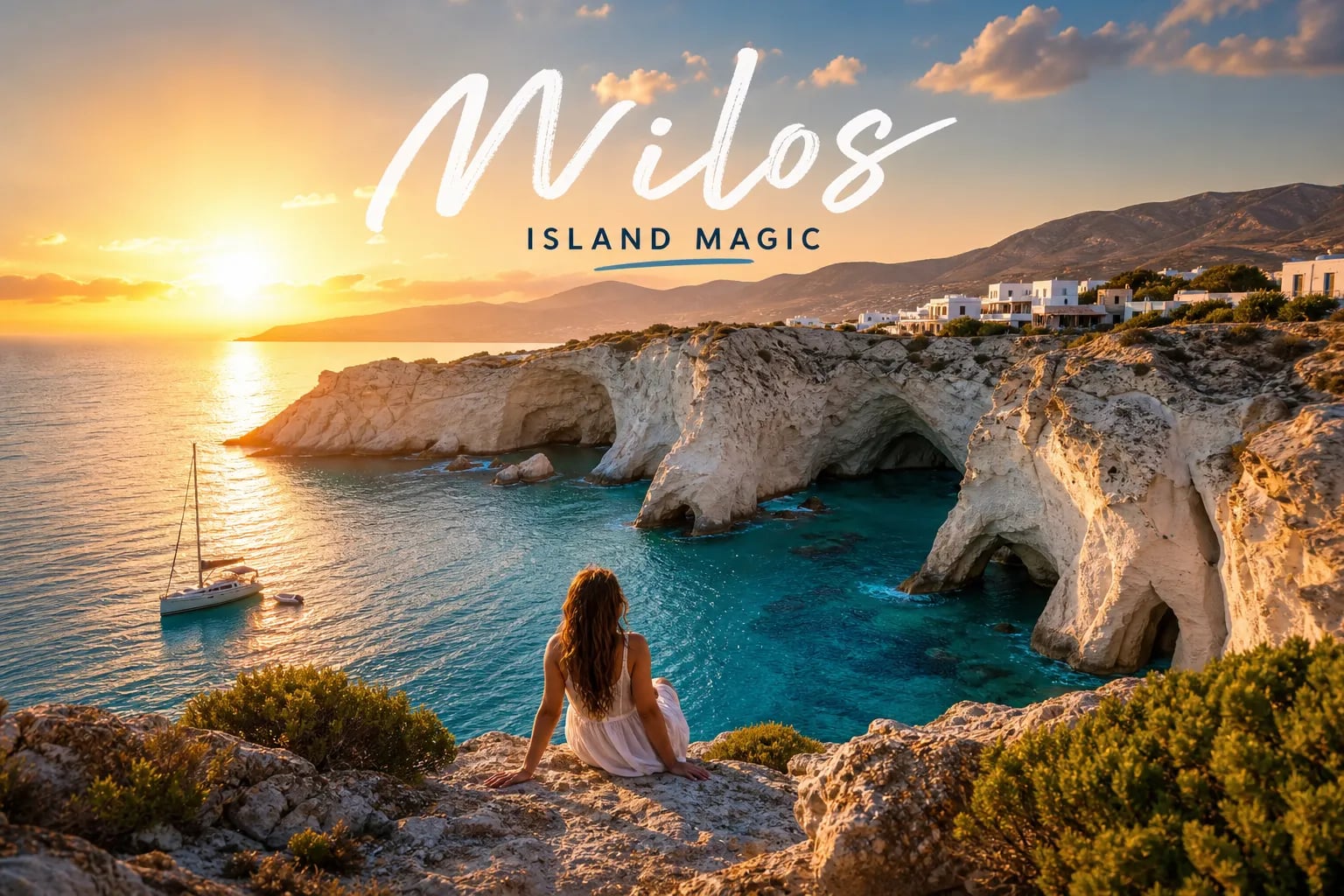
Milos island attractions extend far beyond the bleached pumice rock that dominates every travel feed. Scroll through any social algorithm and you’ll see the same image repeated: a lone figure in white linen, the Aegean impossibly blue behind them. It’s a beautiful picture, and it represents a fraction of what the island actually offers. Milos is a place built on volcanic eruption and centuries of layered human drama, where catacombs among the earliest Christian burial sites in the world cut into the hillside and fishing villages cling to the shoreline in a way that has nothing to do with aesthetics and everything to do with survival. The island doesn’t just reward the curious traveler. It practically demands one.
Here at The Curious Atlas, we build guides around the same principle whether we’re covering the cenotes of the Yucatan or a Greek island in the Aegean: the most memorable places are the ones you reach by boat, by rope ladder, or simply by slowing down long enough to look. This Milos travel guide covers 10 genuine highlights across the island, with access details, realistic timing, and a ready-made 1-to-3-day framework so you can link them into a coherent trip rather than a collection of disconnected stops.
The two iconic Milos island attractions that actually earn their reputation
Some famous places disappoint the moment you arrive. Sarakiniko and Kleftiko are not those places. They are genuinely extraordinary, and they deserve their reputations, provided you approach them with more than a camera and a noon arrival time.
Sarakiniko, a top Milos island attraction on the north coast
Sarakiniko is not a sand beach. It’s a landscape of white volcanic pumice formations carved by wind and sea over millennia, and the geology alone makes it unlike anything else in the Cyclades. The light changes the experience entirely: arrive before 9 AM and the rock glows in warm gold tones with almost no one around; arrive at noon in August and you’re navigating a crowd on bleached stone under full overhead sun.
The parking area fills before 9:30 AM in high season, so an early start is worth it. The bus from Adamas runs multiple times daily, with summer departures typically at 10:10, 11:10, and 12:10 AM and continuing into the evening, confirm the current schedule locally, as times shift seasonally. If you’re staying nearby, the walk takes 40 to 60 minutes. Plan 1 to 2 hours on site, and revisit after 4 PM if your first visit felt rushed.
Kleftiko: why you need a boat, not just a photo
Kleftiko is only accessible by sea, and that fact alone filters out the casual visitor. What’s on the other side of that filter: white sea caves, swimming grottos, snorkeling in water the color of pale glass, and a landscape that looks like a set designer dreamed it up. Half-day tours depart from Adamas, Agia Kyriaki, and Kipos, running 3.5 to 5 hours at roughly €35 to €70 per person. Full-day sailings from Adamas run 7 to 11 hours and typically cost €120 to €180. Book in advance during July and August because spots fill days or weeks ahead.
Milos island attractions underground: the historical layer most visitors skip entirely
Every island in the Cyclades has a pretty village. Few have a site where early Christians buried their dead in hand-carved volcanic rock chambers during the first and second centuries AD, and almost no one visiting Milos makes time for it.
The Catacombs of Milos: one of the earliest Christian burial sites in the world
The Catacombs of Milos, near the village of Tripiti, predate the famous Roman catacombs and are among the oldest Christian burial sites on the planet. Access is by guided tour only, which runs roughly 10 to 15 minutes inside the chambers themselves. Entrance fees in 2026 range from €4 to €10 depending on the source, with reduced rates for seniors and free entry for EU students. Hours run approximately 8:30 AM to 3:30 PM with closures on Tuesdays, though seasonal schedules shift, so confirming locally on arrival is smart. The physical experience of descending into the island’s rock, rather than just gazing at it from above, makes this unlike any other stop on the island.
The Ancient Theatre and the island that once held the Venus de Milo
The Venus de Milo, currently residing in the Louvre, was discovered on Milos in 1820. The site where it stood is a short walk from the catacombs, near the Ancient Theatre of Milos, which overlooks the sea in a setting that puts the island’s classical significance in sharp relief. The theatre is free to enter; published hours are approximately 8:30 AM to 3:40 PM, closed Tuesdays, though it’s worth confirming locally as schedules vary by season. Combine both the catacombs and the theatre into a single two-hour archaeological loop, and you’ll leave with a completely different understanding of what this island has witnessed over the past two thousand years.
Hilltop Plaka and the Venetian castle at sunset
Plaka is the capital of Milos, set on a volcanic ridge above the sea. It gets treated as a pretty village for photos, which is a waste of an afternoon. The more accurate framing: Plaka is an elevated observatory with a medieval Venetian castle at its peak, a local archaeological museum holding fragments from the same site as the Venus de Milo, and tavernas praised by locals and visiting food writers alike for serving food that’s rooted in the island rather than calibrated for tourist expectations.
The Venetian Castle, known as the Castro, offers 360-degree views over the entire island. The light during the last hour before sunset hits the white buildings and the sea below in a way that consistently ranks among the best viewpoints in the Cyclades. Walking the upper village is gentle and requires no strenuous effort. The Folk and History Museum provides cultural context that most beach-focused visitors never bother with. Go up in the late afternoon, watch the sunset from the castle walls, and walk down to dinner in the village below.
Milos beaches and attractions: fishing villages that time apparently forgot
There is a specific kind of beauty in a place that was never designed to be beautiful. Klima, Firopotamos, and Mandrakia were built for function, to store fishing boats and shelter the families who worked them. They happen to look extraordinary as a result.
Klima: the syrmata village that redefines a beach town
The syrmata in Klima are two-level boathouses built directly at the water’s edge. The lower floor served as a boat garage, often partly carved into the volcanic rock, with a ramp or slipway for hauling boats in by wire. The upper floor was the family’s living quarters. The brightly painted doors and shutters create the village’s signature rainbow look, but this is adaptive coastal architecture built around fishing needs, not aesthetics. Klima is not a beach in the conventional sense; it’s a working settlement on a narrow strip of shoreline. Drive down from Plaka, park above the village, and walk the length of it at an easy pace. Stay curious, not intrusive.
Firopotamos and Mandrakia: two villages, one rhythm
Firopotamos carries the same syrmata architecture as Klima with fewer visitors and a slightly more open bay. Mandrakia sits on the north coast in a tight cove and is arguably the most photogenic of the three. Both are reachable by car in under 30 minutes from Adamas. Pair them with an early-morning visit to Sarakiniko for an efficient north-coast morning that covers geology, history, and human life in a single sweep. These three villages alone make a compelling argument for why things to do in Milos go well beyond its beaches.
Volcanic shores and hot springs worth the detour
Milos sits within one of the Aegean’s most active hydrothermal zones, a fact confirmed by geological surveys of the region’s volcanic arc. The island’s volcanic identity isn’t just scenic backstory. It’s physically present in the landscape, and nowhere more so than in the beaches that define the southern coast.
Paleochori and the thermal waters beneath the sand
Paleochori is a long, organized beach about 10 minutes by car from Adamas, which makes it easy to overlook as a purely practical option. The detail that changes that assessment: hydrothermal vents beneath the seabed push water temperatures near the spring vents to approximately 40 to 50°C in localized patches, with sand surface temperatures at the eastern end climbing considerably higher. You can feel the heat rising through the ground, a genuinely strange physical sensation that has nothing to do with air temperature. The beach also has tavernas on the shore and shallow, calm water, making it a reasonable choice for families outside the hot-spring zone.
Firiplaka: the south coast’s most comfortable full-day beach
Firiplaka is soft golden sand, shallow water, and car access with parking nearby. Step onto it on a clear afternoon and the appeal is immediate: the water is calm enough for long, unhurried swimming, the light off the cliffs is warm and low, and the whole place moves at a pace that suits a trip with multiple active days. It lacks the drama of Sarakiniko but offers something equally valuable, an easy, restorative few hours in the water before the next adventure.
Tsigrado: the beach you reach by ladder
Tsigrado’s access involves a wooden ladder and a rope through a narrow rock crevice. This is not a suitable stop for families with young children, but it is entirely manageable for most adults willing to commit to the descent. The payoff is a secluded turquoise cove that, thanks to the effort required to reach it, tends to see far fewer visitors than comparably beautiful beaches on the island, even during the busiest summer weeks. It sits close enough to Firiplaka to make a natural half-day south-coast loop: swim somewhere comfortable, then earn your way into somewhere remarkable.
How to link these attractions into 1, 2, and 3-day plans
These Milos island attractions divide cleanly into three geographic clusters: the north coast, the hilltop archaeological area around Plaka and Tripiti, and the south coast. Planning around those clusters rather than a scattered list of sites eliminates most of the backtracking that wastes travel days on a small island.
1-day plan: north coast plus one boat departure
Arrive at Sarakiniko before 9 AM. Drive to Klima and walk the length of the village. Continue to Firopotamos. From Adamas or Agia Kyriaki, take a half-day Kleftiko boat tour in the afternoon. End the day in Plaka for sunset at the Venetian Castle and dinner in the village below. This is a full day by any measure, but the transitions are logical and the geography keeps the driving minimal.
2-day plan: add the archaeological layer and south coast
- Day 1: North coast cluster (Sarakiniko, Klima, Mandrakia) followed by a half-day Kleftiko boat tour from Adamas or Agia Kyriaki
- Day 2: Morning at the Catacombs and Ancient Theatre near Tripiti, afternoon on the south coast (Firiplaka and Tsigrado), and evening at Paleochori for dinner near the water
3-day plan: go at Milos’s actual pace
- Day 1: North coast (Sarakiniko, Klima, Firopotamos) plus Kleftiko boat tour
- Day 2: Plaka village, Venetian Castle, Catacombs, Ancient Theatre, then Klima in the late afternoon for golden-hour light on the syrmata
- Day 3: Full south coast: Paleochori hot springs in the morning, Firiplaka for open swimming, Tsigrado in the afternoon, and a slow return to Adamas by early evening
The island rewards those who stay curious
The best moments Milos offers are not the ones with the highest follower counts. They’re the ones you reach by descending a rope into a hidden cove, by ducking through a sea cave on a boat tour, or by parking above a fishing village and walking slowly enough to notice how the boats slide in through ground-floor doors painted the color of primary school crayons. That instinct, to look for the layer beneath the surface, is the same one that leads a traveler to swim a Yucatan cenote instead of staying poolside, or to seek out Bacalar’s lagoon before the crowds find it.
For travelers who think that way, Milos island attractions are less a checklist than an invitation.
Leave a Reply