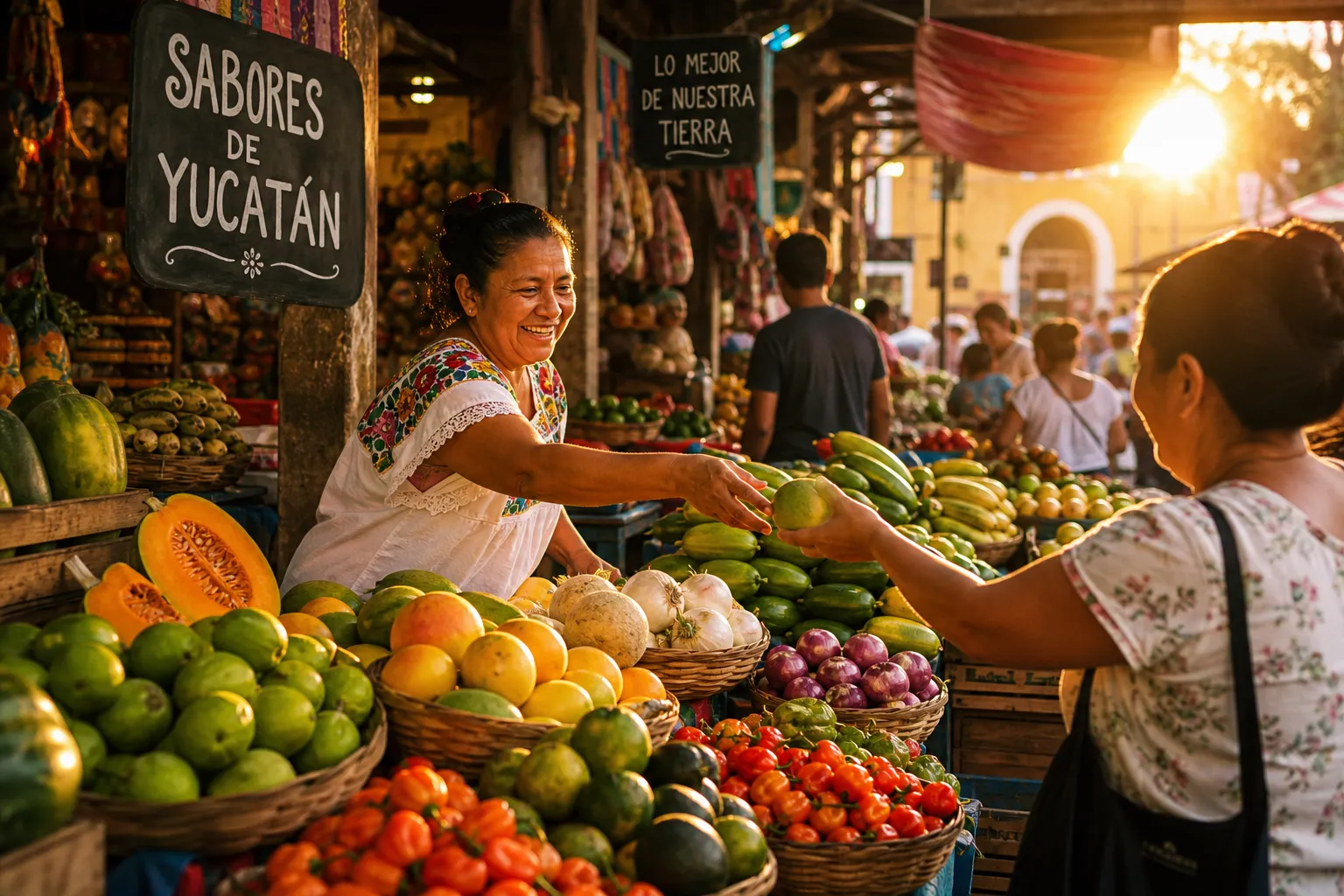
Many visitors to the Yucatán Peninsula spend a week eating at restaurants their hotel concierge recommended. They sit down to plates that taste almost right, never realizing that a short walk away sits an entire parallel food universe: the mercado, the local market, the kitchen where the peninsula actually feeds itself. The real Yucatán is not printed on a laminated menu. It lives inside buildings that have smelled of achiote and sour orange for generations. The local food markets in Yucatan are where that story begins, and where most itineraries never go.
Food markets in Yucatán are not primarily places to shop. They are social infrastructure, the settings where a city’s rhythms are set and its culinary identity is renewed every morning. When a grandmother buys her recados at the same stall her mother used, or a family shares panuchos before work at a lonchería with no sign on the door, they are participating in something that resort itineraries rarely reach.
What follows is your market-by-market roadmap across the peninsula. Ten mercados, from Mérida’s grand central market to a sleepy neighborhood stall in Chuburná to a Saturday morning ritual on the edge of Paseo Montejo, with everything you need to eat well, navigate confidently, and spend your pesos wisely.
Why Mérida’s Local Food Markets Are the Real Capital of Yucatecan Food
A city reveals its character most honestly inside its markets. Mérida, the undisputed culinary capital of the Yucatán, takes this principle to an extreme. The food culture here is centuries deep, rooted in Maya tradition, layered with Spanish colonial influence, and further shaped by Lebanese immigration that left its mark on the local palate in ways most travelers never expect. The mercado tradition is alive, competitive, and entirely serious about food.
Mérida is home to many markets, neighborhood stalls, sprawling downtown halls, and curated weekend gatherings, and knowing which one to visit, and when, is the difference between a forgettable breakfast and a meal you talk about for years. The Yucatan local food markets that draw the most devoted regulars aren’t always the ones that appear in mainstream travel guides.
Mercado Lucas de Gálvez, A Local Food Market in Yucatan Worth Arriving Early For
Lucas de Gálvez is Mérida’s most iconic public market, located at Calles 65 and 69 between 56A in the heart of downtown. Hours can vary by section, most vendors open around 7 a.m., with some food stalls running well into the evening, so it’s worth checking current hours before you visit. Inside, long aisles of fruit and vegetable stalls give way to recado vendors with color-coded pastes stacked in pyramids, fresh seafood, sacks of dried chiles, and achiote in every form imaginable. The prepared food stands along Calle 56-A, widely noted as the market’s main dining corridor, are where the serious eating happens.
This is not a tourist market. Locals shop here daily, and the loncherías serve cochinita pibil, poc chuc, pavo en relleno negro, longaniza, and marquesitas to families who have been coming for generations. Arrive hungry, with no fixed plan, and a willingness to follow whatever smells best.
Mercado San Benito and Mercado Santos Degollado: Where Locals Go for Breakfast
These two markets complement Lucas de Gálvez and reward early risers. San Benito, on Calle 54 between 67 and 69, is the place to find tamal colado, the distinctly Yucatecan tamale served on a banana leaf with traditional red sauce, from El Quimbombito y la Turquita. Santos Degollado is where you go for mondongo kabic at Lonchería Mary: beef tripe cooked with habanero, served with lime and fresh tortillas, a dish that polarizes visitors and converts many of them. Get to either market by 8 a.m. and the food is fresh, the vendors are awake, and the pace is unhurried.
The Neighborhood Mercados Most Visitors Never Find
Beyond the famous markets near Mérida’s centro, the city’s quieter neighborhood mercados offer the most unfiltered version of daily Yucatecan life. No English menus, lower prices, and food made for the people who live three blocks away. These are lesser-known spots but they consistently produce the most memorable meals of any Mérida trip.
Mercado Santa Ana: The Place to Hunt for Real Panuchos
Santa Ana sits on Calle 47 between 58 and 60, just one block from Paseo Montejo, making it one of the most practically located neighborhood markets in the city. The standout stall inside is Cocina Mary, where panuchos arrive loaded with cochinita, lechón, or queso relleno alongside turkey broth and tostadas. This market opens early and rewards breakfast-time visits. If you’re staying anywhere near the Paseo Montejo hotel corridor, Santa Ana is your first-morning destination.
Mercado Santiago, Chen Bech, and the Everyday Mercado Experience
Mercado Santiago in the Santiago neighborhood, Mercado Chen Bech at Calles 57 and 42, Mercado Miguel Alemán, and Mercado San Sebastián form the city’s everyday market infrastructure. They are produce-heavy and built for the people who live nearby: tortilla sellers working by hand, fresh herb vendors, small loncherías where ordering requires no menu, just a nod toward the plate in front of the person next to you. Visiting even one of these on a non-tourist street recalibrates your whole understanding of how Yucatecan families eat.
Mercado Chuburná: Tacos and Polcanes Off the Usual Circuit
Mercado Chuburná sits just outside central Mérida, close enough for a short taxi or rideshare ride, and it’s less commonly mentioned in mainstream guides, which is precisely its appeal. Taquería Coralito inside serves polcanes (torpedo-shaped masa pockets stuffed with black bean filling), panuchos, salbutes, and tortas at prices that feel like a mild misprint. It rewards the traveler willing to push slightly past the obvious, and it’s one of the Yucatan local food markets that regulars guard a little possessively.
Saturday Morning at Mercado Fresco: Mérida’s Slow Food Movement
Mérida’s food culture is not frozen in the past. Mercado Fresco, also known as the Slow Food Earth Market, runs every Saturday from 9 a.m. to 1 p.m. at Calle 33-D x Avenida Reforma, x Colón y Cupules. It is a different energy from a traditional daily mercado, more curated and community-oriented, but it belongs on the same itinerary as evidence that the city’s culinary identity is still actively evolving.
What You’ll Find at the Slow Food Earth Market
Around 53 vendors set up weekly, selling organic vegetables, cerdo pelón pork and sausages, dried beef, goat’s cheese, eggs, honey, preserves, artisan bread, and fresh juices. The market also draws immigrant-community vendors offering Korean, German, Italian, and Arab-inspired prepared foods alongside Peruvian street food, homemade baked goods, and organically raised chicken. It reads like a contradiction until you’re standing in the middle of it, eating something you didn’t expect, next to a local family loading up on heirloom tomatoes for the week.
Why Saturday at Mercado Fresco Deserves Its Own Morning
Arrive by 9:30 a.m. The best produce and prepared foods move quickly, and the most interesting vendors run low by mid-morning. After the market, a walk up Paseo Montejo is the natural extension of the morning. Pair the two and you get a complete picture of Mérida’s food culture right now: rooted in tradition, open to the world, and entirely confident in itself.
Beyond Mérida: What Valladolid’s Mercado Offers
Many travelers treat Valladolid as a stop on the way to Chichén Itzá, passing through without staying long enough to eat properly. That is a significant mistake. Valladolid’s food culture is less influenced by European immigration than Mérida’s and more deeply rooted in Maya culinary tradition, and its municipal market reflects that difference immediately. As one of the most authentic local food markets in Yucatan, it deserves more than a rushed glance.
The Mercado Municipal de Valladolid and What to Order
The Mercado Municipal Donato Bates Herrera sits at Calle 37 x 32 y 30 in Valladolid and runs Monday through Saturday from 7 a.m. to 4 p.m., with Sunday hours until 3 p.m. The morning concentration of street food here is immediate: salbutes, lonchería breakfasts, fresh tortillas made in front of you, and a regional variation of cochinita pibil that tastes noticeably different from Mérida’s version. The recado base is darker, the pork has a smokier edge, and the portions are generous, sized for a working morning. This is a Yucatán farmers market experience in its most unvarnished form. If you plan to extend your itinerary beyond market halls, consider nearby natural stops, see 5 Reasons to Add Suytun Cenote to Your Yucatan Itinerary for one popular option north of Valladolid.
Why Valladolid’s Mercado Culture Feels More Unfiltered
Where Mérida’s markets are accessible and tourist-adjacent, Valladolid’s municipal market is priced for residents and used by them. Your presence as a foreign visitor will register as mild curiosity rather than a commercial opportunity. No one is performing authenticity for you because authenticity is simply the default. That distinction matters more than any specific dish on the menu.
What to Eat and What to Expect to Pay
This is the cheat sheet that prevents the paralysis of staring at a handwritten menu on a plastic board and guessing. Before you walk into any of the local food markets of Yucatán for the first time, here’s what to order and what it should cost.
The Dishes Worth Tracking Down Across Every Yucatán Market
Start with cochinita pibil, the slow-roasted pork that functions as the benchmark for everything else. Then work through panuchos (fried tortillas stuffed with black bean paste and topped with protein and pickled onion), salbutes (puffed fried tortillas with similar toppings), and tamal colado served on banana leaf in the early morning hours. Poc chuc, grilled pork marinated in sour orange, is the simpler but deeply satisfying counterpoint to the heavier dishes. Marquesitas, crispy rolled wafers filled with Edam cheese or Nutella, are the market snack you’ll eat three of before you realize what happened.
The flavor foundations connecting all of these dishes are recados and achiote: understanding that these two ingredients carry most of the weight in Yucatecan cooking makes everything else on a menu easier to read. Also worth noting: kibis, deep-fried bulgur rolls with Lebanese origins, appear at market stalls across the peninsula with a frequency that surprises most first-time visitors. The Yucatán’s culinary story has more chapters than most people realize.
A Realistic Price Guide for Market Eating in Mérida
Individual panuchos, salbutes, and tacos run roughly 16 to 29 MXN each. A simple snack plate falls under 50 MXN. Full plated market meals land between 85 and 150 MXN. Pan dulce and pan francés come in at 12 to 15 MXN. For US travelers, a complete market breakfast in Mérida typically costs a fraction of what you’d pay for a casual sit-down meal back home, context that’s useful when you’re deciding whether to try the mondongo.
Haggling is not customary at prepared-food stalls. Vendors set their prices and build their day around them. The margins are already thin and the prices are genuinely low, treat them accordingly.
How to Navigate Any Local Food Market in Yucatan Without Looking Lost
Practical navigation is the difference between a market visit that feels like an adventure and one that feels overwhelming. The logistics are straightforward once you know them.
Getting There: Transport and Timing for Each Market
For Lucas de Gálvez, take a rideshare or taxi given the congestion in Mérida’s centro. Uber and DiDi both operate reliably in Mérida, with centro rides typically running 60 to 80 MXN. Walking works if you’re staying downtown. Santa Ana is walkable from Paseo Montejo hotels. Mercado Fresco on Saturday mornings is easiest by rideshare to Calle 33-D. In Valladolid, the municipal market is a short walk from the main plaza.
Timing matters as much as transport. Daily mercados are most alive between 7 a.m. and noon. Arrive in this window for the best prepared food and freshest produce. Afternoon visits work for buying ingredients, but most food stalls have sold out or closed by early afternoon.
Safety, Etiquette, and What to Bring
Keep bags close in crowded markets like Lucas de Gálvez. A crossbody bag worn in front works better than a backpack. Bring small bills: coins and 20 to 50 MXN notes are ideal, since most food vendors can’t break a 500 MXN note without genuine difficulty. Don’t expect English menus or English-speaking vendors. Gesture toward what looks good, brush up on your numbers in Spanish, and default to a smile when communication stalls.
Mérida’s markets are generally considered safe for solo female travelers who apply standard urban awareness, keep valuables secure, stay alert in crowds, and trust your instincts.
The Markets Are the Trip
The local food markets of Yucatán are not an add-on to the trip. They are the most honest version of it. Whether you’re sitting over a plate of panuchos at Cocina Mary in Santa Ana or carrying a bag of cerdo pelón sausage out of Mercado Fresco on a Saturday morning, you’re eating the same food this peninsula has been built on for generations. The buildings change and the vendors cycle through, but the flavors are continuous.
Approach these markets with curiosity and without a rigid plan. The best meals happen when you follow your nose rather than a list, sit down at a table with a plastic tablecloth and no written menu, and trust what arrives. If you want the real flavor of the peninsula, seek out the local food markets Yucatan families rely on, not the restaurants designed around your hesitation.
Leave a Reply