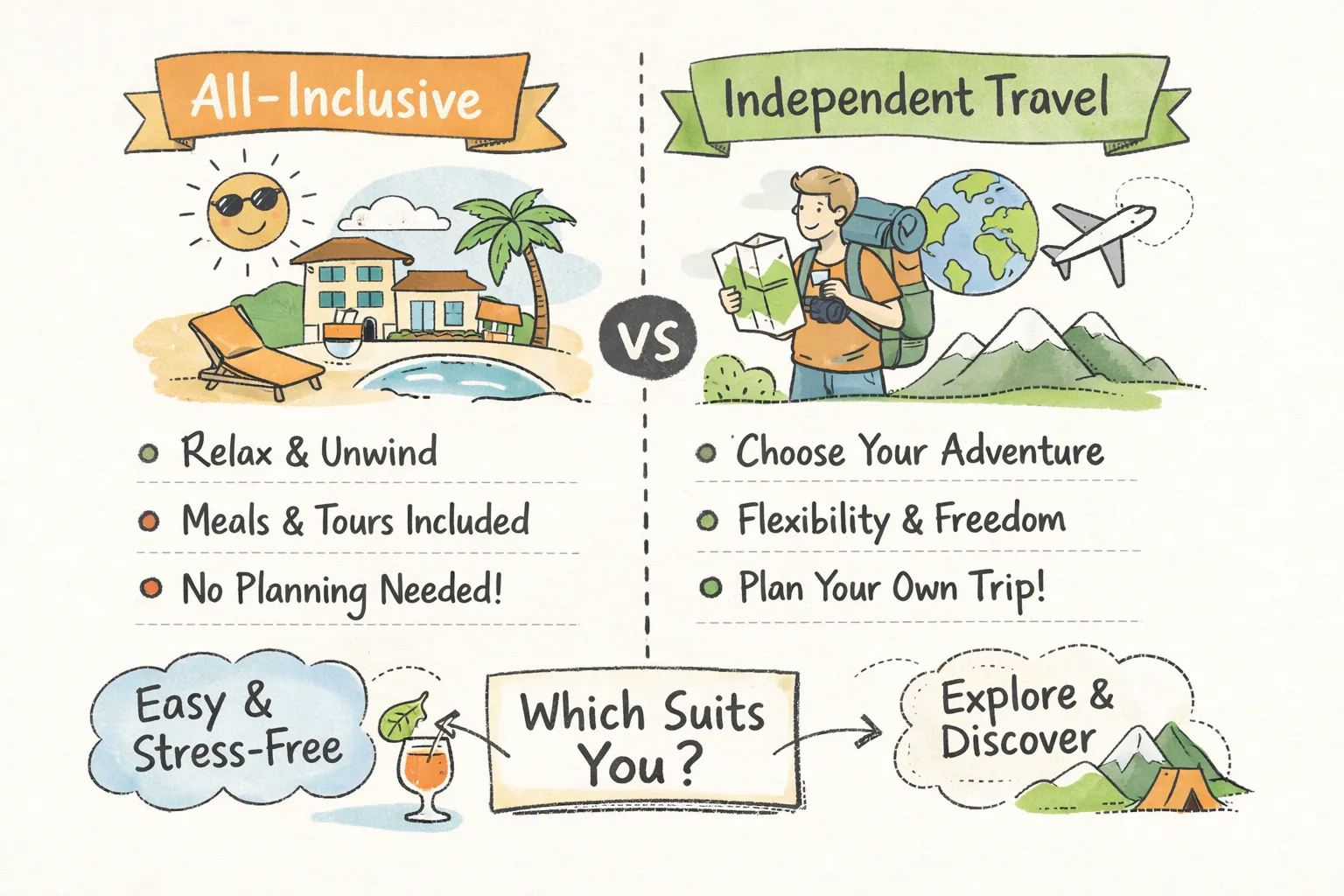
The phrase “all-inclusive” carries a seductive promise. It suggests total freedom: no decisions, no surprises, no mental math at dinner. But spend a week inside one of these resorts and you begin to notice the paradox. You’ve paid for a beautifully managed bubble, and the bubble, by design, keeps the actual destination at arm’s length.
Understanding how an all-inclusive vacation package differs from other vacation types is not simply a question of what’s listed in the fine print. It’s a question of what you’re really buying. The price tag tells one story. What you trade in spontaneity, food quality, and genuine cultural contact tells another. This article breaks down both stories honestly: what’s actually included in a bundled resort package, where the hidden costs live, how the real numbers compare when you book everything yourself, and which format genuinely suits which kind of traveler.
By the end, you’ll have a clear-eyed framework for making the decision, not based on marketing language, but on what travel actually means to you.
What an all-inclusive vacation actually bundles together
At its core, a standard all-inclusive package wraps several categories of cost into a single upfront price. That bundle typically covers:
- Accommodation
- Unlimited meals across multiple on-site restaurants (breakfast, lunch, dinner, and snacks throughout the day)
- Beverages, including cocktails and other drinks
- On-site activities like water sports and fitness classes
- Entertainment programs
Many packages also fold in round-trip airport transfers, and some, though fewer, include flights. Kids’ clubs are a standard feature at family-oriented properties. On paper, the bundle is genuinely comprehensive.
The word “unlimited” in these packages is real, but it operates within borders: the borders of what the resort controls. Step outside the property, book a local tour, or sit down at a restaurant in town, and you’re back to paying individually for everything. The resort’s economy depends on you staying inside it.
The specific inclusions vary enormously by resort tier and destination. A mid-range property in Cancún and a luxury resort in the Maldives both carry the “all-inclusive” label, but the gap between what each actually covers is substantial. Gratuities and taxes are often technically included, but the social reality at most resorts creates genuine pressure to tip bartenders, room service staff, and spa workers anyway. That ambiguity costs real money over a week.
How all-inclusive compares to other vacation formats
All-inclusive vs à-la-carte resorts
À-la-carte resorts charge separately for everything beyond the room rate. Meals, drinks, spa access, and activities are individually priced. This gives travelers complete control over their spending, but it also demands active management. Every decision carries a cost you’re actively tracking. For travelers who find that exhausting, the locked-in simplicity of all-inclusive has obvious appeal. For those who travel to choose freely, it’s just normal life.
All-inclusive vs package holidays
Package holidays land in a middle position. Flights and accommodation are typically bundled, sometimes with breakfast or half-board included, but drinks, dinners, and most activities remain out of pocket. The convenience of not sourcing flights and hotels separately is real, but the day-to-day experience closely resembles independent travel. You’re still making and paying for most decisions yourself.
All-inclusive vs cruises
Cruises are the closest structural cousin to all-inclusive resorts. The cabin, main dining room meals, most onboard entertainment, and deck access are included. But the analogy only holds while you’re onboard. Shore excursions, specialty restaurants, premium bars, Wi-Fi, and gratuities are almost always extra. The cruise model rewards those who stay onboard; all-inclusive rewards those who stay on-property. Both formats are built around the same economic logic: the more you venture outside the package, the more you spend.
The hidden costs that chip away at the “all-in” promise
Spa treatments are excluded at virtually every major all-inclusive property, including luxury chains. Motorized water sports like jet skis and parasailing carry additional fees at most Caribbean and Mexican resorts, even when non-motorized equipment like kayaks and paddleboards is included. Premium fitness classes, private beach cabanas, top-shelf liquor, and golf greens fees are routinely left off the base package. For a practical list of common extras to watch for, consult our All Inclusive Vacation Packages: The Complete Guide.
Within the resort itself, specialty restaurants often require reservations and a per-person surcharge. The “unlimited dining” narrative gets complicated fast when the best restaurant on-property costs extra. Gratuities occupy a particularly murky space. Many resorts advertise a no-tipping policy, but in practice, guests feel clear social pressure to tip bartenders, spa staff, butlers, room service attendants, and tour guides. Over a seven-day stay, that social arithmetic adds up significantly. Off-resort excursions are almost never included, and if a late flight keeps you past the standard 11am checkout, accessing the pool or restaurant for a day pass typically starts at around $100 per person.
The real cost of a week away: all-inclusive vs booking it yourself
For some destinations, the math comes out roughly even. A direct cost comparison for a destination like Destin, Florida, shows near-parity when you account for flights, accommodation, meals, drinks, activities, and transfers separately. The all-inclusive advantage grows when travelers eat and drink heavily on-property throughout the day, every day. For those guests, the bundle is genuinely good value.
The calculus shifts against all-inclusive for a destination like Cancún when travelers prefer light lunches, street tacos from local markets, and a couple of carefully chosen dinners. Travelers who book independently and lean into local food culture can often spend $800 to $1,000 less over seven days for two people. The savings come from the gap between what the all-inclusive package assumes you’ll consume and what exploratory, locally-oriented travelers actually do.
A simplified comparison helps illustrate the difference:
| Cost Category | All-Inclusive (7 nights, 2 people) | Independent (7 nights, 2 people) |
|---|---|---|
| Accommodation + meals + drinks | Bundled ($3,000, $6,000+) | Booked separately ($1,800, $4,000) |
| Local restaurants and street food | Not included (extra) | $300, $600 |
| Off-resort excursions | Extra ($150, $400+) | $150, $400 |
| Gratuities (real-world) | $100, $300 despite “included” policy | $80, $200 |
| Spa, premium dining, cabanas | Extra ($200, $600+) | As chosen |
The honest summary: all-inclusive delivers strong value for a high-consumption traveler who plans to stay on-property most of the day, eat and drink freely throughout, and use the included activities. For anyone who will naturally spend less on food, drink, and resort amenities, or who plans to supplement resort days with off-site exploration, the bundle’s value erodes quickly.
Which vacation style fits which type of traveler
Families with young children are the clearest beneficiary of the all-inclusive model. The bundle eliminates the logistical complexity of feeding kids across an unfamiliar destination, and structured kids’ clubs, pools, and entertainment programs address the relentless energy management that family travel requires. The resort bubble is not a limitation for these travelers. It is the feature.
Couples planning honeymoons or anniversary trips benefit similarly, particularly at adult-only properties. The seamless, predictable experience matches the emotional expectation of the trip. When the goal is to be present with each other rather than navigating logistics, having everything handled becomes a genuine luxury.
Solo travelers typically find the format too restrictive. The ability to set their own pace, stay longer in places that feel right, meet locals, and move on when a place doesn’t resonate is the core of solo travel. An all-inclusive property works against all of that. Foodies find the format limiting almost immediately. Resort buffets and preset menus, regardless of how well executed, rarely replicate the depth and specificity of a regional food scene. And travelers who measure a trip’s success by cultural immersion, unexpected discoveries, and genuine local connection will consistently feel like they’re observing a destination through glass rather than actually stepping into it.
When the resort walls feel too close: the case for independent travel
Independent travel, whether through boutique hotels, locally owned guesthouses, or longer-term rentals, puts the destination at the center of the experience rather than the property. The hotel becomes a base, not the attraction itself. This shift in orientation changes everything about how a trip unfolds. You eat where locals eat. You learn the rhythm of a neighborhood. You find the kind of depth and texture that a week at a resort, however luxurious, rarely provides.
Slow travel takes this philosophy further. Staying in one place long enough to feel its pace, visiting the same market twice, recognizing faces at the corner café, and following curiosity rather than an itinerary produces a fundamentally different travel memory. The cost model is more variable, but for travelers willing to research well, independent slow travel often delivers a richer experience at a comparable or lower total price than an all-inclusive stay.
Boutique hotels, in particular, offer a quality-over-quantity experience that the resort model structurally struggles to match. These properties offer fewer rooms, more personal service, design that reflects the local context, and proximity to the actual city or landscape you came to see. They don’t compete with all-inclusive resorts on convenience. They compete on meaning.
Choosing the format that matches how you actually travel
The best vacation format is the one that aligns with what you genuinely value from travel, not the one with the longest list of inclusions. All-inclusive works beautifully for travelers who want stress-free predictability, family logistics handled in advance, and the freedom of not thinking about money once they arrive. That’s a real and legitimate priority. For those travelers, the resort bubble delivers exactly what it promises.
Independent travel, boutique stays, and slow itineraries work better for those who measure a trip’s success by what they learned, ate, discovered, or felt in the unscripted moments. Understanding the structural difference between an all-inclusive vacation package and other vacation formats is ultimately an act of self-knowledge. What do you actually do all day on vacation? How much do you eat and drink? Do you stay put or wander? Do you find comfort in having decisions made for you, or does that feel like a constraint?
Go in with clear eyes about what’s actually included, where the costs are hiding, and what you’ll genuinely use. Stop comparing price tags and start comparing the experiences each format actually produces. The choice becomes much clearer once you stop asking which option looks better on a booking page and start asking which one sounds more like you.
Leave a Reply