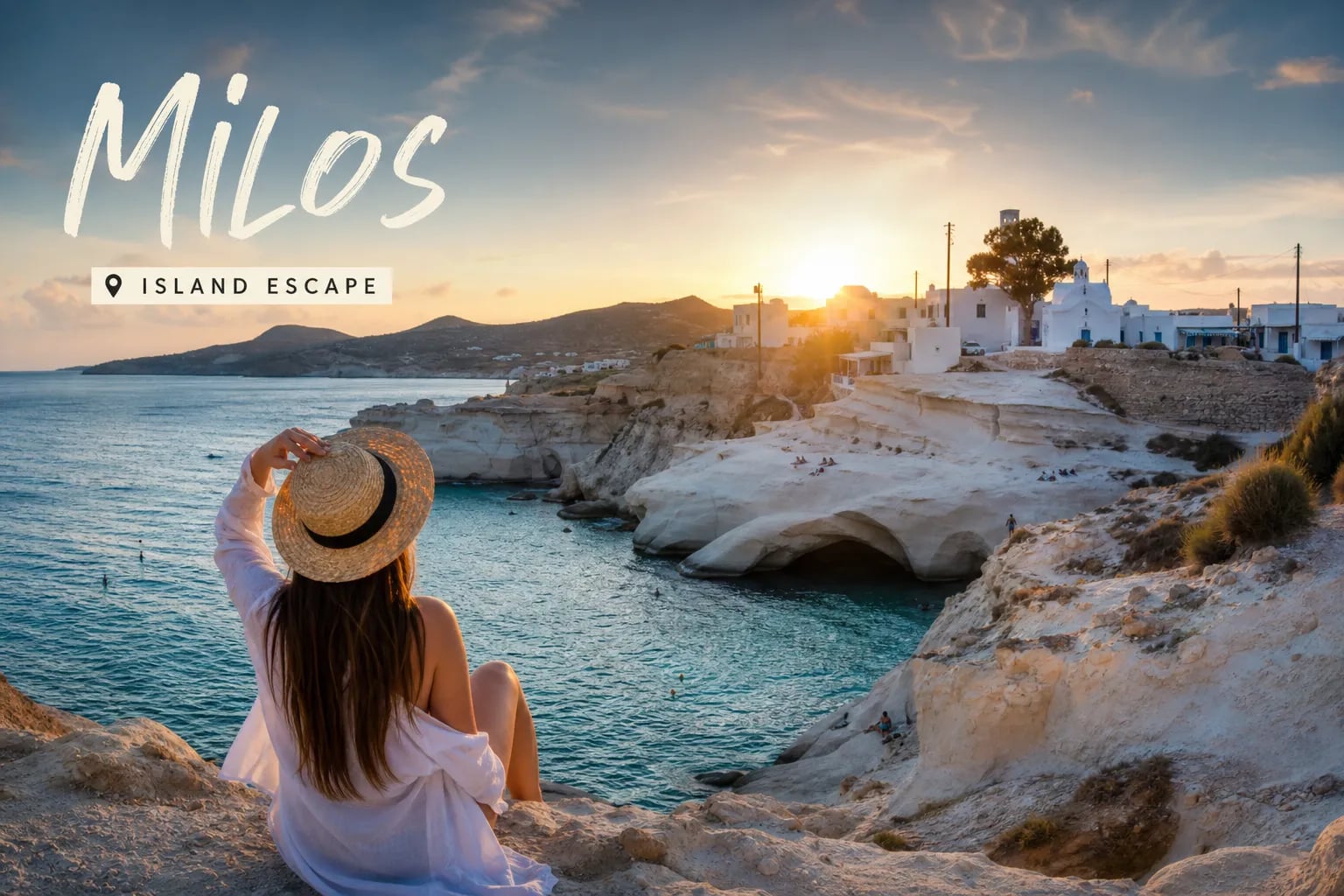
Milos Island sits in the southwestern Aegean like a secret that’s only partially leaked, and it rewards the traveler who arrives before the rest of the world catches on. The most satisfying destinations are the ones that still feel like yours to discover: beaches without velvet ropes, taverna owners who know your order by day two. If you’ve read our deep-dive on Bacalar, that quiet lake town in southern Mexico that slow travelers swear by, Milos will feel immediately familiar. Different latitude, same soul.
Milos has the dramatic geological formations of Santorini without the cruise ship crowds, and clear Cycladic water without the Instagram saturation. Its local food culture still operates on its own unhurried rhythm. This guide is written for independent and solo travelers who want to navigate the island without a tour group script. By the end, you’ll know exactly how to get there, how to get around, which beaches deserve your time, how to book a Kleftiko boat tour, and how to build a 3 to 5 day itinerary that actually feels like travel rather than a checklist.
Milos Island: How to Get There from Athens (and Why the Ferry Beats Flying)
The Piraeus ferry: your most practical option
Ferries from Piraeus run year-round, with up to 4 to 7 daily crossings during summer months. Travel time ranges from 2 hours and 35 minutes on high-speed vessels to around 5 to 6 hours on conventional ferries. Fares start at roughly €33 to €48 for a standard crossing, with high-speed options closer to €78. Book ahead in July and August, since boats fill fast, and arrive at Piraeus early, the port is enormous and finding your gate takes time.
Lavrio also serves Milos once or twice weekly at cheaper rates (around €20), but the crossing runs 15 to 16 hours. For most visitors, Lavrio makes sense only as a budget overnight option or a very specific scheduling situation. For first-time visitors, Piraeus is the right call every time.
Flying in vs. sailing in: what the journey actually costs you
Milos has a small domestic airport with 45-minute flights from Athens. Technically, flying is faster. But the ferry experience is part of how the island first introduces itself: watching the volcanic coastline emerge from flat blue water as you approach Adamas port sets the tone for everything that follows. For most solo travelers, the ferry is the right choice. Flights make sense only for very short trips or shoulder-season visitors on tight schedules.
Getting Around Milos Island: Why You Need More Than the Bus
Renting a car or ATV: costs and what to expect on the roads
Public buses connect Adamas to several popular beaches, but they miss most of the island’s best spots. A rental car or ATV is close to essential for independent exploration. Car rentals run roughly €35 to €55 per day in peak season for an economy vehicle, ATVs start around €25 to €60 depending on timing and availability, and scooters come in at around €15 per day. Roads are narrow, winding, and coastal in character, which makes smaller vehicles the practical choice.
For documentation, you’ll need a valid driver’s license, your passport, and sometimes an International Driving Permit depending on your home country. Basic CDW insurance is often included in rental rates, but confirm this before you sign. For a 3-day trip, renting something is non-negotiable. The island’s geography simply doesn’t reward a passive approach.
When the bus is actually enough
If you’re staying 5 days or more and are happy to plan around bus schedules, you can manage without a vehicle for a couple of days. Travelers based in Adamas can reach Sarakiniko and Firiplaka by bus without much hassle. The trade-off is real, though: the bus saves money but costs flexibility. Some of the island’s most rewarding spots require a spontaneous turn down a coastal road that no bus follows.
Beaches on Milos Island and How to Actually Reach Them
Sarakiniko, Tsigrado, and the volcanic coast you can drive to
Sarakiniko is the image most people picture when they think of Milos: white volcanic rock formations that look more lunar than Mediterranean, sweeping down to turquoise water. It’s accessible by car, ATV, or bus from Adamas, with a free parking lot nearby. Go in the early evening when day-trip crowds have thinned and the light turns everything gold. Firiplaka and Paleochori on the south coast are sandy, road-accessible, and better for long swimming afternoons. Papafragas is a sea cave worth the short walk from roadside parking, the whole detour takes about 20 minutes.
Tsigrado is equally dramatic but requires descending a steep ladder through a narrow cliff gap to reach the cove below. It’s manageable if you’re fit, sure-footed, and comfortable with heights, but solo travelers without climbing experience should approach it carefully: the ladder has been reported to have missing rungs and slippery surfaces, with no safety support below. Wear sturdy shoes rather than sandals, and only attempt it if you’re equally confident about the climb back up.
Boat-only beaches worth planning your whole trip around
Kleftiko and Gerakas are only reachable by boat, and they’re the reason many visitors book a trip to Milos in the first place. Kleftiko is a series of sea caves carved into white volcanic rock, best explored by swimming through the cave openings from a small boat anchored just outside. Gerakas is a secluded beach with no road access at all. These are the beaches that reward travelers who plan ahead, which means booking your boat tour before you sort out your accommodation. Popular tours can fill weeks out during peak summer, and waiting until you arrive is a gamble that often doesn’t pay off.
Booking a Kleftiko Boat Tour: Operators, Prices, and What to Choose
Half-day vs. full-day: matching the tour to your pace
Zefiros Milos runs 4-hour half-day tours to Kleftiko twice daily (morning and afternoon departures) at roughly €50 per adult. It’s a solid value for solo travelers who want to keep the rest of the day free. Horizon Yachts offers a 7-hour sailing tour at around €100 per person, which includes more stops and significantly more time in the water. For slow travelers, the longer tour is worth the extra cost. Platforms like GetYourGuide also list semi-private and private options starting at €300 or more for groups.
Boat tour season runs May through October, with peak operations from June to September. Most tours depart from Adamas, which is the easier all-around starting point, though some operators also depart from Pollonia on the north coast. Confirm your departure port when booking.
Practical tips for booking and what to bring
Book at least 3 to 5 days ahead in July and August. Popular half-day tours fill quickly, and weather cancellations can cascade into a shortage of available spots for days afterward. Morning departures are generally calmer on the water; afternoon departures offer better photography light. Pack reef-safe sunscreen and water shoes for cave entry, and bring more water than you think you’ll need. The sea has a way of making time disappear.
Where to Eat and Sleep: The Slow Traveler’s Milos Base
Local tavernas and what to order
Milos has a genuine local food culture built around fresh seafood, pit-baked cheese pastries called pitarakia, and grilled octopus. Skip the waterfront tourist restaurants in favor of the smaller family-run tavernas in the villages of Plaka and Tripiti. O Hamos in Adamas is widely described as one of the island’s most authentic spots, with homemade recipes that haven’t been adjusted for tourist palates. Medusa in Mandrakia and Enalion in Pollonia are the places to go for fresh fish by the water.
Lunch is the main meal on the island. Eating like a local means ordering the daily catch rather than pointing at a laminated photo menu. The best meals in Milos come from sitting down without a plan and letting the kitchen decide.
Where to base yourself: accommodation options in Adamas and beyond
Adamas is the main port town and the practical base for most independent travelers. It’s central, connected to the ferry dock, and close to bus routes. Guesthouses and studios run roughly €70 to €150 per night in mid-season, while boutique properties and village stays in Plaka or Triovasalos run higher. For solo travelers staying 4 or more days, a studio with a kitchen is the smartest choice, it cuts daily food costs significantly and gives you the freedom to eat on your own schedule.
A 3 to 5 Day Milos Itinerary for the Independent Traveler
Days 1 to 3: the essential Milos loop
Day 1: Arrive by ferry into Adamas, pick up your rental car or ATV, and orient yourself. Head to Sarakiniko in the late afternoon when the tour buses have gone. Dinner in Adamas. Day 2: Full-day boat tour to Kleftiko and Gerakas. Schedule this for your second day so you still have time to rebook if weather cancels the morning departure. Day 3: Drive the south coast, Firiplaka in the morning, Tsigrado for those comfortable with the ladder descent, and Paleochori for a long lunch by the water.
Days 4 and 5: slowing down and going deeper
Day 4: Hike up to Plaka, the hilltop capital, in the morning before the heat peaks. Walk through the Cycladic alleyways and visit the Archaeological Museum. Spend the afternoon at Firopotamos cove, which rewards visitors willing to navigate the narrow coastal roads to get there. Day 5: Revisit your favorite beach without an agenda. Spend the afternoon in Pollonia on the north coast, a quiet fishing village that most visitors bypass entirely. Take the evening ferry back to Piraeus, or stay one more night and leave the next morning at your own pace.
Milos is a place that gives more the longer you stay. Its rhythms are slow by design, and the travelers who get the most out of it are the ones who stop trying to optimize their time there.
Plan Your Milos Island Trip Before the Secret Gets Louder
Milos is not a place to conquer in 48 hours with a checklist. It’s a place to let unfold over a few quiet days of white rock, warm water, and unhurried lunches in tavernas where the owner refills your water glass without being asked. The best months to visit are late May through June and September, when the sea is warm, the meltemi winds have eased, and the island feels like it still belongs to the people who live there.
That window is still open on Milos, but it won’t stay that way indefinitely. The slow travel philosophy that guides everything we write here at The Curious Atlas is simple: find the places that reward presence over pace, and get there while they still feel like yours. The ferry schedule is already online. Boat tours fill faster than most visitors expect. July has a way of arriving before anyone is ready.
For more guides built around this kind of travel, from the Yucatan Peninsula to the Aegean, explore the rest of The Curious Atlas. The next great destination is already waiting.
Leave a Reply