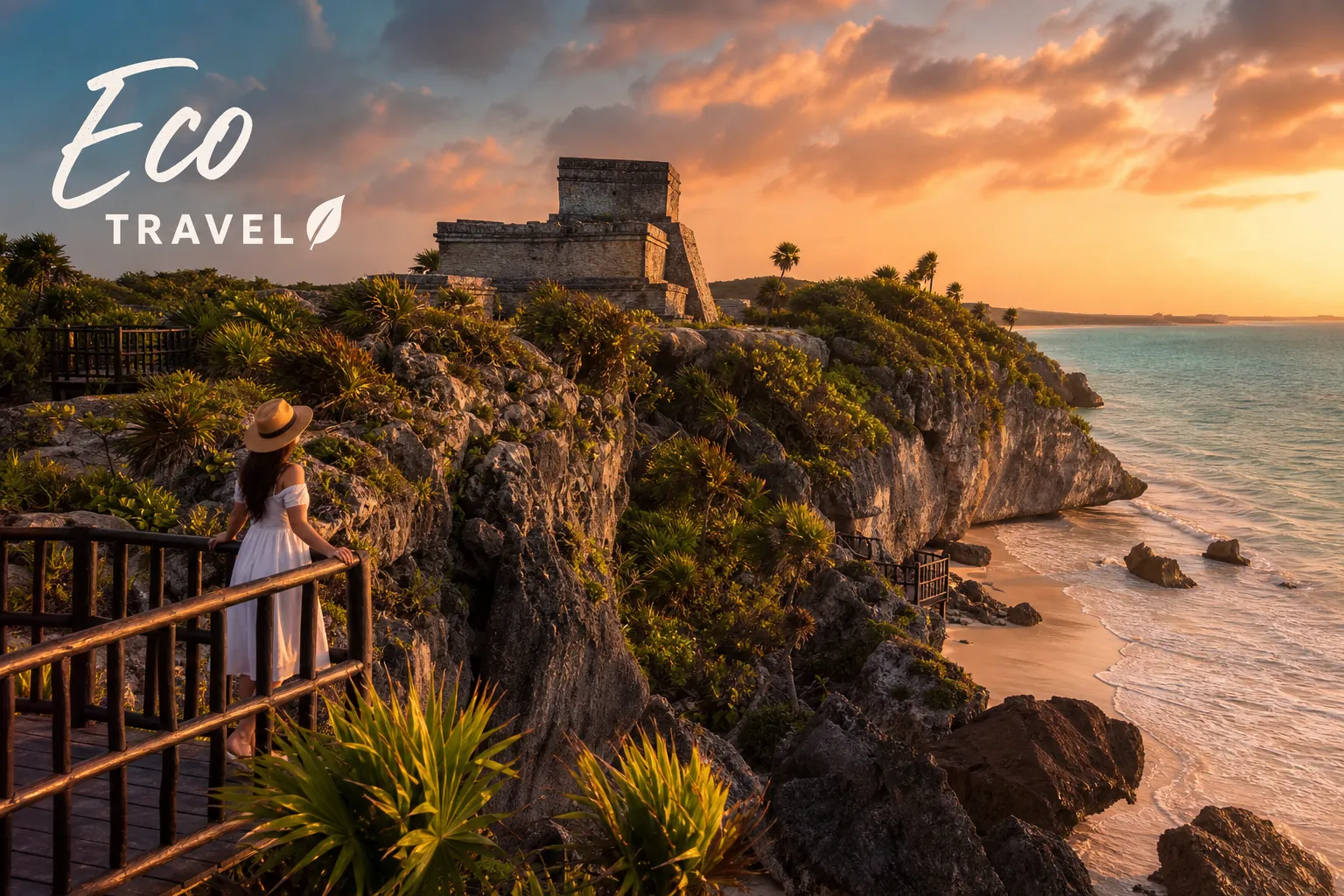
Here is a number that stops most people cold: roughly 80% of coral along Mexico’s Caribbean coast has died or been severely damaged since the 1980s. And here is the number sitting right next to it: 12 million tourists visit those same reefs every single year. These two facts are not a coincidence. They are a conversation, and the Yucatan Peninsula is where that conversation is happening loudest. Sustainable tourism in Mexico, particularly across the Yucatan, is no longer a niche concern. It is the central question facing every traveler who books a flight to Cancun.
The Yucatan is one of the planet’s most genuinely extraordinary ecosystems. Its underground cenote network, mangrove coastlines, and reef systems form one interconnected aquifer and coastal corridor, a living architecture that took millions of years to build, shaped by karst geology that began forming during the Cretaceous period. It is also one of the most visited tourism corridors in the Western Hemisphere, generating roughly 400 tons of waste per day in the Mexican Caribbean alone. Both things are true at once.
This guide is not a guilt trip. It is a practical map for traveling this region in a way that doesn’t quietly subtract from it. An unhurried approach turns out to be one of the most quietly effective strategies a traveler can adopt. What follows covers four pillars: accommodation, sunscreen, cenote etiquette, and transport. Master these four and you’ve done more than most.
Why the Yucatan needs travelers who actually pay attention
The reef numbers are specific enough to be worth sitting with. A 2018 report found that 50% of Mexico’s reefs were in poor or critical condition. The causes are documented, not speculative: wastewater from resort development, sunscreen runoff from millions of annual swimmers, coastal construction that disrupts sediment flow, and industrial fishing pressure. Mass tourism infrastructure doesn’t just visit these ecosystems; it chemically and physically alters them.
What makes the Yucatan particularly vulnerable is the connectivity of its natural systems. The cenotes scattered across the interior are not isolated swimming holes; they are windows into an underground freshwater network that connects directly to the reef offshore. What enters a cenote inland, sunscreen chemicals, plastic, sewage, can travel through that aquifer and reach the Caribbean coast. This is why the rules in this guide aren’t arbitrary. They reflect how the ecosystem actually works, at a systems level rather than at the level of optics.
Sustainable tourism in Mexico: eco-friendly accommodation and how to spot the real thing
The word “eco” appears on approximately everything in the Yucatan, which means it has been largely drained of meaning as a marketing term. A recycling bin in the hotel lobby and a sign asking you to reuse your towel do not constitute a sustainability program. The travelers who find genuinely responsible accommodation know what third-party certifications to look for and what the absence of them usually signals.
The credible certification bodies operating in Mexico include Biosphere (linked to the Responsible Tourism Institute and aligned with the UN’s 17 Sustainable Development Goals), EarthCheck (which uses a staged audit process based on measured performance across energy, water, waste, and carbon), Rainforest Alliance, Green Globe, and Travelife. Many of these are internationally recognized schemes, some GSTC-recognized, that have been independently assessed against international baseline standards rather than being self-declared by the property. Mexico’s sustainable tourism initiatives also include municipal and state-level certification programs in Quintana Roo, which add another layer of accountability for locally operated properties. When a hotel lists one of these named certifications, it means something specific. When it only says “eco-friendly” without a named certifier, treat that as a red flag.
Community-based sustainable tourism in Mexico: the slow-stay model
Community-run accommodation takes the concept further. The Maya Ka’an model in Quintana Roo is among the best-documented examples of community-based tourism in Mexico and the broader Riviera Maya region: local Mayan communities directly operate and receive income from visitor stays, which means your accommodation spending stays inside the local economy rather than flowing to an international hotel group. There is also a carbon argument for this kind of slow approach. Staying longer in a single town, rather than hopping between destinations, distributes your flight’s emissions over more days and meaningfully cuts your per-day footprint.
Reef-safe sunscreen rules every Yucatan traveler needs to follow
Chemical UV filters, particularly oxybenzone and octinoxate, are prohibited at many cenotes and reef snorkeling sites across Mexico’s Riviera Maya, with individual sites and municipalities in Quintana Roo enforcing their own specific restrictions. Additional compounds, including octocrylene, PABA, and butylparaben, are also banned at a number of sites. These restrictions exist for good reason: these compounds cause coral bleaching, disrupt larval development in reef species, and accumulate in enclosed aquatic systems like cenotes at rates that exceed open-water dilution. They don’t rinse off harmlessly; they concentrate in the places you swim.
The safest sunscreen choice for swimming in the Yucatan is a mineral-based product using only zinc oxide or titanium dioxide as the active UV filters. A rash guard eliminates the problem entirely for snorkeling or swimming and provides more reliable sun protection than any lotion. Before entering any cenote or reef area, check the site’s specific rules, most certified operators post these clearly, and rinse off thoroughly if you have applied any product beforehand. When in doubt, go without.
One more thing worth flagging: “reef-safe” is not a regulated label in most countries, including the United States. A product can carry that phrase on its packaging while still containing octocrylene, homosalate, PABA, or butylparaben, all of which are problematic for reef and cenote ecosystems. The only reliable check is reading the ingredient list and confirming that the only UV filters listed are zinc oxide or titanium dioxide. Everything else is marketing.
Cenote etiquette that protects these underground ecosystems
The rules at major Yucatan cenotes, including Gran Cenote, Dos Ojos, and Cenote Ik Kil, are consistent in the fundamentals: shower before entering, wear no sunscreen or insect repellent in the water, don’t touch the rock formations or limestone walls, don’t feed or disturb wildlife, and follow posted signs and staff instructions. At Gran Cenote specifically, jumping and professional camera tripods are also prohibited; note that payment methods, entry policies, and specific rules can vary by site and are subject to change, so check directly with the operator before your visit.
The reasoning behind the no-touching rule is worth understanding rather than just following. Cenote limestone formations take thousands of years to develop. The oils from human skin accelerate their degradation. And because cenote ecosystems are closed or semi-closed environments, contamination accumulates rather than dilutes. A chemical that might disperse harmlessly in the open ocean becomes concentrated in a cenote and remains there.
Certified cenote operators now routinely limit group sizes, which is a concrete signal that a site is being managed for long-term ecological health rather than maximum throughput. When you’re choosing between two nearby cenotes, the one with enforced group limits and mandatory rinse showers is almost always the better environmental choice, even if it costs slightly more. Timing matters too. Coach tours dominate the most-visited sites between 7 and 10 in the morning. Arriving after 10am or late afternoon dramatically reduces visitor density and delivers a better experience alongside a lower-impact one. Lesser-visited swimming holes across the peninsula, like Suytun Cenote, away from the handful of overtouristed defaults, distribute that pressure far more evenly.
Low-impact ways to move around the Yucatan Peninsula
Transport is the sustainability decision most travelers spend the least time thinking about, and it’s one of the most consequential. The ADO bus network connects the main Yucatan corridor comprehensively: Cancun to Playa del Carmen, Tulum, Bacalar, Merida, and Valladolid, with fixed prices, climate control, reliable schedules, and comfortable seats. It is also, by a significant margin, the lower-carbon way to travel this route.
The carbon math is straightforward. A solo rental car traveling the same distance as a loaded ADO coach assigns all emissions to one person; the bus spreads those emissions across forty passengers. Per-kilometer estimates for intercity bus travel run roughly four times lower in per-passenger emissions than a solo petrol car on the same route. That difference compounds across a multi-day itinerary.
Shared colectivo vans serve shorter hops between towns and cost less than buses while keeping your spending inside the local transport economy rather than going to an international car rental company. The Cozumel question comes up often: ferry or domestic flight? The ferry from Playa del Carmen takes longer, but the sea crossing is short enough that the time difference rarely justifies the emissions cost of a domestic flight. The ferry is the obvious choice on both environmental and experiential grounds. The broader transport principle worth carrying through the whole trip is the slow travel one: a traveler who bases themselves in a single town for a full week generates fewer transits, spends more money inside the local economy, and leaves less behind in terms of both carbon and waste. That’s not just good ethics. It’s genuinely good travel.
Putting it all together: a Mexico green travel approach to the Yucatan
Four pillars, applied consistently, make a real difference: choosing accommodation with named third-party certification or community-run credentials, switching to mineral-only sunscreen and rash guards before swimming, respecting the closed-ecosystem logic of cenotes, and moving through the region on shared public transport instead of solo rental cars. None of these require sacrifice. They require attention.
The deeper shift is less about a checklist and more about an orientation. Passing through the Yucatan quickly, hitting every Instagram location in ten days, places like Las Coloradas, generates a different kind of pressure than staying somewhere long enough to understand it. The single highest-impact decision any traveler can make here is to stay longer, move less, and spend more money inside the local economy rather than with international hotel chains or on flights between nearby destinations. That is what regenerative tourism in Mexico actually looks like in practice, not a certification on a hotel door, but a different relationship with the places you visit. For frameworks and studies on nature-based tourism approaches that inform sustainable management, see work on nature-based tourism.
Sustainable tourism in Mexico demands exactly this kind of intentionality, and the Yucatan is where the stakes are clearest. If you want the specific on-the-ground information to plan a trip built on these principles, The Curious Atlas has deep guides on cenote selection, getting around by ADO, the slow-travel case for Bacalar, and what independent travel in Tulum actually looks like without the luxury resort markup. For practical safety planning, see Is Mexico Travel Safe? Essential Tips for a Worry-Free Trip.
Leave a Reply