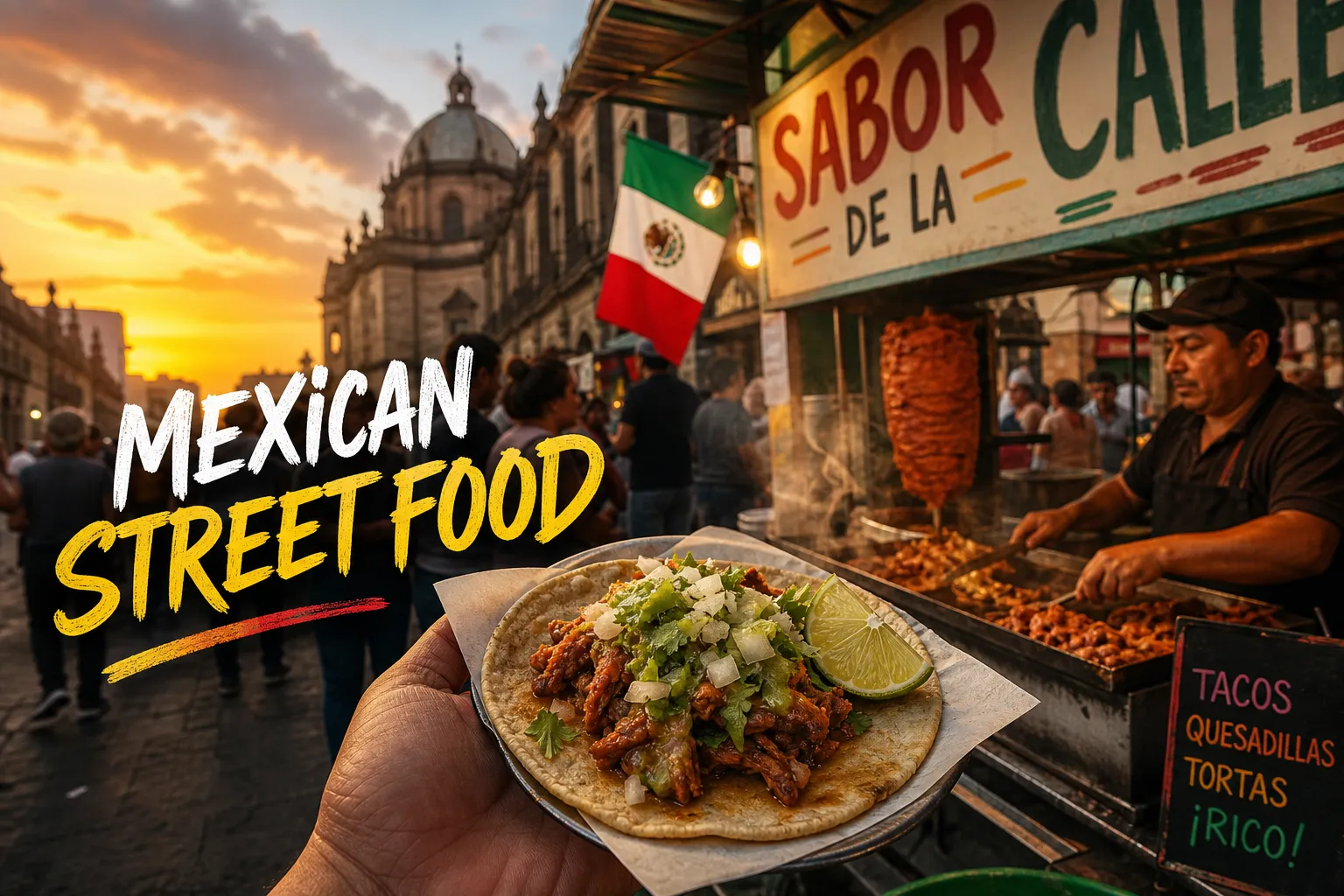
If you’re hunting for the best street food Mexico has to offer, brace yourself: one weekend of tacos in one city barely scratches the surface. Many travelers assume they’ve got it figured out after a few rounds in the capital, then they cross a state line and discover that the country that perfected tacos al pastor in Mexico City also birthed marquesitas in Mérida and tlayudas in Oaxaca, and those dishes taste nothing alike. Street food here is a moving target shaped by migration, markets, and memory, which is exactly why it rewards the curious traveler.
Whether you have three days in Mexico City or three weeks to wander the Yucatán Peninsula, knowing what to order, where to look, and what to pay turns sidewalks into dining rooms and strangers into guides. Think of what follows as a region-by-region playbook for 15 foundational dishes, your starting point for understanding what to eat in Mexico City, Oaxaca, Guadalajara, and the Yucatán.
We start in the capital, branch to Oaxaca and Guadalajara, connect the country through corn, then end in the Yucatán, where the rules change and the flavors deepen. Along the way, you will get prices, timing, and stall-selection habits that keep you safe and well fed.
Best street food in Mexico City: benchmarks every traveler should know
Tacos al pastor, birria, and the spit-roasted standard
If you eat only one taco in the capital, make it al pastor. Pork spins on a vertical trompo, basting itself in achiote and chiles until a taquero flicks off thin sheets of meat, crowns the taco with a shard of pineapple, and finishes with onion, cilantro, and salsa. The technique is commonly traced to Lebanese immigration and the shawarma tradition, and Mexico City has embraced it with a craftsman’s seriousness ever since.
For a benchmark experience, head to El Vilsito in Narvarte, an auto shop by day and a taquería by night that turns out some of the best street tacos in Mexico City once the grills roar. Birria belongs on your shortlist too, whether you take it as straight tacos or as quesabirria, where the tortilla crisps in fat, the cheese melts, and a cup of bubbling consommé waits for your dunk. Start with al pastor in Narvarte, then chase a quesabirria with consommé for contrast and comfort. Round out your first lap with rich, simply seasoned carnitas tacos and lightly charred carne asada if you want a grilled counterpoint. You are calibrating your standards now, and Mexico City is where those standards are set.
- El Vilsito, Narvarte Poniente: Petén 248 at Av. Universidad. Nightly al pastor gold.
- Mercado de Coyoacán, Del Carmen: Ignacio Allende 49. Classic tostadas and market snacks between taco runs.
- Don Antonio’s tacos de canasta, Condesa: Corner of Aguascalientes and Av. Chilpancingo. Basket tacos for the morning rush.
- Carnitas Paty, Mercado La Merced: Lorenzo Boturini 1702. A carnitas checkpoint inside the capital’s great market.
Tacos de canasta, quesadillas, and the everyday masa staples
Tacos de canasta are the breakfast heartbeat of working Mexico City. Pre-assembled and lightly steamed in a basket, they’re sold in rapid-fire bulk from a bicycle or a curbside perch, with potato, beans, and chicharrón as the usual fillings. Three or four make a fast, filling morning.
Quesadillas here are made to order on a comal, often without default cheese, and they shine when stuffed with squash blossoms, mushrooms, or huitlacoche. Add sopes and tlacoyos to your map as well. Sopes come as thick masa discs with raised rims that hold beans, salsa, and crema, while tlacoyos are oval, stuffed with beans or favas, then griddled and topped with nopales and salsa. Both dishes are strongly associated with central Mexico, and Mexico City’s versions are widely regarded as the benchmark.
What to pay and when to show up
As of 2026, street tacos in the capital generally run 13 to 25 MXN each, putting a filling four-to-five-taco meal around 60 to 100 MXN. Tamales clock in at roughly 15 to 25 MXN per piece, and market tostadas often land at 30 to 40 MXN. Carry small bills and coins, since many stands cannot break large notes.
Timing is leverage. Taco stands hum around breakfast and again after 9 p.m. for the late crowd, and big mercados like La Merced and Mercado de Coyoacán are at their best on weekday mornings, when selection peaks and lines stay manageable. Weekends draw larger crowds and can mean shorter inventory by midday, so plan accordingly.
Oaxaca and Guadalajara: best street food Mexico’s south and west have to offer
Tlayudas, tamales, and Oaxaca’s street-eating culture
Tlayudas are Oaxaca’s signature street canvas. Picture a plate-sized, blistered tortilla spread with black beans, stacked with cecina or tasajo, layered with Oaxacan string cheese, lettuce, and salsa, then folded or served open-face. It’s crisp, smoky, and satisfying, something like Mexico’s answer to an open-face street pizza.
Oaxacan tamales flip the script too. Wrapped in banana leaves, they steam into custardy pockets that hold mole negro, chicken, or rajas, and the leaf lends a scent of earth and a silkier texture than corn-husk tamales up north. Order a tlayuda at Mercado 20 de Noviembre, then a banana-leaf tamal for a one-two punch of smoke and comfort.
Prices in Oaxaca are generally traveler-friendly, though they vary by vendor, stall size, and season. Tlayudas tend to range from roughly 70 to 120 MXN depending on size and fillings, while banana-leaf tamales are typically in the 20 to 30 MXN range, making them an easy add-on between market strolls. Treat these figures as ballpark estimates and ask your vendor to confirm.
- Mercado 20 de Noviembre, Centro, Oaxaca City: the city’s tlayuda and grilled-meat corridor.
- Tlayudas Libres, Calle de Los Libres 212: late-night grills, roughly 9 p.m. to after midnight.
- Mercado Sánchez Pascuas and La Cosecha Mercado Orgánico: calmer morning markets for tamales and breakfast plates.
Guadalajara’s torta ahogada and the case for regional sandwiches
Guadalajara answers tacos with a sandwich that swims. The torta ahogada packs crispy pork into a bolillo roll, then drowns it in tomato-chile sauce until your fingers surrender. Locals debate sauce ratios the way sports fans argue lineups, which tells you everything about how seriously the city guards its flavors.
Plan a short crawl to feel that civic pride firsthand. Make room for at least one torta ahogada stop, then add a mixed-meat campechano taco or a longaniza taco if you are passing through the Bajío. Prices vary by stall and heat level; a torta ahogada generally runs around 30 to 60 MXN, though regional and vendor differences apply, so budget a little flexibility.
For tradition, aim for José el de la Bicicleta in Mexicaltzingo. For fame and convenience, Tortas Toño in Providencia. For neighborhood cred and heat, El Profe Jiménez in Santa Tere. Each one will try to convert you to its sauce theology.
The corn-based snacks that tie Mexico’s best street food together
Elotes, esquites, and the humble magic of street corn
Elotes and esquites are democracy on a stick or in a cup. Elotes come as corn on the cob slathered with mayo, cheese, chile, and lime, while esquites tuck the same flavors into a cup of hot kernels, often with a ladle of seasoned broth. They’re messy by design and perfect as street intermissions anywhere from Mexico City to Cancún.
Prices are typically in the 15 to 25 MXN range, an approximate guideline based on general 2026 street-food pricing, which is why locals and travelers alike converge on these stands nightly. Ask for extra chile if you want a kick, or look for chamoy in the north if you want sweet-sour heat. Elotes and esquites are probably the most universal order you can make anywhere in Mexico’s street universe.
Gorditas, sopes, and tlacoyos: the underrated masa snacks
Gorditas are thick masa pitas split and stuffed with beans, cheese, or meats, then painted with salsa. Sopes come as sturdy discs with raised rims to hold beans, lettuce, crema, and your salsa of choice. Tlacoyos are oval and stuffed before griddling, usually finished with nopales and cheese. All three are the underordered cousins to tacos.
Filling and generally affordable, roughly 20 to 35 MXN each as a broad estimate, they reward a day-two exploration once the taco itch is scratched. You will learn more about masa in one afternoon of these snacks than a week of restaurant menus could teach you.
Yucatán’s street food: a different universe entirely
Cochinita pibil tortas and the slow-cooked Yucatán tradition
Cochinita pibil starts the night before you arrive. Pork bathes in achiote and sour orange, then roasts low and slow in banana leaves until dawn. Come morning, the meat is piled into tortas and tacos, finished with pickled red onion and a whisper or a wallop of habanero.
In Mexico City, El Turix in Polanco delivers a credible urban version, but the soul of the dish lives in Mérida’s markets. Look for Taquería La Lupita in Mercado Santiago or the Wayan’e stands scattered across town, where the pork’s deep red hue and citrusy tang signal a long, careful cook. Cochinita pibil is a morning ritual in the Yucatán, and the best stalls often sell out by late morning, so arrive early. Budget roughly 18 to 30 MXN for a torta in a market setting, and less for a taco. The flavor-to-cost ratio is remarkable, and the habanero’s fruitiness, not just its fire, is what makes the dish sing.
Marquesitas in Mérida and the sweet side of street eating
Marquesitas are Mérida’s evening performance. A thin batter hits a hot iron, turns crisp in seconds, then gets rolled around grated Edam and something sweet like cajeta or chocolate. The sweet-salty contrast is the whole point, and once you crack the first bite, you understand why plazas fill with these wafer rolls after dark.
Find them after 6 p.m. around Plaza Grande and in neighborhood parks across the city. Prices vary by vendor and filling, so ask before you order and expect figures to shift with the season. Watch the pour, the flip, and the roll, then eat while the shell still crackles.
Going deeper into Yucatán street food
Stay a few days and the peninsula starts speaking in more dialects. Valladolid’s Taquería Honorio is a reference point for cochinita and lechón. Izamal’s quiet streets hide stalls selling salbutes and panuchos that barely register on tourist maps. Evenings in Parque de las Américas in Mérida bring waves of family snack stands under the trees.
On our travels with The Curious Atlas, we keep returning to the peninsula because the layers keep revealing themselves. Our city and neighborhood guides for Mérida, Valladolid, and the coastal towns map morning cochinita circuits, evening marquesita clusters, and the quiet corners where the best cooks work without fanfare. If the peninsula is on your route, read those before you go, then build in time for the serendipitous finds no guide can predict.
How to eat street food in Mexico safely and confidently
The stall-selection instinct every street eater needs
The most reliable signal of a good stall is a crowd of locals. High turnover keeps food fresh and temperatures safe, so follow the lines rather than laminated English menus. Scan the setup: clean work surfaces, covered ingredients, and a division of labor between the person handling cash and the one plating your order are all green lights.
Avoid cooked items that sit lukewarm in open trays, and be cautious with unrefrigerated salsas and crema. Trust your senses, if a stall smells off or looks disorganized, step aside and try the next one. Favor stalls where food is cooked to order, follow the locals, and remember that hot and fresh almost always beats lukewarm.
Timing, turnover, and the best hours to eat
Morning markets are best right at opening, when produce is crisp and vendors are fully stocked. Taco stands run two rhythms: a breakfast bump starting around 9 a.m., then a second wind from about 9 p.m. until late. Night vendors often sell out their best items early in the evening window, so arriving at the start of that run gives you the best selection.
Skip tap water and ice of unknown origin. Bottled or sealed drinks are the safe default, especially if you’re eating across several stalls in a row. When in doubt, choose the stall with the freshest-looking ingredients and the fastest-moving line.
Finding the best street food in Mexico: a final word
Mexico’s best street food rewards curiosity and patience more than careful planning. No list of 15 dishes captures the full sprawl, because flavors shift every few hundred miles, vendors move with the seasons, and the best meal is usually the one you wander into after following your nose. This Mexican street food guide gives you a map, but the magic arrives when you treat the street as a classroom and every cook as a teacher.
If the Yucatán Peninsula is on your route, linger an extra day or three. The morning cochinita circuits and late-night marquesita carts alone justify the pause, and The Curious Atlas has the on-the-ground guides you’ll want in your pocket. Wherever you land in Mexico, whether you’re chasing the best street food in Mexico City or tracking down a remote Oaxacan market, eat boldly, pay fairly, and let the sidewalk lead you to the next lesson.
Leave a Reply