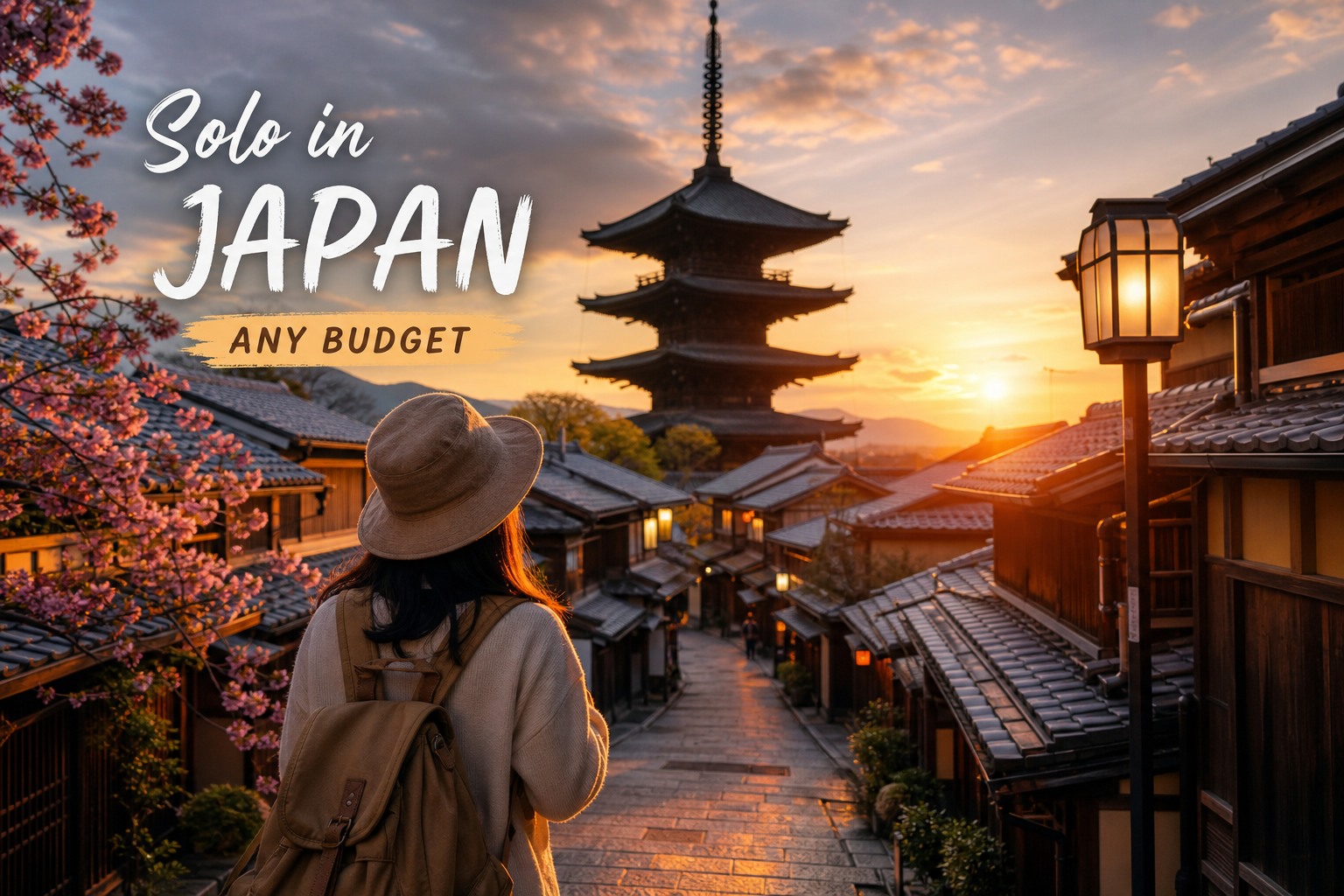
There is a quiet paradox at the heart of every Japan trip solo traveler eventually notices. You move through one of the densest, most populated countries on earth, and yet you rarely feel crowded. You eat alone at a ramen counter and feel perfectly at ease. You navigate a major train station, Tokyo Station alone has over 30 platforms across its various lines, without speaking the language and somehow arrive exactly where you meant to go. Japan doesn’t just tolerate solo travelers. Its infrastructure, hospitality formats, and cultural norms seem, at some level, to have been built with them in mind.
This guide is written for independent travelers who want to go deeper than the five-day Golden Route highlights. Think of it as a slow-travel framework, the kind The Curious Atlas has been building for curious, self-directed travelers for years. We’ll work through the transport decisions, accommodation formats, solo dining culture, safety realities, and three real itineraries at different trip lengths. By the end, you’ll have everything you need to plan a Japan trip solo that fits the country Japan actually is, not the one the tour brochures sell.
Why a Japan trip solo feels natural from day one
Most countries simply haven’t thought through the logistics of a single traveler. Japan has. The single-seat counter at a ramen shop, the business hotel room engineered for exactly one person, train reservation systems that allow solo bookings without added fees, these aren’t accidents. They reflect a cultural respect for individual focus and self-sufficiency that runs deep in Japanese society. When you travel alone here, the infrastructure meets you.
On the safety question, Japan ranks among the safest destinations in Asia for independent travelers, a status consistently reflected in global travel safety indices. Police boxes, called koban , are commonly found in many neighborhoods and staffed around the clock. Station staff are generally helpful to lost travelers, even across language barriers. Petty crime rates are genuinely low by global standards. Emergency services are reachable via 110 for police and 119 for fire and ambulance. None of this means you stop paying attention, but the baseline risk here is lower than in most destinations that get framed as “solo travel friendly.”
For slow travelers specifically, Japan offers another advantage that faster itineraries simply miss. The country rewards patience in ways that a five-day whirlwind cannot access. The traveler who spends a week in Kyoto’s backstreets discovers a city underneath the temple circuit. The traveler who lingers in Tohoku encounters a Japan that most international visitors never find. Treating a Japan trip as a deep dive rather than a highlight reel is not just philosophically satisfying; it is practically the better trip.
Planning your Japan trip solo: transport and where most people overspend
Choosing the right rail pass
The JR Pass question comes up in every Japan travel conversation, and the honest answer is that it depends entirely on your itinerary. The 7-day Ordinary Pass costs ¥50,000 in 2026, the 14-day costs ¥80,000, and the 21-day costs ¥100,000. These prices make sense on multi-region itineraries packed with Shinkansen legs. They often don’t make sense for shorter or region-focused trips. The simplest check: list every JR train journey you plan to take, price each one individually, and compare the total to the pass cost. If the difference is small or negative, individual tickets win. For current pricing context, see the JR Pass 2026 pricing guide here.
For itineraries concentrated in one region, regional passes offer significantly better value. The Kansai Area Pass suits a Kyoto-Osaka-Nara circuit well. JR East passes cover Tokyo day trips toward Nikko or Sendai. Kyushu travelers have their own pass options for the Fukuoka-Kagoshima corridor. The key insight is that the nationwide pass earns its price only when your itinerary crosses multiple distant regions with several long Shinkansen legs. For most first-time visitors on a focused seven-day trip, it doesn’t.
IC cards and everyday transit
Regardless of which pass you buy, a Suica or Pasmo IC card is non-negotiable. The JR Pass does not cover city subways or private railways, which means your IC card runs parallel to any pass you hold. It handles subways, buses, private train lines, and even convenience store purchases. Load it at any major station kiosk on arrival. For city-focused travelers on shorter trips, an IC card plus a handful of individual Shinkansen tickets may be all the transport infrastructure you need.
Choosing where to stay: neighborhoods and accommodation formats
Neighborhood choice shapes the entire texture of a solo Japan trip. In Tokyo, Shinjuku offers the best all-around balance of transit access, food density, and accommodation variety for a first-time solo visitor. Ueno and Asakusa suit budget travelers who want cultural texture at lower price points. For Tokyo’s indie, local side, Shimokitazawa and the historic streets of Yanaka are neighborhoods the guidebooks are catching up to but haven’t fully mapped yet.
In Kyoto, the Gion and Higashiyama corridor rewards slow travelers who want to walk the backstreets at dawn before the day-trippers arrive. The Kyoto Station area trades atmosphere for transit convenience, which is the right trade for travelers running heavy day-trip itineraries. In Osaka, Namba and Umeda are the dominant solo bases for good reason: nowhere else in the city concentrates food, late-night life, and rail connections as effectively.
On accommodation formats, the match to your travel rhythm matters more than the budget tier alone. Business hotels are the workhorse option: private, efficient, and built around a single traveler’s needs. Capsule hotels work well for short city stays and add a genuine cultural experience. Consider budgeting at least one or two ryokan nights in Kyoto, where the tatami room, onsen, and multi-course kaiseki dinner are central to what makes the city worth visiting. Hostels make sense when social connection is the specific goal; many offer female-only dormitory floors, which is worth noting for solo female travelers making the booking.
Eating alone in Japan is one of travel’s quiet pleasures
Japan normalizes solo dining in a way that most Western countries have not figured out. The ramen counter is the easiest entry point: you order from a vending machine in some cases, eat facing the wall or a small window, and leave without ceremony. No one is waiting for your table. No one finds it unusual. The yakitori bar and the standing izakaya operate on similar logic: counter seating for one, small plates ordered gradually, comfortable noise without social pressure.
The deeper food experiences in Japan live beyond the well-marked tourist trail. Nishiki Market in Kyoto is genuinely worth visiting, but the back lanes around it hide standing sushi counters and tofu shops that see a fraction of the foot traffic. In Kyoto’s quieter districts like Karasuma, neighborhood izakayas serve homemade-style food at counters that feel nothing like a tourist experience. In Tohoku, Sendai’s miso-based dishes and local sake culture are rarely on international travel lists, which is precisely the point. These are the kinds of finds The Curious Atlas exists to surface for travelers who want more than the obvious circuit.
A few etiquette anchors matter more than the rest: sit where directed by staff, keep bags off the counter, expect a small otoshi charge at some izakaya, and order gradually rather than all at once. Basic courtesy phrases, arigatou and oishii, are genuinely appreciated far beyond their literal meaning. This isn’t about following rules to avoid embarrassment. It’s about being a guest who pays attention to where they are.
Japan trip solo safety tips: etiquette and solo female travel
Cultural norms every solo traveler should know
Japan’s social norms are clear and consistent. No phone calls on public transit. No eating while walking in most contexts. Shoes off at the threshold of traditional spaces. Queue discipline that is close to ceremonial in busy stations. Internalizing these early doesn’t require memorization; a few hours of observation in any train station will show you exactly how the system works. Following them is a form of respect, not performance.
Solo female travel in Japan
Solo female travel in Japan is widely considered among the safest in Asia. Many women traveling alone report a level of ease that surprises them, particularly coming from cities in other regions where street harassment is more common. Informed preparation still matters. Women-only train cars are available on major commuter lines in Tokyo and Osaka, typically during weekday morning rush hours (around 7:00 to 9:30 AM) and select evening and late-night services; hours and availability vary by line and operator. They’re marked clearly on platforms and train doors. In nightlife districts like Roppongi and Kabukicho, the advice is situational alertness rather than avoidance: don’t follow unsolicited invitations into bars or clubs, keep your drink in sight, and stick to well-lit areas late at night. Share your itinerary with someone you trust before you go. These are sensible precautions anywhere; in Japan, they cover the full extent of what most solo female travelers need.
Emergency preparation
For any solo traveler, emergency prep is the preparation you hope never to use. Download Japan’s national earthquake early-warning app before you arrive. Save your accommodation address in Japanese characters for taxi rides. Keep a backup photo of your passport and travel insurance details on a separate device or in cloud storage. Local koban police boxes are a readily available on-the-ground resource if something goes wrong, look for them on city corners and in busy transit hubs. Knowing these resources exist before you need them is what separates a confident solo trip from an anxious one.
Building your solo Japan itinerary: from 5 days to two weeks
For a first-time solo traveler on a 5 to 7 day trip, the Tokyo-Kyoto pairing with a day in Osaka or Nara covers the cultural and culinary peaks without overwhelming a newcomer. Spend two to three days in Tokyo, prioritizing neighborhoods like Yanaka and Shimokitazawa alongside the obvious stops. Take the Shinkansen to Kyoto and spend two to three days on the temple circuit, Fushimi Inari at dawn before the crowds arrive, and counter meals in the back lanes around Nishiki. Individual tickets or a simple regional pass will cover this route more cost-effectively than a nationwide JR Pass.
The 10 to 14 day itinerary is the one for travelers who want to understand Japan rather than photograph it. After two to three days in Tokyo, take the Shinkansen northeast into Tohoku: Sendai as a practical hub, Matsushima Bay for the scenery, and the mountain temple of Yamadera for the kind of experience that doesn’t make Instagram feeds because it requires actual effort to reach. Kakunodate’s preserved samurai district rewards an overnight stay for anyone who wants Edo-period streets without the Kyoto crowds. Return south through Nikko before heading to Kyoto for a full week of neighborhood immersion. This is the itinerary where the nationwide JR Pass starts to justify its price. It’s also the kind of route The Curious Atlas is built to support: off-the-beaten-path, substance over spectacle, meaningful over efficient.
On budget: a solo trip to Japan is not the cheapest destination in Asia, but the value per experience is high when planned well. Research from 2026 puts daily costs in yen at roughly ¥8,000 to ¥12,000 for budget travel (hostels, ramen counters, regional passes) and ¥15,000 to ¥25,000 for mid-range travel with business hotels and sit-down restaurants. The slow travel premium tier, ryokan nights, curated food experiences, and regional day trips, runs higher still. For Canadian travelers, it’s worth converting these figures using a current exchange rate at the time of booking, as currency fluctuations affect the CAD equivalent meaningfully. These figures cover accommodation, food, local transport, and entry fees but exclude international flights and any JR Pass purchase, both of which should be budgeted separately before departure.
The trip worth taking slowly
Japan returns you to something the pace of modern travel tends to erase: the experience of being fully present in one place. Every ramen counter, every early-morning temple walk before the tour groups arrive, every navigated train transfer in a station with no English signage is a small confirmation that you can move through the world on your own terms. The country asks you to pay attention, and it rewards that attention in ways that are hard to explain until you’ve been there.
Planning a Japan trip solo doesn’t need to be complicated once you break it into the right decisions: which transport pass matches your route, which accommodation format suits your travel rhythm, how to approach solo dining with confidence, what safety preparation actually looks like in practice, and which itinerary length gives you the kind of Japan worth going back for. The best solo trip to Japan is rarely the fastest one. That applies to the planning, too.
Frequently asked questions: Japan trip solo
Is Japan a good destination for solo backpacking?
Japan is one of the best destinations in Asia for solo backpacking. Its rail network is extensive, its hostels are well-run, and its solo dining culture means you’ll never feel out of place eating alone. Budget solo backpackers in Japan typically spend around ¥8,000 to ¥12,000 per day outside of transport passes.
What’s the safest way to plan Japan travel for one?
The core of safe Japan travel for one is straightforward preparation: download the earthquake early-warning app, carry your accommodation address in Japanese characters, and note the local emergency numbers (110 for police, 119 for fire and ambulance). Japan’s low crime rates and helpful station staff make solo travel here less stressful than in most comparable destinations.
What are the best solo traveler tips for Japan first-timers?
Get a Suica or Pasmo IC card on arrival. Eat at ramen counters and standing izakayas without hesitation, solo dining is normal here. Choose your JR Pass based on actual itinerary math rather than assumption. And give yourself more time than you think you need: Japan consistently rewards travelers who slow down.
Leave a Reply