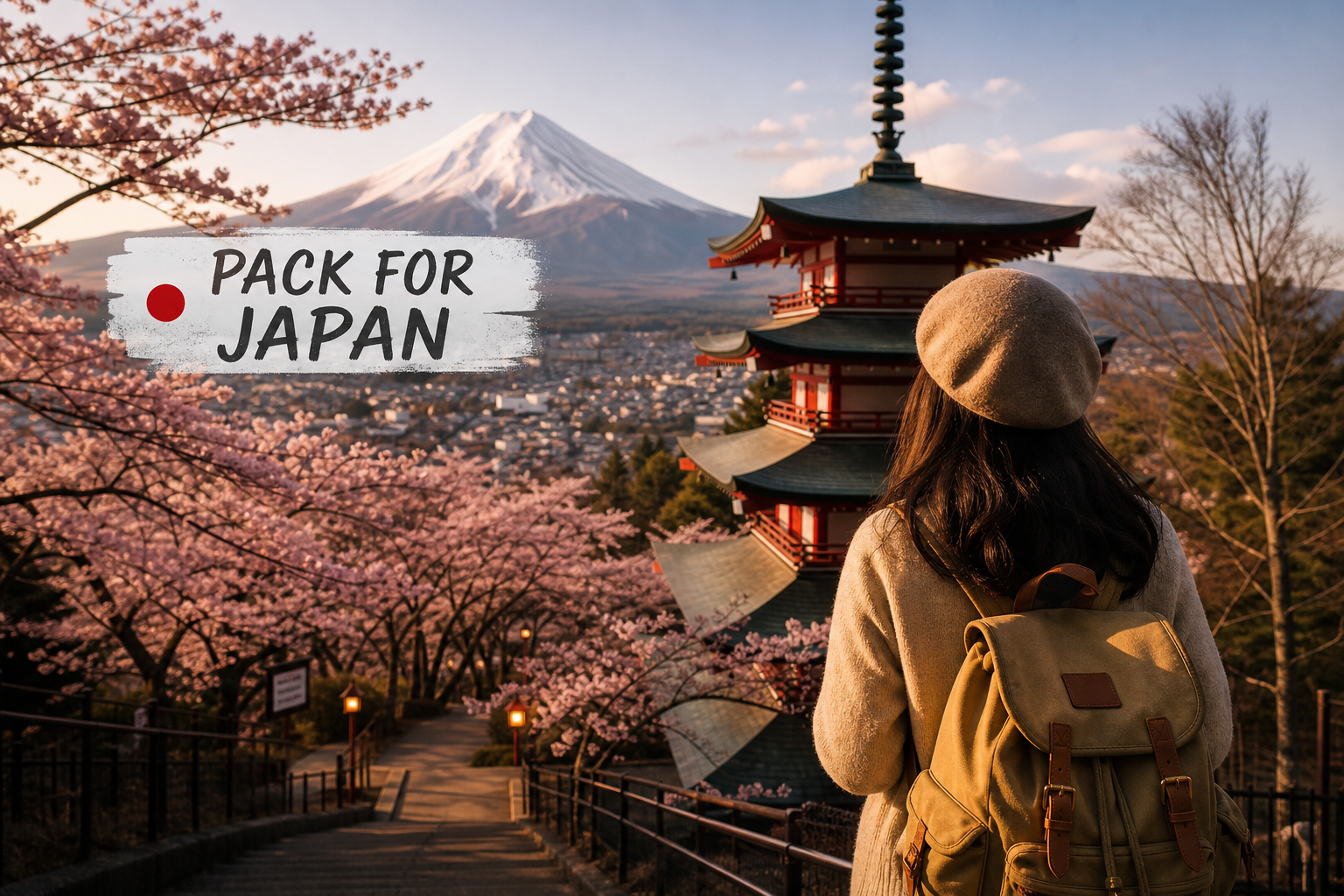
Most people pack for Japan like they’re preparing for every possible disaster. The result is a suitcase that becomes its own burden before the first train ride. Japan is one of the world’s most convenient countries to travel in, yet it’s exactly where over-packing creates the most friction: crowded station stairs without an escalator in sight, coin lockers too small for a large rolling suitcase, the quiet embarrassment of hauling a full-size bag through a ryokan corridor while guests in yukata glide past you in silence.
This japan packing list approaches the question the way slow travelers think about packing for any extended journey: a deliberate, season-aware kit built around the capsule wardrobe principle, not a bloated “just in case” collection. At The Curious Atlas, we apply this same logic to extended Yucatán trips, where three bottoms and four tops carry a traveler through a month of coastal heat. Different hemisphere, same philosophy. Japan simply enforces it with architecture.
What follows covers seasonal clothing for spring and autumn (Japan’s two most-visited seasons), what to wear at temples and onsen, the tech gear that actually earns its weight, items you cannot easily source once you land, and a clear framework for deciding between carry-on and checked luggage.
The slow-travel packing philosophy Japan quietly demands
Japan doesn’t just tolerate minimalist packing. It structurally rewards it. The country’s transit infrastructure, the abundance of coin lockers, and konbini convenience culture mean that less baggage translates directly into more freedom. This isn’t an aesthetic argument. It’s a practical one built into every train platform and narrow guesthouse hallway in the country.
Why Japan punishes heavy luggage more than most destinations
Some older or smaller stations lack elevators or escalators between platforms. Many ryokan have narrower hallways than modern hotels, and you remove your shoes at the entrance, meaning you’re navigating in socks while maneuvering a large bag. Many coin lockers at major stations are sized for daypacks and small carry-ons; large checked suitcases often won’t fit at all. The traveler who arrives with a manageable 40L backpack moves through Japan with ease. The one with two large suitcases spends their energy managing luggage instead of exploring.
The capsule wardrobe approach for extended stays
Slow travelers in Japan tend to base themselves in one city for a week or more, which completely changes the packing equation. You’re not rotating through five hotels in five nights. You’re building a temporary home. For many travelers, a capsule wardrobe of five to seven neutral, mix-and-match pieces covers most situations without dead weight, think two base layers, two mid-layers, one pair of versatile trousers, and one pair of walking shoes that goes with everything. That’s a week’s worth of outfits with room for laundry cycles in between.
The one rule that simplifies every packing decision
If you can’t hand-wash it in a sink and wear it again within 24 hours, think twice before packing it. Many accommodations across Japan, from ryokans to Airbnbs to business hotels, have laundry facilities nearby, and coin laundromats are clean, affordable, and common in urban neighborhoods. This single constraint eliminates most packing anxiety and keeps your bag at a size that Japan’s infrastructure is actually designed to accommodate.
Japan packing list by season: spring and autumn deep-dive
Spring and autumn are Japan’s most visited seasons, and also its most layering-dependent. The temperature data tells a clear story: Tokyo in spring ranges from around 13°C in March to 23°C by May, with mornings and evenings running significantly cooler than midday. Autumn in Kyoto and Osaka sits between roughly 15°C and 26°C depending on the month and region. These aren’t extreme ranges, but they require thoughtful layering rather than single-weight packing. For additional packing ideas tailored to Japan’s seasons, this practical guide on what to pack for Japan is a useful reference for beginners and repeat visitors alike.
Spring packing (March to May): layers, pollen, and unpredictable mornings
Cherry blossom season brings cool mornings and warm afternoons, temperatures can shift significantly between sunrise and midday. A base layer, one mid-layer (a light merino sweater or cardigan works best), and a compact rain jacket cover the vast majority of spring days across Tokyo, Kyoto, and Osaka. Footwear should prioritize grip and comfort over style: prioritize comfortable, grippy shoes over anything flat-soled when you’re walking uneven stone paths around shrines and temples. One more item worth packing deliberately: antihistamines. Pollen season in Japan is severe from late February through April, and walking through cedar forests near shrines without medication is an experience you won’t repeat by choice.
Autumn packing (September to November): Japan’s most forgiving packing season
Autumn is both the easiest season to pack for and, by most accounts, the most rewarding time to visit. Temperatures across central Honshu sit between 10°C and 22°C depending on the month and region, cool enough that layers matter, warm enough that you won’t need a heavy coat until late November. Two base layers, one warm sweater, a light-to-medium jacket, and a scarf for evenings covers the full range. Autumn also means more outdoor walking through forested temple grounds and riverside paths, which makes investing in the right footwear more important than the season might suggest at first glance.
A quick note on summer and winter
Summer demands breathable fabrics and a portable fan. Japan’s humidity from June through August is genuinely punishing, and no amount of cotton layering substitutes for a fabric that actually wicks. Winter in Kyoto, Nagano, or Hokkaido requires thermal base layers and waterproof footwear. Both seasons follow the same capsule wardrobe logic: pack for layering, not for redundancy. The specific garments change, but the system doesn’t.
Dressing right for temples, shrines, and onsen culture
Japan has dress code nuances that don’t require a special “Japan outfit” collection. They require awareness. Two situations consistently catch first-time visitors off guard: temple visits and onsen etiquette. Both are easy to navigate once you understand what’s actually expected.
What to actually wear at temples and shrines
Japan’s religious sites are more lenient than their Southeast Asian counterparts. There’s no mandatory shoulder or knee coverage at most temples and shrines, but modest, clean clothing is a sign of respect that locals genuinely notice. Avoid athletic wear or anything visibly beach-oriented at major sites. The practical tip that matters most: pack at least one pair of slip-on shoes. You’ll remove footwear more often than expected, at ryokans, certain restaurant interiors, and some temple buildings. A shoe that comes off in under five seconds becomes a daily quality-of-life detail.
Onsen and ryokan: what to bring and what the inn provides
Most ryokans provide a yukata, small towels, and basic toiletries. What they don’t always provide: a hair tie for long hair, a razor, a large bath towel in some traditional bathhouses, and 100-yen coins for lockers. Pack these specifically rather than assuming they’ll be available. One planning note that has real packing implications: tattoos remain restricted at many public onsen across Japan. If this applies to you, researching private bath options before arrival saves both money and the frustration of being turned away at the door.
Tech gear for slow travelers on an extended Japan trip
Japan is tech-friendly in infrastructure, but it has quirks that catch travelers off guard: 100V outlets, limited socket availability in some older guesthouses, and a genuine decision to make around connectivity before you land. Getting these details right before departure saves meaningful time once you’re navigating Tokyo Station for the first time.
Connectivity: eSIM vs. pocket Wi-Fi for longer stays
For solo slow travelers in 2026, an eSIM is the clearest answer. No device to carry, charge, or return at the end of your trip. For a month-long stay, providers like Nomad, Airalo, and Sakura Mobile all offer 30-day plans with 20 to 50GB of data at competitive rates. For a deeper comparison, see Mobile Internet Options in Japan for Tourists. Pocket Wi-Fi makes more sense for couples or groups sharing a single data connection. Japan’s coverage is generally strong across urban areas and most populated regions, so for the majority of itineraries the decision comes down to convenience and cost rather than signal quality.
The essential tech kit for a long Japan stay
Japan uses Type A plugs at 100V, but most modern chargers are 100, 240V compatible, a simple plug adapter is all you need. See our Japan Power Outlet Guide: Adapters, Voltage & What to Pack for full details. No voltage converter required for phones, laptops, or cameras. Pack a 10,000 mAh power bank; it covers a full day of navigation, photography, and transit apps without hunting for an outlet. A GaN multi-port charger consolidates your cables into one compact brick. Before you land, set up the Suica card on your iPhone or Google Pay equivalent. It works across trains, subways, buses, and konbini registers nationwide, and removes the need for a physical IC transit card entirely.
What Japan doesn’t sell easily: the bring-from-home shortlist
Japan has extraordinary convenience stores and well-stocked pharmacies, but a few categories consistently catch Western travelers off guard. The mistake is assuming that “if it exists in the world, Japan has it.” Japan has exceptional local versions of most products, your specific version is a separate matter entirely, and worth sorting before departure.
The most common miss is deodorant. Western-style antiperspirants are rare on Japanese pharmacy shelves, where the domestic market favors milder formulations. High-SPF sunscreen in familiar brands, specific shampoo formulas, and women’s hygiene products in familiar styles are all worth packing from home. For medications, the gap is more significant: Western cold and flu formulations like NyQuil, Advil Cold and Sinus, and Sudafed are not available in Japan in their familiar forms. Japanese OTC equivalents exist but are often milder or require a prescription. Bring any medication you actually rely on, including ibuprofen, melatonin, and antihistamines, in sufficient quantity for your full trip. A translated doctor’s note for any prescription medication is a practical necessity, not an optional precaution.
Japan packing checklist: carry-on vs. checked luggage
Japan’s transit system is one of the best in the world, and your relationship with it will be shaped almost entirely by how much luggage you’re moving. The decision between carry-on and checked is less about airline rules and more about how you want your days to feel once you’re there.
The case for carry-on-only in Japan
For trips up to three weeks, carry-on-only is achievable with a capsule wardrobe and a realistic laundry cadence. Air Canada’s carry-on limit caps at 55 x 40 x 23 cm, while JAL allows up to 55 x 40 x 25 cm. Packing to the lower end of those dimensions gives you flexibility across both carriers and every overhead compartment. The payoff goes beyond airline convenience: carry-on-only travel means the freedom to move between cities on short notice without coordinating luggage forwarding or paying checked bag fees on domestic legs.
When a checked bag makes sense and how to use it right
For trips longer than three weeks, for travelers returning with significant souvenir hauls, or for anyone needing hiking boots or heavy cold-weather layers, a checked bag earns its place. Keep valuables, electronics, medications, and one change of clothes in your carry-on regardless of what goes below the plane. Japan’s baggage forwarding service, takuhaibin, is inexpensive, reliable, and available through most convenience stores. It lets you ship a bag directly between hotels for around 1,500 to 2,500 yen, which means even checked-bag travelers can move through train stations freely by sending luggage ahead the night before. For multi-city slow travel, this is the move.
Pack for the traveler you actually are
A well-considered japan packing list isn’t a gear acquisition exercise. It’s a reflection of how you intend to travel. The slow travelers who’ve applied this thinking to extended Yucatán journeys (see our Light Pack Kit for Slow Travel in Mexico), or to months in Southeast Asia and Portugal, already know that intentional packing is what keeps a trip feeling light. Japan rewards that intention more visibly than most destinations, its infrastructure makes the payoff immediate and physical, at every train platform and every guesthouse doorway.
The action step is simple: choose your season, build your base layer system around it, confirm your eSIM before departure, and close the browser tab with 47 “must-have Japan items” you were about to order. You’re already more prepared than you think. The goal was never to pack everything. It was to pack exactly what lets you move freely through one of the world’s most extraordinary places.
Leave a Reply