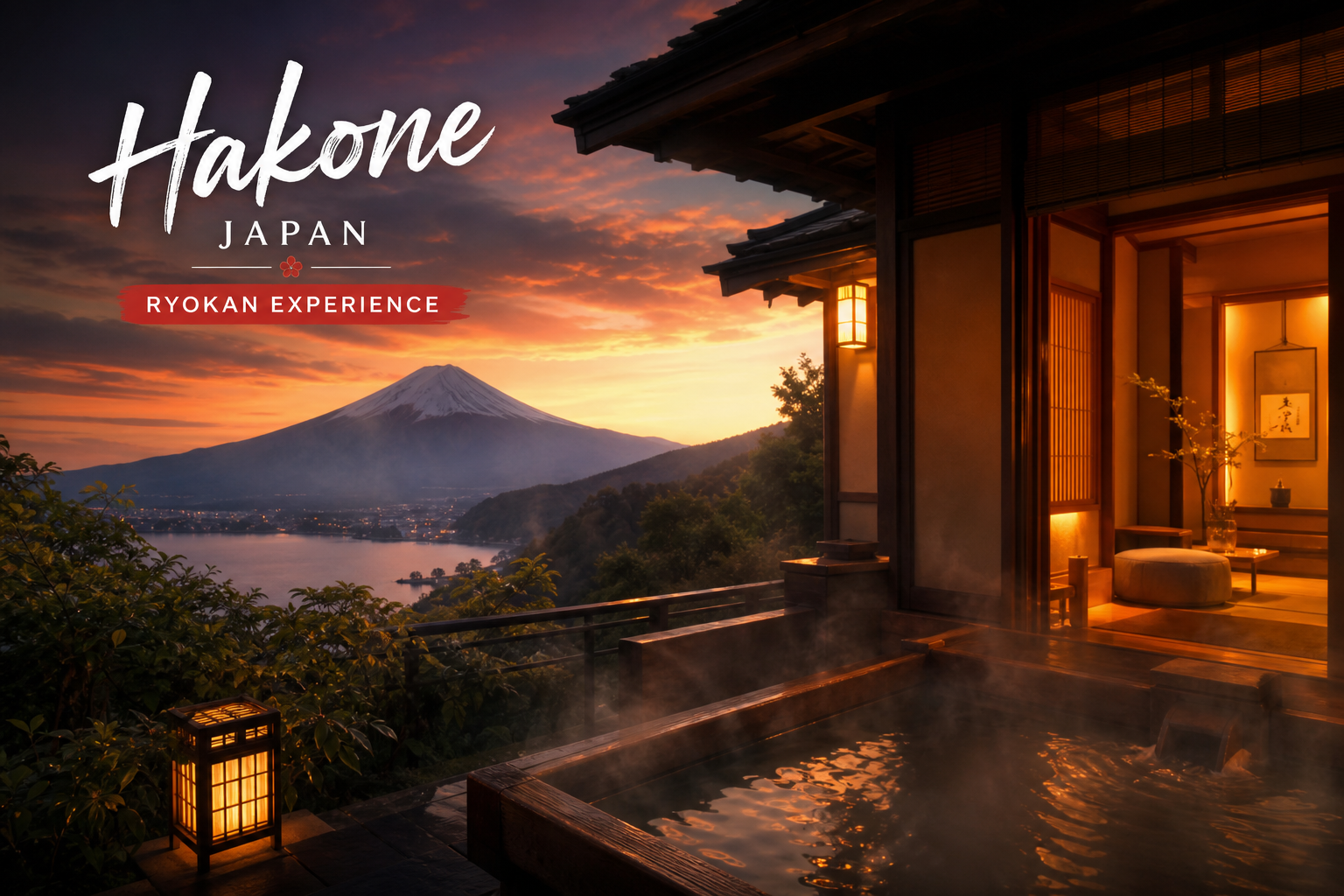
The moment you slide off your shoes at the entrance of a Japanese inn, something shifts. Not in a dramatic way, but in the quiet, cellular way that only happens when a place is designed to slow you down by default. You step onto tatami, a staff member appears with tea and sweets, and the frantic pace of Tokyo, just 90 minutes behind you, starts to feel like a different lifetime. A traditional inn stay in Hakone, Japan, a ryokan in the fullest sense, isn’t a hotel experience with Japanese aesthetics layered on top. It’s a complete cultural ritual, and it runs on entirely different rules.
Hakone sits at the intersection of accessible and extraordinary. Close enough to Tokyo for a weekend escape, yet the volcanic mountains, mineral-rich waters, and centuries-old innkeeping traditions make it feel genuinely removed from the modern world. For first-timers to Japan, a Hakone ryokan is the clearest entry point into traditional inn culture, with options ranging from understated mountain retreats to some of the most refined properties in the country. This guide covers what to expect when you arrive, how to behave at the baths, what you’ll eat, how to choose your area and room type, and exactly how to book.
One thing worth understanding before you start planning: staying at a ryokan in Hakone, Japan is not an experience you power through. Everything about it, from the multi-hour kaiseki dinner to the unhurried morning bath, resists the urge to rush. That’s not a limitation. That’s the entire point.
Hakone Ryokan Arrival: What the First Hour Actually Feels Like
The genkan, or entryway, is where the transformation begins. You remove your shoes, leave the outside world at the door, and step up into the inn. A staff member greets you, often by name, and escorts you to your room. On the low table, you’ll find matcha and a small plate of wagashi, traditional sweets shaped like seasonal motifs. The check-in paperwork, if it exists at all, happens quietly, almost as an afterthought.
This is omotenashi in practice: anticipatory hospitality, where the staff has already considered what you need before you think to ask. Your futon placement, your meal timing, your bath reservation, all of it is arranged without you having to manage it. For travelers who spend most of their trips coordinating logistics, this feels genuinely disorienting at first, and then deeply restorative.
Your room will have a low table, floor cushions, and a futon that appears later in the evening, turned down while you’re at dinner. The tokonoma, a small decorative alcove, typically displays a seasonal scroll or flower arrangement. On the table you’ll find a folded yukata, the casual cotton robe worn throughout the stay. Wear it left panel over right; reversing it is a common mistake for first-timers, since the reverse is reserved for funerals. The yukata goes with you to the onsen, to dinner, and on quiet walks around the inn’s grounds.
Three etiquette basics matter most: never step onto tatami in shoes or slippers, give a soft knock before entering communal spaces, and respect the general culture of quiet that a ryokan operates by. These aren’t rigid rules enforced by staff. They’re the invisible architecture of the experience.
Onsen Culture From the Inside Out
The hot spring bath is central to any Hakone ryokan stay, and it’s the part that makes some first-timers most nervous. The main decision to make before you book is whether you want a communal bath or a private one.
Communal vs. Private Onsen
Communal baths are segregated by gender, shared with other guests, and deliver the full traditional onsen experience. Private baths, either in-room or in a detached open-air setting, offer complete seclusion and cost significantly more. For couples, solo travelers with tattoos, or anyone uncomfortable with communal bathing, a private onsen room changes the experience entirely.
Several Hakone ryokans guarantee private baths for every room. Hakone Kowakien Ten-Yu puts a private open-air bath in every room, with nightly rates running from roughly ¥152,000 to ¥285,000 (approximately $1,000, $1,900 USD). Hakone Gora Byakudan does the same across all 16 of its rooms at ¥41,800 to ¥79,800 per night (around $280, $530 USD). Hakone Hoshi no Akari sits in the mid-range with private semi-open-air baths at around $340 to $400 per night for two people. For travelers with visible tattoos, private baths are the practical solution: most communal onsens still prohibit tattoos due to longstanding cultural associations, but private baths sidestep the policy entirely.
The Pre-Bath Ritual
Whether you choose communal or private, the pre-bath ritual is non-negotiable. Shower thoroughly at the seated wash station before entering the water. Soap up, rinse completely, and clean your space. No swimwear. No phones or cameras. Keep your small towel folded at the edge of the bath rather than dipping it in the water. These rules aren’t arbitrary; they exist because the water is shared and the space is sacred in a meaningful, non-metaphorical sense.
Hakone’s waters are sulfurous and mineral-rich, drawn from the volcanic geology of the Fuji-Hakone-Izu National Park. The water feels noticeably different from a regular hot bath: slightly silky, deeply warming, with a faint mineral smell that signals you’re soaking in something geologically significant. Most guests bathe twice, once in the evening before dinner, and again early in the morning before breakfast. Both are worth it.
Kaiseki Dining: Why the Meal Is the Whole Experience
Kaiseki is the Japanese haute cuisine form that evolved from tea ceremony culture, and at a Hakone ryokan, it’s the culinary equivalent of the onsen: structured, seasonal, and impossible to rush. A full kaiseki dinner typically moves through seasonal appetizers, clear soup, sashimi, a simmered dish, a grilled course, rice with pickles, and dessert. The portion of each course is considered rather than abundant. The goal isn’t to fill you up; it’s to show you the season through food, with every ingredient reflecting what’s growing, swimming, or ripening right now in this specific region.
Meals are served in your room or in a private dining room, never in a loud communal setting. The pacing is slow by design: a kaiseki dinner at a quality inn runs two hours. For travelers used to eating in twenty minutes, this requires a genuine adjustment. Most guests report that by the third course, they’ve stopped checking their phones and started actually tasting things.
Breakfast operates on the same intentional logic. Grilled fish, rice, miso soup, tofu, pickled vegetables, and tamago arrive in careful sequence, a simple meal, but deeply considered, often featuring local Hakone produce or seasonal mountain vegetables. Nearly every first-timer who skips it in favor of sleeping in wishes they hadn’t.
For the highest kaiseki standards in Hakone, three names come up consistently: Gora Kadan, widely regarded as the benchmark for refined kaiseki and elite hospitality in the region; Hakone Gora Byakudan, which focuses on sophisticated seasonal menus across a smaller, more intimate property; and Hakone Ginyu , which pairs strong kaiseki quality with some of the better scenic views in the area. Sitting still for a two-hour dinner is itself a kind of practice, and slow travelers tend to recognize the philosophy immediately.
Choosing Your Area: Gora, Yumoto, Miyanoshita, and the Lake Side
Gora is the best area if a classic mountain inn experience is your priority. Surrounded by forest and elevated enough to feel genuinely removed, it’s home to Hakone’s most celebrated ryokans, including Gora Kadan and Hakone Gora Byakudan. The trade-off is practical: Gora has limited dining outside your inn, the terrain is hilly, and it’s less convenient as a base for moving around Hakone. Go here if you intend to stay in and let the inn be the destination.
Hakone-Yumoto is the gateway town and the most straightforward choice for first-timers. It has the best transport connections from Tokyo, the widest range of accommodation types, from budget guesthouses to mid-range traditional inns, and more restaurant and shopping options than any other area. It’s busier and slightly more touristy than Gora or Miyanoshita, but for a first stay, the accessibility removes a lot of logistical stress.
Miyanoshita occupies a middle ground worth considering: quieter and more refined than Yumoto, with an atmosphere that recalls an older, less-crowded version of Hakone. Nearby dining options are limited, but the trade-off in atmosphere is substantial. It works well for travelers who want a genuine traditional experience without paying Gora-level prices.
If Lake Ashi views or the possibility of seeing Mt. Fuji from your room are the priority, the Motohakone and Hakone-machi areas deliver that specific reward. They’re less convenient for transport and have fewer dining options, but the scenery is unmatched. Hakone Ginyu and Hakone Kowakien Ten-Yu offer strong combinations of scenic setting, kaiseki quality, and private onsen options from this part of Hakone.
How to Book a Hakone Ryokan
Three periods make Hakone ryokans genuinely hard to book: cherry blossom season in late March through early April, Golden Week in late April through early May, and autumn foliage around mid-November. During these windows, availability at well-regarded properties collapses quickly. For regular travel, book at least three months ahead. For weekends, holidays, or any of the peak periods above, aim closer to six months out, especially for sought-after properties. Rooms with private onsen baths or Fuji and lake views sell out first, so treat those as the most time-sensitive bookings. (See Tokyo’s weather by season: the slow traveler’s guide.)
Price structure at a Hakone ryokan follows a clear logic. Rooms with access to communal baths are the most affordable entry point; Hakone Gora Byakudan starts at ¥41,800 per night for this tier. Adding a private open-air in-room bath increases the cost significantly, sometimes doubling it. Almost all ryokans sell rooms on a “2 meals included” or MAP plan, meaning dinner and breakfast are built into the rate. When comparing prices across properties, factor this in: what looks expensive per night often includes two full meals at a quality level that would cost considerably more if purchased separately.
For booking platforms, Jalan and Ikyu carry the most comprehensive inventory in Japanese, while Booking.com and Relux provide accessible English-language options for international travelers. Booking directly through a ryokan’s own website sometimes unlocks specific room types or early check-in arrangements that third-party platforms don’t surface. Check both before confirming.
Getting From Tokyo to Hakone
The most atmospheric route is the Romancecar, Odakyu’s limited express train from Shinjuku directly to Hakone-Yumoto, roughly 85 to 90 minutes and about ¥2,470. No transfers required, large windows, and a sense of occasion that regular trains don’t provide. For ryokans in the Gora area, the faster option is the Shinkansen to Odawara followed by the Hakone Tozan Train up to Gora, totaling 70 to 90 minutes at around ¥3,500 to ¥4,500. If your ryokan is on the lake side near Moto-Hakone or Hakone-machi, the direct highway bus from Shinjuku takes about two hours and costs roughly ¥2,000 to ¥2,240.
The Hakone Free Pass covers round-trip Odakyu travel from Shinjuku plus unlimited rides on the Tozan Train, cable car, ropeway, lake cruise, and most local buses. A two-day pass runs about ¥6,000 from Shinjuku. For a single overnight stay that includes sightseeing across multiple Hakone areas, it pays for itself. If you’re going straight to your ryokan and staying put, skip the pass and buy individual tickets instead.
The Philosophy Behind the Stay
A ryokan works precisely because it removes the option to rush. The kaiseki dinner takes two hours. The onsen requires you to be still in hot water. The futon is prepared and put away by someone else, on a schedule you didn’t set. Every element is designed to interrupt the habit of performing your travels rather than living them.
The key decisions are straightforward in retrospect: choose your area based on whether atmosphere or transport access matters more to you, book at least three months ahead regardless of season, and consider a private onsen if this is a milestone trip or a first encounter with communal bathing. Choose your Hakone ryokan carefully, and let the inn handle the rest.
At The Curious Atlas, this is the kind of travel we believe in most: going deep into a single place rather than skimming across many. Whether that means spending three nights in a ryokan in Hakone, Japan, or a slow week on the shores of Bacalar in Mexico (see our Light Pack Kit for Slow Travel in Mexico), the philosophy is the same. Arrive curious, resist the urge to optimize, and let the place do what it was designed to do.
Leave a Reply