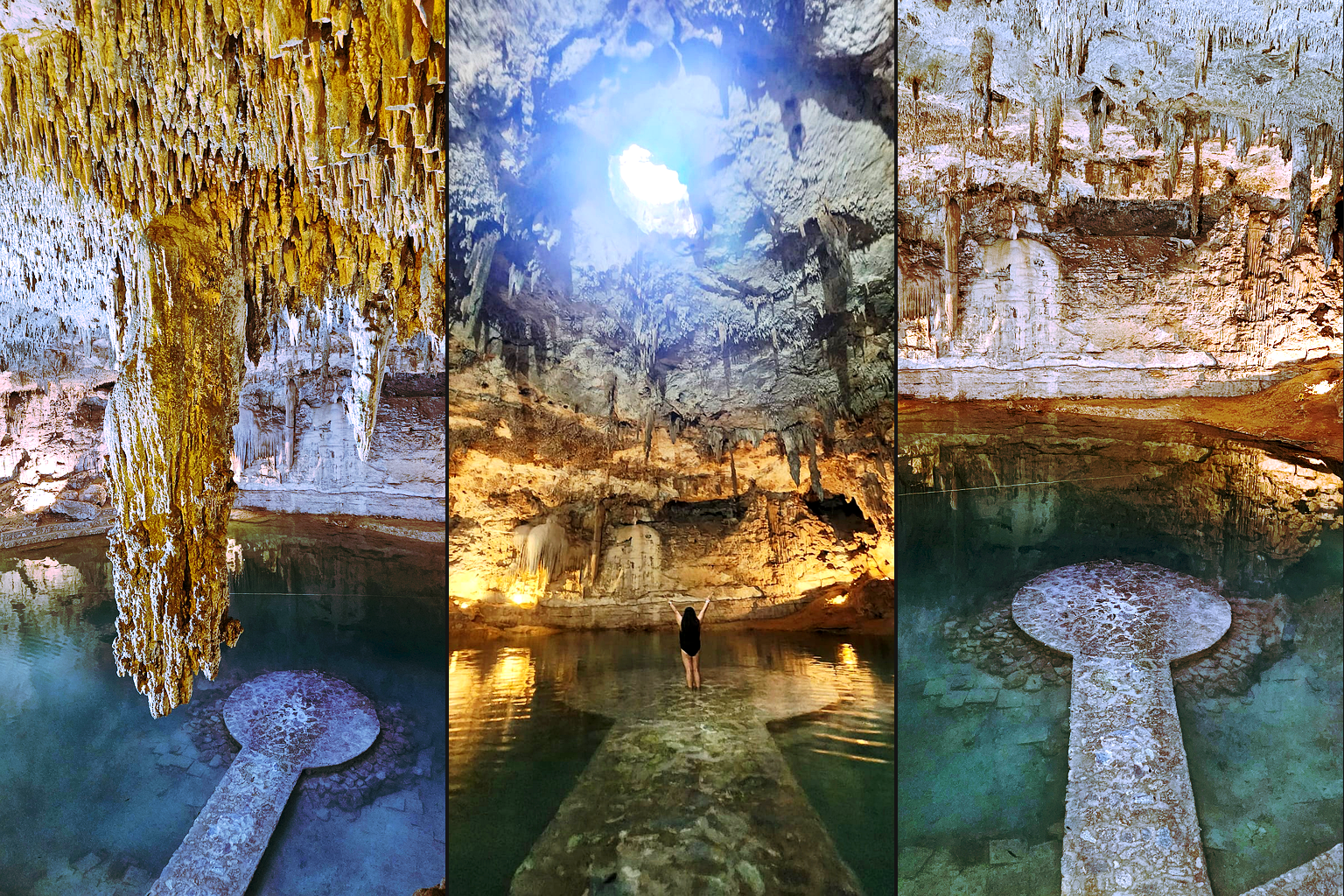
Suytun Cenote has a way of showing up in people’s plans at the last minute. Most travelers who end up at this subterranean pool east of Valladolid will tell you the same thing: they nearly skipped it. Their Yucatan plan was built around Chichén Itzá in the morning and the Riviera Maya coast by afternoon, with Valladolid treated as a fuel stop rather than a destination. Then someone at the hostel mentioned a cenote with a beam of light. That accident is worth engineering on purpose.
Suytun Cenote sits roughly 10 kilometers east of Valladolid on Highway 180, inside a cavern carved by millennia of groundwater. Its signature image, a narrow column of sunlight dropping through a hole in the cave ceiling and landing on a stone platform surrounded by dark still water, has made it one of the most photographed spots in Mexico. But the image tells only part of the story. Here at The Curious Atlas, the Yucatan comes up more than almost any other region, and Suytún earns its mention not because of a single photo, but because of how well it fits into a larger, layered journey. These five reasons are specific and practical, designed to help you decide, plan, and arrive prepared.
1. The Suytun Cenote Light Beam Is Real, but Timing Determines Everything
The cavern photograph that circulates widely online is not staged, but it is conditional. The column of sunlight appears when the sun sits high enough to drop directly through the ceiling opening, which means the window runs from roughly 11 AM to 2 PM. Arrive at 9 AM when doors open and you will find a quieter cenote, but the beam will be weak or absent. Cloud cover can eliminate it entirely, a clear day is not a nice-to-have, it is the whole premise.
For photographers, the practical setup involves a managed queue. A rope line forms at the circular stone platform in the water, where lifeguards give each visitor approximately one minute on the platform, with repeat visits permitted within your one-hour slot. Tripods are allowed and genuinely useful here, since the cenote is dim and long-exposure shots reduce noise significantly.
Drones are banned and bags are checked at entry, so leave the drone behind entirely. For a wider composition that captures both the beam and the stalactite ceiling, the top of the entrance staircase offers the best framing without waiting in the platform queue. Shoes come off at the platform edge, so wear footwear that slips on and off easily.
2. Getting to Suytun Cenote Takes Less Effort Than You Expect
The cenote’s location is one of its quiet advantages. The drive from central Valladolid takes 9 to 15 minutes, which puts it firmly in the category of a morning half-day excursion rather than a logistical commitment. Three realistic transport options exist, and each suits a different travel style.
Transport Options
A taxi from central Valladolid runs approximately 140 MXN one way and requires no planning beyond flagging one down near the main plaza. Colectivos heading toward Tikuch depart when full and cost considerably less, making them the budget traveler’s default, though the schedule is unpredictable. Renting a scooter or car gives you full scheduling flexibility and free parking at the site, which matters on days when you want to combine multiple cenotes in the same circuit.
Travelers coming from Cancún or Playa del Carmen follow the same basic route. Take an ADO bus to Valladolid (roughly 1.5 to 2 hours, fares generally in the 150 to 180 MXN range depending on class and timing), then connect by taxi or colectivo. Neither origin city requires a tour group or a rental car, though a car simplifies combining Suytún with Chichén Itzá and other stops on the same day without waiting for vehicles that depart when full. You can read about how to use the ADO Mexico website here.
Ticket Price and Hours
The gate price for adults sits at 250 to 280 MXN, which is broadly comparable to other well-maintained cenotes in the region. Booking through the official Suytún website brings that down to approximately 230 MXN, with children’s tickets discounted similarly, worth doing if you plan ahead. Life jackets are included in the entry fee. Carry MXN cash for any on-site costs beyond the entrance, as card acceptance can be inconsistent.
3. Off-Peak Timing Changes the Experience Completely
Suytún is not undiscovered. On a weekend midday with two tour buses in the parking lot, the platform queue runs long, the cavern echoes with conversation, and the meditative quality of the space evaporates quickly. On a Tuesday morning with twenty people inside, the same cave feels like a private geological wonder. The difference comes down almost entirely to when you arrive and which days you choose.
Two tour buses in the parking lot is the clearest signal to either adjust your expectations or return later in the afternoon. Weekdays run noticeably quieter than Saturdays and Sundays. Arriving at the 9 AM opening puts you ahead of the midday tour wave, even though the beam is still building at that hour. One tactical option: arrive early for swimming and exploration, then stay through 11 AM to catch the light. Late afternoon, after 2 PM as buses begin to leave, also offers a quieter window, though the beam fades as the sun lowers.
The official visit window is approximately 60 minutes. In practice, a complete visit including the platform queue, a swim, and time to absorb the stalactite ceiling runs 45 to 75 minutes. There is no reason to rush, but there is also no reason to plan a half-day here if you have other stops on the same day. One hour inside the cenote is genuinely enough, though the memory tends to linger a good deal longer.
4. Valladolid Turns the Cenote into a Full Day Worth Journaling About
Factor in travel time and Suytún becomes a roughly 90-minute excursion on its own. Valladolid as a base converts that into a day with real depth. The city sits roughly 30 to 45 minutes from Chichén Itzá by car, colonial in its architecture, and affordable in a way that feels deliberately different from the tourist economy of Tulum or Playa del Carmen. The painted facades along Calzada de los Frailes, the central plaza, and the local market reward a slow hour before or after the cenote without requiring a guide or an itinerary.
The food scene is worth building time around. Valladolid offers honest Yucatecan cooking, cochinita pibil, sopa de lima, poc chuc, and salbutes, at prices that reflect local economics rather than tourist markup. Spots like IX Cat Ik for Mayan cuisine in a garden setting, or the market stalls at Mercado 41 for shrimp tacos, deliver the kind of meal that earns its own paragraph in a travel journal.
For cenote enthusiasts, the area surrounding Valladolid is one of the densest concentrations of accessible cave pools in the Yucatan. Cenote Zaci sits inside the city itself. Cenote Oxman, known for its vivid blue water and hanging roots, and Cenote Samula are both within a short drive. Stringing two or three together in a single day is realistic and satisfying, particularly with a rental car or a hired driver who knows which access roads to take.
5. Suytun Cenote Fits a Larger Yucatan Route Better Than Almost Any Other Stop
Geography is the cenote’s most underappreciated feature. Suytún sits at the crossroads between the Yucatan’s two most-visited landmarks: Chichén Itzá lies roughly 40 kilometers to the west, and the Riviera Maya coast extends to the east. A traveler moving between those two poles passes directly through the Valladolid corridor without a detour. That kind of positioning is genuinely rare.
One coherent structure for the day runs like this. Start at Chichén Itzá at opening, it simultaneously beats the heat and the crowds. Allow two to three hours to cover the main structures. Drive east toward Valladolid and arrive at Suytún between 11 AM and noon to catch the light beam at its peak. Spend an hour at the cenote, then spend the afternoon in Valladolid for lunch and a slow walk through the colonial center. This is one of the most complete single days in the Yucatan, and it requires no tour company to execute.
For travelers with an extra day, Ek Balam slots cleanly into the same circuit. The site is an undervisited Maya ruin north of Valladolid with one of the best-preserved stucco facades in the region and far smaller crowds than Chichén Itzá. Combining Ek Balam, Suytún, and Valladolid on one day, then Chichén Itzá on the next, uses the geography efficiently without the overlap and backtracking that plagues loosely planned itineraries.
Offbeat stops like Suytún are positioned between anchor landmarks so the logistics flow without scramble. The routes cover which colectivo stop to use in Valladolid, which restaurant near the plaza earns the longest lunch, and how to read the parking lot at Suytún before you buy your ticket. That is the difference between a list of coordinates and a journey that actually coheres.
The Case for Making It Deliberate
Suytun Cenote is not a hidden gem. The buses find it, the Instagram algorithm surfaces it, and the platform queue on a Saturday midday will remind you that plenty of people already know; you can see visitor impressions on Trip Advisor’s Suytun Cenote reviews. But knowing about a place and experiencing it well are different things, and the gap between them is almost entirely logistical. The light beam, the access from Valladolid, the off-peak windows, the surrounding day-trip circuit, and the itinerary logic all point toward the same conclusion: this stop rewards planning, not stumbling.
Build a day around it, not just a photo stop into it. Pair it with Chichén Itzá in the morning, eat lunch in Valladolid afterward, and leave with more than one strong memory. Suytún is one piece of a larger journey. It is a good one.
Leave a Reply