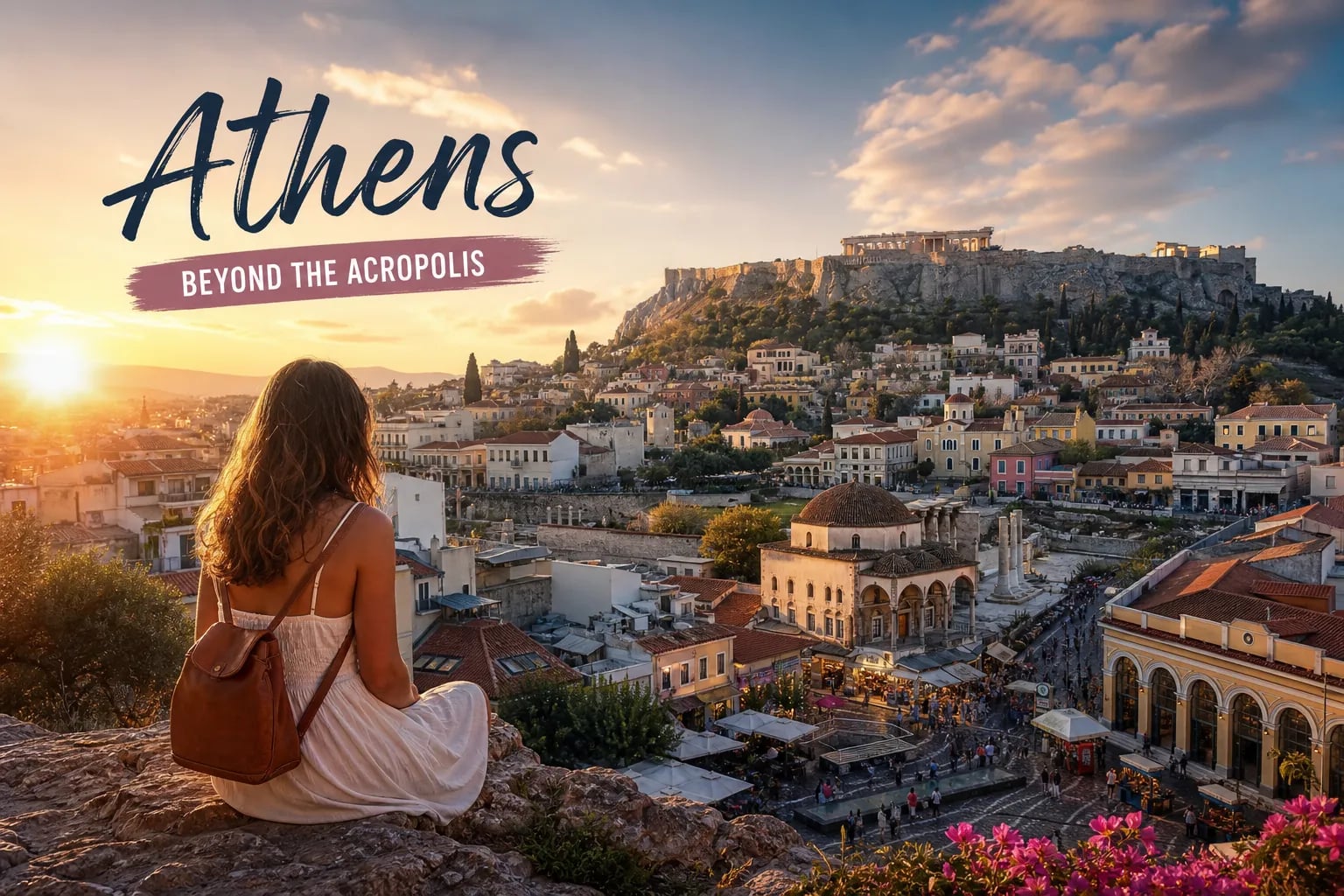
Athens attractions are everywhere once you stop looking only upward. The city draws roughly four million visitors a year to a single hilltop, which means that everything surrounding that hilltop often goes unseen. That’s the quiet paradox of Athens: one of the most visited cities on earth, yet one that keeps enormous reserves of itself hidden in plain sight, one neighborhood at a time.
At The Curious Atlas, we write for travelers who want to know a place rather than simply photograph it. Athens rewards that kind of attention more than almost any city on the Mediterranean. What you find when you stay curious and stay longer is a city with layers, ancient, Byzantine, Ottoman, neoclassical, and thoroughly modern, compressed into the same streets in a way that makes the city itself feel like a living archaeological site.
This guide gives you the practical tools to see Athens well: which sites deserve your time, how to structure your days by neighborhood, sample itineraries for one to four days, and the timing logic that separates a smooth visit from an exhausting one. Whether you’re planning things to do in Athens for a single afternoon or a full week, the framework below adapts to your pace.
Top Athens attractions: the sites that earned their reputation
Some places become famous for good reason, and the Acropolis is the clearest example in Athens. But knowing how to visit the iconic sites efficiently is what creates room in your day for everything else the city has to offer.
Start early or lose the morning
The single most effective decision you can make in Athens is arriving at the Acropolis at opening, which is 08:00 year-round. Summer mornings there are genuinely stunning before the crowds arrive, and the heat that makes midday visits punishing is still manageable at that hour. Plan for two to three hours on the hill itself. The current full-price ticket is €30, with a reduced rate of €15. Booking in advance at tickets.hh.gr can generally help you avoid the on-site queue, which builds quickly after 09:00 in peak season.
The Acropolis Museum deserves its own half-day
The most common mistake travelers make is rushing through the Acropolis Museum directly after the hilltop, when their feet are tired and their attention is spent. Treat it as a separate anchor, ideally an afternoon visit on a different day. At €20 full price and €10 reduced, it justifies the time. Friday evening hours are an underrated secret: the museum stays open until 22:00, and the crowd thins considerably after 18:00. Allow at least 90 minutes, two hours if you want to give the Parthenon sculptures the attention they earn.
The Ancient Agora and why it gets overlooked
The Ancient Agora sits at the foot of the Acropolis, walkable from Monastiraki in minutes, and yet it consistently sees a fraction of the foot traffic of the main hill. The Temple of Hephaestus, tucked inside the Agora grounds, is arguably the best-preserved ancient Greek temple you’ll see in Athens, and it typically draws far fewer visitors than the Acropolis. Budget 90 minutes to two hours and come away with a far more grounded sense of what ancient Athenian civic life actually looked like.
Hidden Athens attractions most visitors miss
Every great city contains a second city, visible only to those willing to move slowly and look sideways. In Athens, that second city is not hidden. It’s simply off the main current. These are the places that shift how you understand everything else you’ve seen, and they belong on any honest list of Athens must-see sites.
Kerameikos: the cemetery that changes how you see the city
The ancient Kerameikos cemetery is one of the most genuinely moving sites in Athens, and one of the least visited. It served as the burial ground of ancient Athenians for centuries. It was also the starting point of the Sacred Way to Eleusis, the processional route connecting Athens to one of the ancient world’s great religious sanctuaries. The small onsite museum holds remarkable funerary sculpture that puts faces, in a sense, to the people whose monuments you’ve been walking among all day.
Note before you plan: as of 2026, Kerameikos has been temporarily closed due to ongoing works, so check the official Hellenic Heritage website for current status. When open, admission is €10 full and €5 reduced. Its location near Monastiraki makes it easy to fold into a morning that also includes the flea market and the Agora.
Anafiotika: a Cycladic village tucked into the Acropolis slope
Most visitors to Athens walk directly beneath Anafiotika without realizing it exists. It sits on the northeast slope of the Acropolis, just above Plaka, and it looks exactly like a village on a Cycladic island: whitewashed walls, bougainvillea draped over doorways, cats ruling the alleyways, and very little tourist commercial activity, few cars, no restaurant menus posted outside, almost no souvenir shops.
The origin story alone is worth knowing. In the 1840s and 1860s, builders and craftsmen from the island of Anafi came to Athens to work on the reconstruction of the capital under King Otto. They built homes on the rocky slope using the architecture of the island they’d left behind, some of it reportedly constructed overnight to take advantage of customs that allowed overnight-built structures to be claimed by their builders. What remains today is a pocket of island Greece in the center of a capital city, and most visitors pass the entrance without ever looking up.
Athens Central Market (Varvakios Agora): where the city feeds itself
The Varvakios Agora near Monastiraki is where Athens does its actual eating and cooking. This is a working food market: meat halls, fish counters, olive oil vendors, spice stalls, cheese, herbs, and the kind of organized chaos that only a genuinely functional place produces. It’s one of the best Athens attractions for understanding the city’s food culture without a tour guide filtering the experience for you. The market runs Monday through Saturday, roughly 07:00 to 18:00, with the meat and fish sections typically winding down by early afternoon, check current municipal schedules before you visit, as hours can shift seasonally. Go between 07:00 and 10:00 for the fullest, most atmospheric window.
How to pair neighborhoods with the right attractions
Athens organizes itself into walkable zones, and understanding which neighborhood anchors which sites is the mental model that turns a confusing city into a navigable one. Think of it not as a map but as a set of moods, each suited to a different traveler mindset and a different part of the day.
Plaka and Koukaki: the classical base
Plaka is the old-town gateway to the main archaeological sites, Anafiotika, and the atmospheric streets that connect them. It carries more tourist foot traffic than any other neighborhood, which works well for a morning but can feel saturating by afternoon. Koukaki, directly south of the Acropolis hill, is the quieter residential alternative. It puts the Acropolis Museum within a five-minute walk and filters out most of the souvenir-shop noise. For any traveler who wants proximity to the monuments without the tourist saturation, Koukaki is the better base.
Monastiraki and Thissio: the market-and-ruins corridor
This zone is Athens at its most energetically street-level: flea markets, street food, the entrance to Kerameikos, and multiple significant ruins, all in a stretch where the city’s history and daily life are visibly happening side by side. The morning window is best for the markets, with the archaeological sites better visited in early afternoon before tour groups peak again. The view of the Temple of Hephaestus from the Thissio side of the Agora is one of the finest in the city and costs nothing to appreciate from the street.
Kolonaki and Psirri: two moods, two itinerary roles
Kolonaki is the upscale museum district: the Benaki Museum, the Museum of Cycladic Art, and Lycabettus Hill all cluster here, making it a natural anchor for a museum-focused afternoon. Psirri is a different proposition entirely. It’s an evening neighborhood, rebetiko bars, dinner spots, murals, and the kind of wandering that doesn’t need a destination. Reserve it for after dark rather than folding it into a daytime sightseeing schedule.
Sample Athens itineraries by trip length
The most useful itinerary isn’t a rigid hour-by-hour schedule. It’s a mental map you can adapt based on energy, heat, and whatever catches your attention along the way. The frameworks below are built to be loosened, not followed exactly.
One day in Athens: the essential circuit
Start at the Acropolis at 08:00, spend two to three hours on the hill, and walk down to the Acropolis Museum for a late-morning visit. Lunch in Koukaki or Plaka, then spend the afternoon wandering Plaka and climbing into Anafiotika before the light changes. Move toward Monastiraki for early evening, and finish at the Areopagus rock, the ancient hill just west of the Acropolis, for sunset over the city. This route is almost entirely walkable and keeps you in the historic center throughout the day.
Two days: adding depth without adding chaos
Keep Day 1 as the core circuit above. Use Day 2 for a second compact cluster that feels more like a living city: Syntagma Square, the National Garden, the Panathenaic Stadium (30 to 60 minutes is enough), and the Temple of Olympian Zeus. These sites connect on foot with minimal backtracking and give you a completely different sense of Athens outside the ancient core.
Four days: the slow-travel version
Days 1 and 2 follow the structure above. On Day 3, anchor the morning and early afternoon at the National Archaeological Museum, it needs two to three hours to do properly, then drift into Psirri for dinner and evening wandering. Day 4 is deliberately unhurried: Lycabettus Hill in the morning, the Kolonaki museum strip in the afternoon, and an evening in whichever neighborhood felt unfinished. This is a pace built for depth over distance, and it tends to produce the kind of travel that actually stays with you.
Practical details: tickets, timing, and making the most of each site
Good planning isn’t about rigidity. It’s about creating enough structure that you have space to follow the unexpected when it appears. These logistics make that possible.
The combination ticket situation in 2026
The classic multi-site combination ticket that used to bundle the Acropolis, Ancient Agora, Roman Agora, Kerameikos, Hadrian’s Library, the Temple of Olympian Zeus, and Aristotle’s Lyceum into one pass was phased out in April 2025. As of 2026, these sites are ticketed separately. The Acropolis ticket at €30 full price remains the anchor of any visit; budget separately for the Acropolis Museum at €20 full, and individual tickets for the Agora and other sites. Third-party bundled passes exist through some commercial sellers, but they come at a premium and aren’t worth it for most visitors.
The best times of day to visit each major Athens attraction
For the Acropolis in summer, before 09:00 is non-negotiable if you want manageable crowds and bearable heat. Avoid the 10:00 to 14:00 window in July and August entirely. The Acropolis Museum on Friday evenings after 18:00 is a genuine pleasure, with the Parthenon-level gallery quieter than at almost any other time. The Athens Central Market is best between 07:00 and 10:00. Anafiotika can go at almost any time since it sees far fewer visitors than the surrounding sites, which is the entire point of going.
Athens stays with you longer than the postcard version
The Acropolis is extraordinary. It deserves every hour you give it, and the view from the top at morning light is one of those genuinely moving experiences that travel occasionally delivers. But the city’s real character, what makes Athens distinct rather than merely ancient, shows up in a cemetery where almost no one visits, in a neighborhood built by island workers who missed home and recreated it on a hillside, and in a market hall where the city has been feeding itself for generations.
These are the Athens sightseeing experiences that stay with you after the photographs fade. They don’t show up on the big tourist maps. They’re the kinds of things to do in Athens that reward slowness, curiosity, and the willingness to turn down an alley just to see where it goes. And they’re what separates a trip you remember from one you merely document.
If this is the kind of travel you’re drawn to, curiosity as the compass rather than the checklist as the guide, The Curious Atlas writes exactly this way. The next destination is already waiting.
Leave a Reply