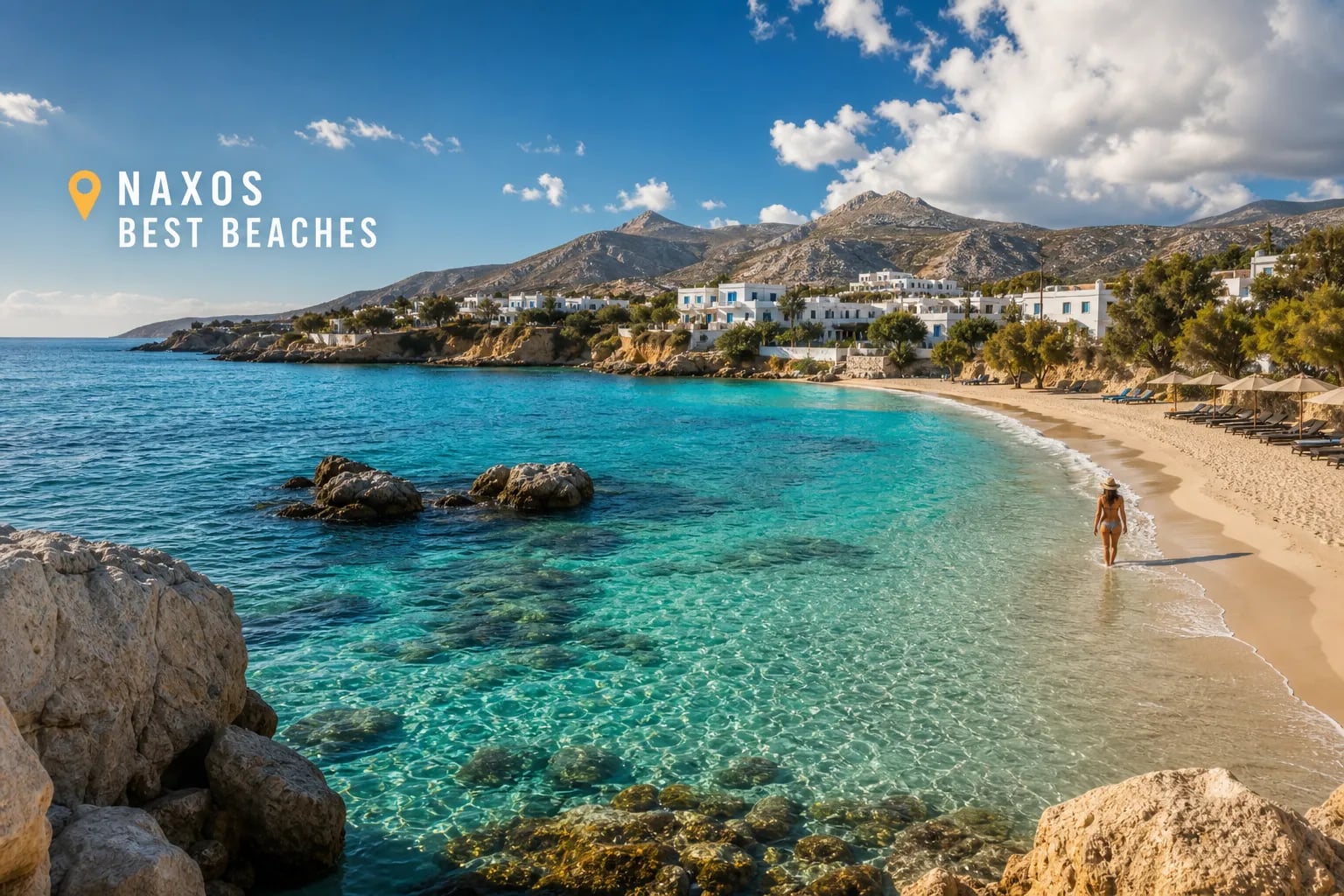
Most travelers arrive on Naxos expecting a tidier version of the Greek islands they already know: a handful of postcard-ready coves, a beach club, and a bus that covers the essentials. What they find instead is something harder to navigate and far more rewarding. Naxos island beaches are more varied than many visitors expect, the island has an unusually long and diverse coastline for a Cyclades island of its size, and almost none of it comes with a helpful sign pointing you toward the right stretch for your particular travel style.
The beaches here range from shallow, glass-calm family bays to wild cedar-backed coves that barely register on tourist maps. That range is the point. But without a framework for choosing, you can spend three days bouncing between beaches that weren’t right for you while the perfect one sits just a short drive away, Agios Prokopios, for instance, is only about 5 km from Naxos Town. This guide is built to fix that. At The Curious Atlas, the philosophy is simple: a beach worth visiting has a story, not just a sunbed queue. What follows is how that lens sorts the best swimming on Naxos by the kind of traveler you are.
What makes Naxos island beaches different from the rest of the Cyclades
Naxos is bigger, greener, and less curated than Mykonos or Santorini. Where those islands have been aggressively optimized for a particular kind of visitor, Naxos has been largely left to itself. The meltemi wind has shaped its coastline over centuries, and most of that coastline remains exactly as it was shaped: raw, long, and unhurried. That looseness is a feature, not a bug.
The island divides into two distinct coastal personalities, and understanding which one you want shapes every decision that follows. The west coast offers organized, bus-accessible beaches suited to families and casual swimmers, while the southern shore delivers wild, cedar-backed coves that feel genuinely remote.
The west-coast strip vs. the wild southern shore
The west coast runs in a nearly unbroken sandy arc from Agios Georgios, just steps from the port, south through Agios Prokopios, Agia Anna, Plaka, and on to Mikri Vigla. This corridor is organized, bus-accessible, and built for convenience. The infrastructure works. The south coast from Kastraki through Alyko is a fundamentally different experience: cedar-backed, largely unorganized, and generally accessible only by car or with very limited seasonal public transport. Same island, different world.
Organized vs. unorganized: why the distinction matters
Organized beaches on Naxos mean sunbeds, umbrellas, and a beach bar that finds its volume by noon. Unorganized means you bring your own shade, carry your own water, and keep the silence. Neither type is superior. Choosing the wrong one for your mood, though, will ruin a perfectly good afternoon, which is reason enough to decide in advance.
Best Naxos island beaches for families and calm-water swimmers
The western coast was built for this. The shallow, gradually deepening water along the main beach corridor, combined with reliable bus access and full facilities, makes it genuinely effortless for families and for anyone who wants to arrive, swim, and eat without logistical friction.
Agios Prokopios: the gold standard for calm swimming
About 5 km from Naxos Town, Agios Prokopios is the island’s benchmark beach, and it earns that status. The water is crystal-clear and shallow close to shore, so you can see the sandy bottom without snorkeling gear. The coarse golden sand is thick and pleasant underfoot. Facilities are full-service, sunbeds, umbrellas, cafés, beach bars, and the bus from town runs frequently throughout high season, with intervals commonly around 20, 30 minutes on the main west-coast corridor (check the current seasonal timetable for exact times). The one practical note: July and August crowds are real. Arriving before 10 a.m. secures a good position and a quieter first hour on the water.
Agios Georgios and Agia Anna: close, calm, and bus-friendly
Agios Georgios is essentially in Naxos Town, a 10-minute walk from the port. As a first-day swim, it doesn’t get easier. The water is shallow and sheltered, the infrastructure is full, and it costs you nothing in transit time. Agia Anna, 6 km south, adds tavernas, a slightly more local atmosphere, and fine sand that holds its shape well into the afternoon. Both beaches share the same caveat: when the meltemi blows hard in late July and August, expect some chop on the surface even in these sheltered bays. Sea temperatures peak around 24, 25°C in August, making the water genuinely warm from June onward.
Where solo travelers and quiet-seekers find their stretch of sand
The further south you travel on Naxos, the fewer people you’ll find. Two beaches in particular reward the traveler willing to walk a little further or rent a car for a day. Both sit beyond the reach of the main bus corridor, which is precisely why they stay quiet.
Plaka’s southern stretch: the crowd-free escape hiding in plain sight
Plaka runs for nearly 4 km, which is its best-kept secret. Most visitors cluster near the bus stop at the northern end, where the sunbeds are, then turn around. Walk 20 minutes south and the infrastructure disappears entirely. The sand stays fine and pale gold, the water remains the same turquoise clarity, and the only sound is the meltemi moving through the dunes. Plaka’s southern stretch is one of the best unorganized beach experiences on the island, and most people who visit Plaka never find it.
Alyko and the Hawaii beach: Naxos’ most beautiful wild coast
About 20 km from Naxos Town and reachable only by car, Alyko sits in a cluster of protected coves framed by cedar and pine forest. The beach nicknamed “Hawaii”, sometimes listed as Glyfada Hawaii beach Naxos on local maps, offers soft white sand, water that reads crystal-clear even from above, and largely no organized beach infrastructure: no sunbeds, no bars, no real crowd. This is the beach for travelers who find organized beaches slightly exhausting. Note that the access track involves some unpaved sections, so a standard rental car handles it fine but check conditions before taking anything low-slung. Spending a full morning here before looping back through the island’s interior is one of the better days Naxos offers.
Naxos island beaches for snorkelers, windsurfers, and active swimmers
Not every beach visit is about lying horizontal. The meltemi, which blows consistently from May through October, with July and August delivering the strongest gusts, turns the southern end of the west coast into some of the Aegean’s most reliable conditions for watersports. The same rocky fringes that make these beaches less comfortable for lazy swimming make them excellent for anyone with a mask.
Mikri Vigla: the meltemi-powered windsurfing and kitesurfing hub
Eleven kilometers from Naxos Town, Mikri Vigla splits in two. One side faces the open wind corridor and delivers consistent, strong conditions for experienced windsurfers and kitesurfers, particularly in July and August when the meltemi blows 4, 7 Beaufort on 20 or more days a month. The other side sits in a calmer bay with clear water suitable for swimmers who are happy to enjoy the spectacle from shore. Wind schools operate here throughout the season, so beginners can access instruction without needing to arrive as an expert.
Wind season timing and snorkeling alternatives
July and August bring the strongest meltemi, ideal for watersports and rougher for casual swimming at exposed beaches. June and September offer a better balance of warm water (around 22, 24°C) and manageable conditions for anyone who isn’t there for the wind. May is noticeably cooler at around 18, 19°C, so adjust expectations if you’re visiting early in the season. For snorkeling, the rocky headlands around Mikri Vigla and the natural coves near Alyko reward patience with clear water, good visibility, and species like wrasse and sea bream that favor the rocky fringes the sandy main beaches can’t match.
Getting to Naxos beaches: what the bus covers and when to rent a car
The good news for independent travelers without a car is that the main west-coast corridor is genuinely well-served. The honest caveat is that anything south of Mikri Vigla requires different planning entirely.
The west-coast bus corridor and a Naxos beach map
A regular bus runs from Naxos Town through Agios Prokopios, Agia Anna, Plaka, and on toward Mikri Vigla throughout high season. This single route covers the majority of the island’s most popular beaches on Naxos. For most travelers spending 3, 4 days beach-hopping along the west coast, the bus is entirely sufficient and removes all parking headaches. Before you set out, it’s worth sketching a basic Naxos beach map using the route as your spine, Agios Prokopios and Agia Anna are your first stops, Plaka sits mid-corridor, and Mikri Vigla anchors the southern end. The service to Mikri Vigla runs only a few times daily, so checking the current seasonal timetable before relying on it for that leg makes sense.
When renting a car unlocks the island’s best-kept beaches
Alyko, Kastraki, Pyrgaki, and the east-coast beaches, including remote Psili Ammos and Moutsouna, are not practical by bus. A one-day car rental covers the entire southern coast comfortably, and the main roads are straightforward even for cautious drivers, though some tracks near remote coves are unpaved. Car hire is widely available in Naxos Town. For many travelers, two car days over a week-long trip is enough to reach everything the bus can’t, without surrendering the flexibility of the rest of your stay to a rental schedule.
Building your Naxos beach days: a practical rotation
Three days of focused beach time covers the main personalities of the Naxos coastline without feeling rushed. The key is grouping beaches by proximity rather than treating each one as a separate expedition.
- Day 1: Agios Prokopios in the morning for calm, shallow swimming, then a walk south along the coast to Agia Anna for lunch. Bus-accessible throughout, no logistics required.
- Day 2: Take the bus to Plaka early and walk the full length south to the unorganized stretch, then continue to Mikri Vigla in the afternoon if the wind is up. This single route covers three distinct beach personalities.
- Day 3: Rent a car and drive the southern coast, Kastraki, Alyko, Hawaii beach, then loop back through the island’s interior villages for a completely different view of Naxos.
At The Curious Atlas, the same instinct that sends you walking past the sunbed cluster at Plaka shapes guides to swimming spots from Mexico’s Caribbean coast to the Aegean. If this guide resonated, the cenote guides near Tulum and the beach scene along Playa del Carmen are worth reading next, there’s a particular kind of clarity that clear water offers whether you’re in the Cyclades or the Yucatan.
Naxos island beaches reward the traveler who goes a little further
The families and calm swimmers have Agios Prokopios and Agia Anna. The solo wanderers have the southern end of Plaka and the cedar-backed coves of Alyko. The wind chasers have Mikri Vigla. The bus gets you most of the way; a car gets you the rest.
Choosing the right Naxos island beaches for your travel style is the only real decision you need to make to enjoy this coastline fully. A peaceful traveler at a packed beach bar feels as out of place as an adventure seeker staring at a flat, sunbed-covered bay. Naxos has enough beach to satisfy both. This guide exists to make sure you end up on the right stretch of sand for you.
Leave a Reply