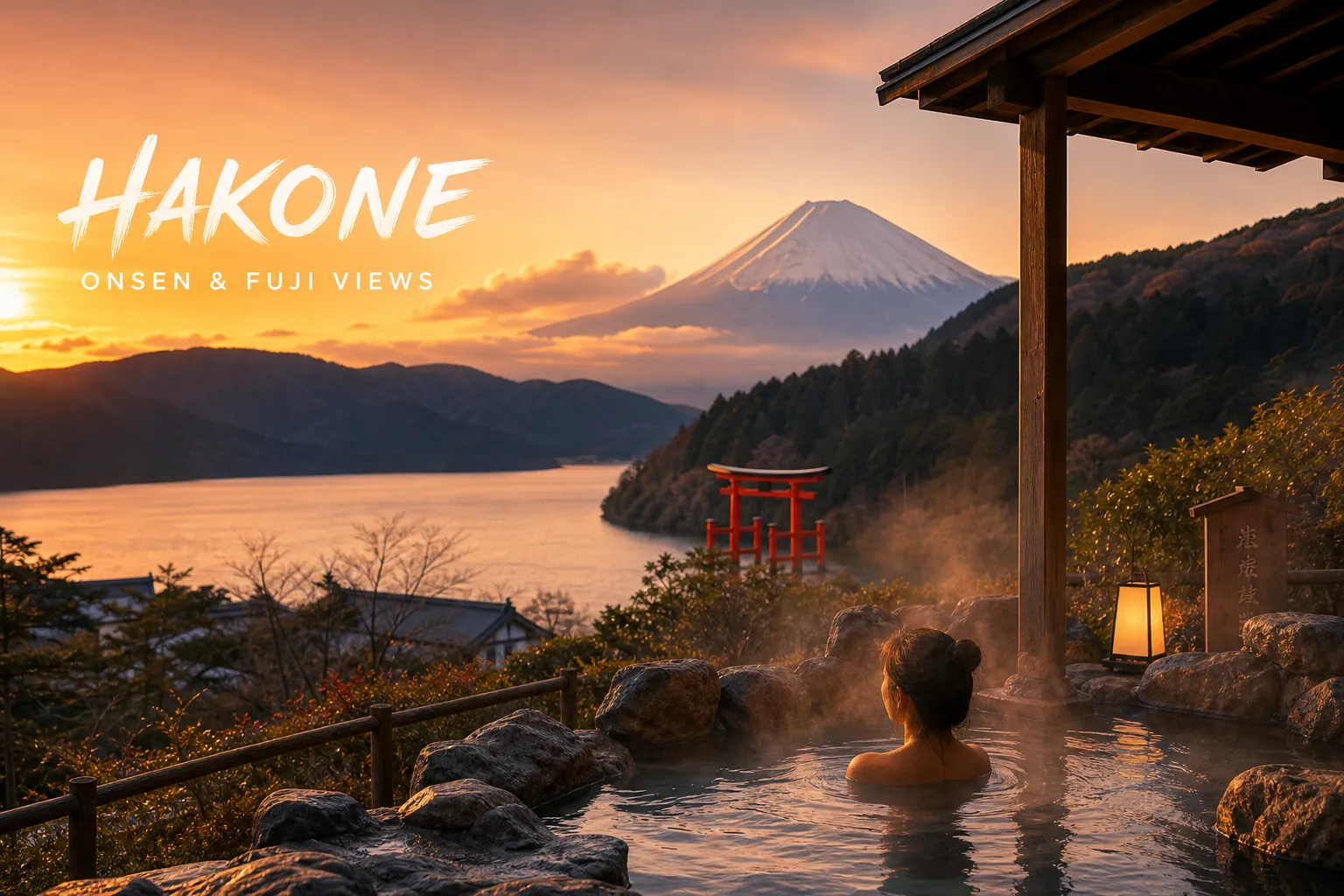
This Hakone travel guide covers everything a first-timer needs: how to get there from Tokyo, which transport pass saves you money, what to see on the classic loop, and how to choose between a day trip and an overnight ryokan stay. Hakone is one of those rare destinations that slows a trip down without asking you to sacrifice anything. Two hours from Tokyo, you’re standing in sulfur steam watching a volcanic valley breathe. A cable car lifts you over white smoke and blackened rock. Then a boat crosses a caldera lake, and when the clouds allow, Mount Fuji hangs above the far shore like a painting someone forgot to take down. At The Curious Atlas, we’re drawn to places where nature does the heavy lifting. Hakone does it quietly, and completely.
Whether you have six hours or two full days, there’s a version of Hakone built for it. Start with the logistics, because getting there is where most first-timers overthink it.
Hakone travel guide: getting there and choosing the right route
Two routes dominate, and each suits a different kind of traveler. The Odakyu Romancecar from Shinjuku is the single-seat, no-transfer option: around 85 to 95 minutes straight to Hakone-Yumoto, with reserved comfortable seating and a scenic ride through the Kanagawa countryside. Book seats in advance, especially on weekends. If you’re starting your day from Shinjuku and want to arrive relaxed, this is the right call.
From Tokyo Station, the Tokaido Shinkansen to Odawara takes 30 to 35 minutes, followed by a 15-minute transfer on the Hakone Tozan Line to Hakone-Yumoto. The total time is comparable, but the transfer adds a step. This route suits travelers already staying near Tokyo Station or those with JR Passes looking to minimize cost on the long leg.
Using the Hakone FreePass wisely
The FreePass grants unlimited rides on eight transport modes inside Hakone: the Tozan Railway, cable car, aerial ropeway, Lake Ashi sightseeing boats, and the local bus network. The 2-day pass from Shinjuku is priced at ¥7,100 for adults, a figure that bundles the round-trip base Odakyu fare, so you’re paying for the transport in from Tokyo as part of the deal. If you board at Odawara instead, the pass costs ¥6,000 and covers Hakone rides only. (For the most current pricing, check Odakyu’s official site and Hakone FreePass details, which list pass-only and pass-plus-roundtrip totals separately.) The pass typically saves money if you plan multiple paid rides such as the ropeway, the Lake Ashi sightseeing cruise, and the Tozan Railway in a single day, combine those three and you’ll generally come out ahead. One important note: the Romancecar limited-express surcharge is separate, pay it. The extra comfort on a 90-minute morning ride is worth every yen.
What to see in Hakone without rushing through it
The Hakone loop circuit runs in a logical counterclockwise arc: Hakone-Yumoto by rail to Gora, cable car up to Sounzan, ropeway over Owakudani, then the Lake Ashi cruise back toward the eastern shore. That sequence is both the most efficient route and the most dramatic one, moving from mountain village to volcanic valley to open water in a single continuous journey.
Hakone Open-Air Museum: more than sculpture on a lawn
The Hakone Open-Air Museum (open 9:00 AM, 5:00 PM daily, last entry 4:30 PM) is not a typical art institution. It spreads across roughly 70,000 square meters of outdoor sculpture gardens, a figure cited by the museum itself, with mountain views framing works by Picasso, Rodin, Henry Moore, and Japanese contemporary artists. Admission is ¥2,000 for adults same-day, or ¥1,800 booked online. The museum sits adjacent to Chokoku-no-Mori Station on the Hakone Tozan Railway, just a short walk from the platform, which means no extra bus connection and no complicated scheduling.
Plan 1.5 to 2 hours here, ideally on a clear morning before the day-trip crowds arrive from Tokyo. The combination of scale, silence, and scenery makes it one of the most genuinely affecting art experiences in the Kanto region. It’s easy to underestimate it on the map, most people allocate an hour and quietly extend it.
The Hakone Ropeway and Owakudani volcanic zone
From Sounzan, the aerial ropeway carries you over the Owakudani volcanic zone: sulfur pools, white steam venting from blackened rock, and the faint smell of eggs cooking in geothermal heat. Those same vents are the source of the famous kuro-tamago, hard-boiled eggs with blackened shells, a well-known local specialty sold at the Owakudani station stop. The ropeway operates roughly 9:00 AM to 5:00 PM. On clear days, Mount Fuji appears directly ahead as you descend from Owakudani toward Togendai, framed by the ropeway cables in a view that has come to define the Hakone ropeway experience.
One practical caveat: the Owakudani section closes occasionally due to elevated volcanic activity. Check conditions the day before your visit through the Hakone Navi site or the Odakyu FreePass app. Closures are temporary but can shift your timing significantly if you’re working through a tight Hakone day trip.
Lake Ashi, the cruise, and the honest truth about Fuji views
The Lake Ashi sightseeing cruise runs between Togendai, Hakone-machi, and Moto-Hakone, with each leg taking 25 to 40 minutes. The replica European galleons are theatrical on purpose, and the scenery earns every bit of the drama: cedar forests on both shores, a red Hakone torii gate rising from the water near Moto-Hakone, and the open sky above the caldera. The cruise is covered under the FreePass, so there’s no reason to skip it. Treat it as transport that also happens to be beautiful.
When (and where) you’ll actually see Mount Fuji
Hakone is famously cloudy, and Fuji views are genuinely unpredictable. The best odds are early morning before noon, in winter (November through February), and on days following rainfall that clears the haze from the lower atmosphere. From the lake, the widest and most frequently photographed angle is near Hakone-machi. From the ropeway, the view opens between Owakudani and Ubako. Autumn, specifically October and November, offers the best balance of color, crowd levels, and atmospheric clarity.
Summer is the lowest-probability season for a clear Fuji view, and many travelers arrive in July or August and see nothing but low cloud. If a Fuji view is a priority, plan your trip in winter and set your alarm early. The mountain doesn’t perform on a schedule.
Hakone itinerary: day trip or overnight stay
A 6 to 7 hour Hakone day trip from Tokyo can cover the Open-Air Museum, the Tozan Railway to Gora, the cable car to Sounzan, the ropeway over Owakudani, and the Lake Ashi cruise back to Hakone-machi, if you start early with the 8:00 AM Romancecar from Shinjuku and move at a steady pace. It’s satisfying but tight. You’ll eat on the go. You won’t soak in anything, literally or figuratively. For first-timers short on time, it works. For suggested schedules and variations on this loop, consult this comprehensive Hakone travel guide.
The Hakone 2-day plan changes the character of the trip entirely. The case for two days isn’t about fitting in more sights, it’s about arriving before the day-trip crowds, wandering Hakone-Yumoto in the late afternoon when the town quiets down, and waking up the next morning with the mountain, the stillness, and a bath drawn before the day starts. Staying overnight also unlocks dinner service at your ryokan, a full evening at the onsen, and the version of Hakone that day-trippers never actually see. If you travel slow by instinct, this is the one worth choosing.
Onsen culture and where to soak in Hakone
Japan’s onsen culture has a short but firm learning curve. You wash completely before entering any communal bath. Tattoos are still prohibited at many public facilities, though policies are shifting at smaller private properties. Silence is the default mood. For travelers new to this, private onsens (kashikiri-buro) are the easiest entry point: no shared space, no etiquette anxiety, and the same quality of hot spring water. For a full primer on hot springs and what to expect, see our Hakone Onsen Guide: Best Hot Springs, Tips & What to Expect.
Several ryokans in Hakone are designed with international guests in mind. Fufu Hakone and Hakone-Gora Byakudan include private open-air baths in every room, fully self-contained with no reservation required. Tsukinoya and Hananoyado Fukuya offer reservable private baths for guests who want a communal property with a private option. For tattoo-friendly properties, Tenzan Onsen allows tattooed guests in its communal baths without cover-ups, while Kinnotake Tonosawa explicitly welcomes guests with or without tattoos in its in-room private outdoor baths. If you’re planning to stay overnight in a traditional inn, read our Hakone Japan Ryokan Experience: A Complete First-Timer’s Guide for tips on bookings and etiquette.
For day visitors, Tenseien offers day-use entry at around ¥2,730 per person, with reservable private onsen rooms at approximately ¥2,200 per hour. Ryokan nightly rates for mid-range properties with private baths typically run ¥40,000 to ¥70,000 per night for two people including meals; luxury options start around ¥80,000 and climb well above that. Book private baths well in advance. Hakone Yuryo accepts reservations up to one month ahead and fills quickly on weekends, especially during autumn and cherry blossom season when rates can double.
Going slowly is how Hakone actually works
Hakone rewards the traveler who doesn’t race through it: the one who sits by the volcanic valley long enough to watch the mist shift, or takes a bath before sunrise with no agenda. The FreePass, the transport chain, the ryokan booking, those are just scaffolding. What Hakone offers underneath all of it is a reminder that some of the world’s most striking natural experiences sit within two hours of a major city, waiting quietly for someone to notice.
Use this Hakone travel guide to pick your dates, book the Romancecar early, and let the volcanic valley do the rest.
Leave a Reply