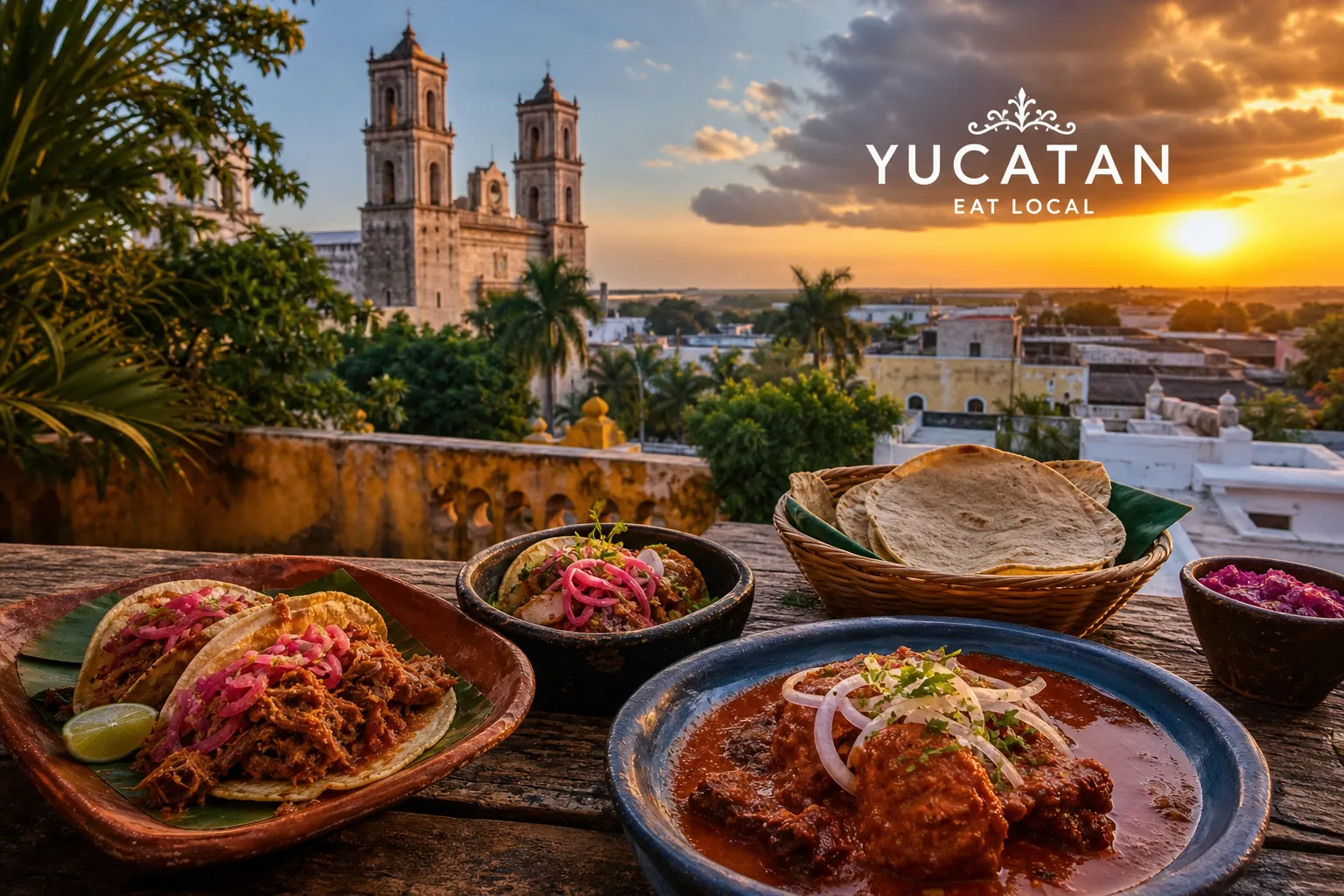
Most travelers taste Yucatecan food. Very few actually understand it. There is a difference between eating a plate of cochinita pibil because it appeared on a travel blog’s “must-try” list, and eating it with full knowledge that the technique behind it draws on centuries-old Mayan tradition, that the underground pit oven predates the Spanish conquest, and that every bite is the result of a culinary lineage that survived colonialism more intact than almost any other regional cuisine in Mexico. This Yucatan cuisine guide exists to give you that context. Context changes flavor. It always does.
This is the kind of reading that slow travelers at The Curious Atlas actually want: not a menu card dressed up as journalism, but a real understanding of a food culture. By the time you finish, you will know the story behind the dishes, the ingredients that define them, where to find honest versions across the peninsula, and how to order without defaulting to the tourist circuit. Sopa de lima, papadzules, poc chuc, relleno negro, these are not just names to check off a list. They are a living archive of a civilization, and they taste better once you know that.
The ancient foundation every dish is built on
The Mayan pantry that survived centuries
Before a single Spanish ship appeared on the horizon, the Mayan diet revolved around corn, squash, beans, chili, and turkey. These are not historical footnotes. They are the structural backbone of every significant dish still served across Yucatan today. The peninsula’s geographic isolation shaped everything: surrounded by sea on three sides, cut off from the mountainous highlands that defined Oaxacan and central Mexican cooking, Yucatan developed a cuisine that retains especially strong Mayan influences relative to most other Mexican regions.
This is worth sitting with for a moment. Oaxacan cuisine draws on extraordinary chile variety, mole complexity, and the culinary traditions of multiple distinct indigenous groups living across varied microclimates. Central Mexican food built itself around the taco-and-salsa grammar most of the world now associates with “Mexican food.” Yucatecan cuisine did neither. It held its Mayan core and absorbed outside influences carefully, on its own terms.
How colonialism added to, but didn’t erase, the original flavors
The Spanish and Caribbean trade routes introduced pork, Edam cheese, and sour orange to the peninsula. What makes Yucatecan culinary history remarkable is that these imports merged with existing Mayan cooking methods rather than replacing them. Pork went into the pib. Sour orange became the acid that balanced rich marinades. Edam cheese found its way into queso relleno, one of the most distinctive dishes on the regional table.
You can see this fusion most clearly in papadzules, a dish with pre-Hispanic origins in its egg-and-pumpkin-seed filling, presented on a plate shaped by Spanish-influenced plating conventions. Or in poc chuc, where pork, the colonial ingredient, is marinated in sour orange and grilled over an open flame in a way that would have felt recognizable to a Mayan cook centuries ago. The food of Yucatan is, in the deepest sense, a story of survival.
Yucatan Cuisine Guide: Ingredients and Techniques That Define the Tradition
Achiote, sour orange, and the building blocks of flavor
Achiote, the earthy red-orange paste made from annatto seeds, is the single most defining flavor marker of Yucatecan cuisine. It delivers color, a slightly peppery depth, and a warmth that you will recognize the moment you encounter cochinita pibil, pollo pibil, or any dish prepared with recado rojo. Nothing else tastes like it, and no substitute comes close.
Sour orange, the bitter citrus also called naranja agria, provides the acidic brightness that balances the richness of pork dishes. It is entirely distinct from the Mexican limes used elsewhere in the country, and substitutions using standard lemon or lime juice often change the result in ways that are hard to pinpoint. If you try to recreate cochinita pibil at home and wonder why it doesn’t taste quite right, the sour orange is very likely part of the reason. The recados, blended spice pastes that serve as marinade bases, are what tie all of this together. Recado rojo (achiote-centered, earthy and red) and recado negro (made from charred chiles, smoky and nearly black) are the two foundations of the regional flavor vocabulary. Knowing them helps you understand why dishes that look superficially similar can taste completely different.
Habanero rounds out the trio: fruity and deeply aromatic in small amounts, ferociously hot in larger ones. Critically, habanero in Yucatan is typically served as a separate salsa rather than cooked into the dish itself, which means spice level is largely in your hands.
Pib cooking: the underground oven technique
Pib cooking is exactly what it sounds like. Food, usually wrapped in banana leaves, is slow-cooked over hot stones in a sealed underground pit. No conventional oven can replicate the result. The meat becomes deeply tender, the banana leaves impart a faint herbal fragrance, and the sealed environment concentrates every flavor in the marinade. Cochinita pibil and pollo pibil are the most famous examples, but the technique appears throughout the cuisine in tamales and other preparations.
Understanding pib explains something practical that confuses many first-time visitors: why does the cochinita pibil at a street market or local comedor taste so profoundly different from the “Yucatecan pork” on a hotel restaurant menu? The answer is usually technique. A slow-cooked, banana-leaf-wrapped pit preparation and a pan-braised approximation using the same marinade are not the same dish. Seek out the real thing, and you will understand why.
The dishes worth planning your meals around
The pork dishes that anchor Yucatecan cooking
Cochinita pibil is the dish most travelers try first and keep returning for. Achiote-and-sour-orange-marinated pork, slow-cooked in banana leaves until it pulls apart effortlessly, served with pickled red onions that cut through the richness. It is available everywhere from street market tacos to sit-down restaurants, but the quality gap between a great version and a mediocre one is enormous.
Poc chuc offers an instructive contrast. Where cochinita pibil is braised, voluptuous, and deeply colored, poc chuc is grilled, lighter, and slightly charred at the edges. Pork marinated in sour orange, cooked over flame, and served with beans, pickled onions, and tortillas. It is a reliable test of any local kitchen’s quality. A kitchen that gets poc chuc right understands the cuisine.
The dishes that reveal the Mayan side of the menu
Sopa de lima is one of the most underrated dishes on the peninsula. A bright, tangy chicken soup made with Yucatecan lima, a local citrus distinct from common lime, and finished with crispy tortilla strips, it is distinctive in Mexico for its clean, citrus-forward profile. Order it as a starter and it resets your entire sense of what the cuisine can do.
Papadzules are corn tortillas rolled around hard-boiled eggs and covered in a pumpkin-seed sauce with tomato salsa on top. Pre-Hispanic in origin, naturally vegetarian, and rarely found outside of Yucatan, they are a direct line to the cuisine’s Mayan roots. Relleno negro, turkey or chicken in a deeply spiced, nearly black chile sauce built on recado negro, is the dish for a slow meal with nowhere else to be. Its complexity rewards patience.
Street food and market finds that tourist menus skip
Panuchos, salbutes, and the art of the fried tortilla
Panuchos are fried corn tortillas stuffed with refried black beans, topped with shredded turkey or chicken, pickled onions, avocado, and salsa. They are most commonly found at market stalls and comedores rather than hotel restaurants, and they represent the everyday genius of Yucatecan street cooking at its best. Salbutes are similar in form but skip the bean filling, which makes them lighter and slightly softer in texture. The two are typically sold side by side, and ordering both is the right move.
If your itinerary includes Valladolid, longaniza de Valladolid is non-negotiable. This smoked, spiced pork sausage is the town’s signature street food, best eaten at a local market stall rather than at a restaurant trying to upscale it. The town sits roughly two hours from both Mérida and Cancún and is worth stopping in specifically for this reason.
The sweet ending every Yucatecan evening deserves
Marquesitas are among the most beloved street desserts on the peninsula: crispy rolled crepes filled with Edam cheese, Nutella, caramel, or fruit, sold from evening carts in Mérida’s parks and plazas. They are best eaten immediately, still warm, while walking. Huevos motuleños, technically a breakfast dish, deserve mention here because market breakfasts in Yucatan are one of the best food experiences available on the peninsula. Tortillas topped with fried eggs, black beans, tomato sauce, cheese, and plantains, eaten at a market counter at 8 in the morning, is an experience that no resort breakfast buffet can approach.
The best Yucatecan eating happens standing up, or on a plastic stool at a market table with a handwritten menu on the wall, surrounded by the sounds of a working kitchen. Keep that in mind when planning where to spend your meal budget.
Where to eat authentically across the peninsula
Mérida: the culinary capital and where to start
La Chaya Maya is the most consistently recommended traditional restaurant for first-time visitors. It covers the full range of Yucatecan specialties in one menu and reliably executes the classics. For cochinita pibil specifically, Manjar Blanco is a local institution, with a feature on Taco Chronicles that reflects its standing in the community. Expect a wait for a table, and plan accordingly.
The Mercado de Santiago and the Sunday Mercado Domingo at Plaza Grande are the real entry points into everyday Yucatecan eating: tamales, panuchos, salbutes, and egg dishes for a few dollars, eaten alongside the people who live here. El Marlin Azul, near the centro, is the move for fresh, affordable seafood without hunting for it. Hacienda Teya, slightly outside the city, is worth a visit for papadzules done properly.
Valladolid and the broader peninsula
Beyond Mérida, the coastal towns add ceviches, fish tacos, and shrimp-based dishes that never appear on inland menus. If your itinerary combines Mérida with a coastal stop, plan at least one meal around whatever the local catch is that day. The instinct to stick to “safe” choices from a guidebook is the single fastest way to miss what makes Yucatecan food extraordinary.
The approach that works best, and the one The Curious Atlas consistently recommends across every destination it covers, is this: slow down, eat where the menu is handwritten, and order what the table next to you is having. It works in Mérida, it works in Valladolid, and it holds true in every coastal comedor from Progreso to Holbox.
Ordering smart: dietary needs, spice levels, and practical tips
Vegetarian and vegan options and how to find them
Papadzules are the most naturally vegetarian dish on any traditional Yucatecan menu, egg-based, pumpkin-seed sauced, and deeply traditional rather than a menu concession to dietary trends. (For more on papadzules, see the dishes section above.) Sikil pak, a roasted pumpkin-seed dip with Mayan roots, is naturally vegan and worth seeking out at markets. Both are genuinely representative of the cuisine rather than workarounds.
One practical warning: even dishes that appear simple, like beans or fried tortillas, are often prepared with lard. The phrases that will help you are sin carne (without meat), sin queso (without cheese), sin manteca (without lard), and sin crema (without cream). Travelers with seed sensitivities should also note that pumpkin-seed-based sauces appear frequently, and achiote is an annatto seed derivative.
Navigating habanero heat and ordering with confidence
Habanero is the regional chile, and it is genuinely hot in any meaningful quantity. Because it is typically served as a separate salsa rather than cooked into dishes, you control your own exposure. When uncertain about a dish, ask ¿pica mucho? (is it very spicy?). The word picante in Yucatan means something considerably more serious than it does in other Mexican regions, so treat any affirmative answer with respect.
Travelers avoiding pork will find the menu narrower than elsewhere in Mexico, but seafood on the coast and egg-based dishes in Mérida offer genuine alternatives. The cuisine is pork-forward by nature, not by accident, and understanding that history makes the limitation easier to navigate.
Eat slowly, and eat curiously
Eating well in Yucatan is not a matter of finding the right restaurant. It is a matter of arriving with enough context to recognize what you are tasting and why it matters. Cochinita pibil is not just good pork. Sopa de lima is not just a nice soup. These are dishes shaped by centuries of Mayan culinary tradition, by colonialism, by survival, and by a culinary intelligence that outlasted every attempt to simplify it.
This Yucatan cuisine guide is a starting point, not the whole map. The peninsula’s food culture is vast enough that every return trip reveals something new: a market comedor you walked past last time, a recado variation you hadn’t tasted before, a longaniza vendor in a town you only passed through. The food rewards the traveler who keeps coming back.
At The Curious Atlas, this is the kind of exploration the blog exists for: past tourist menus, beyond the resort breakfast buffet, and into the markets, comedores, and late-night marquesitas carts where Yucatan’s food culture actually lives. If you are planning a trip to the peninsula, start with this Yucatan cuisine guide, then go eat something you cannot pronounce yet. That is usually where the best meals are hiding.
Leave a Reply