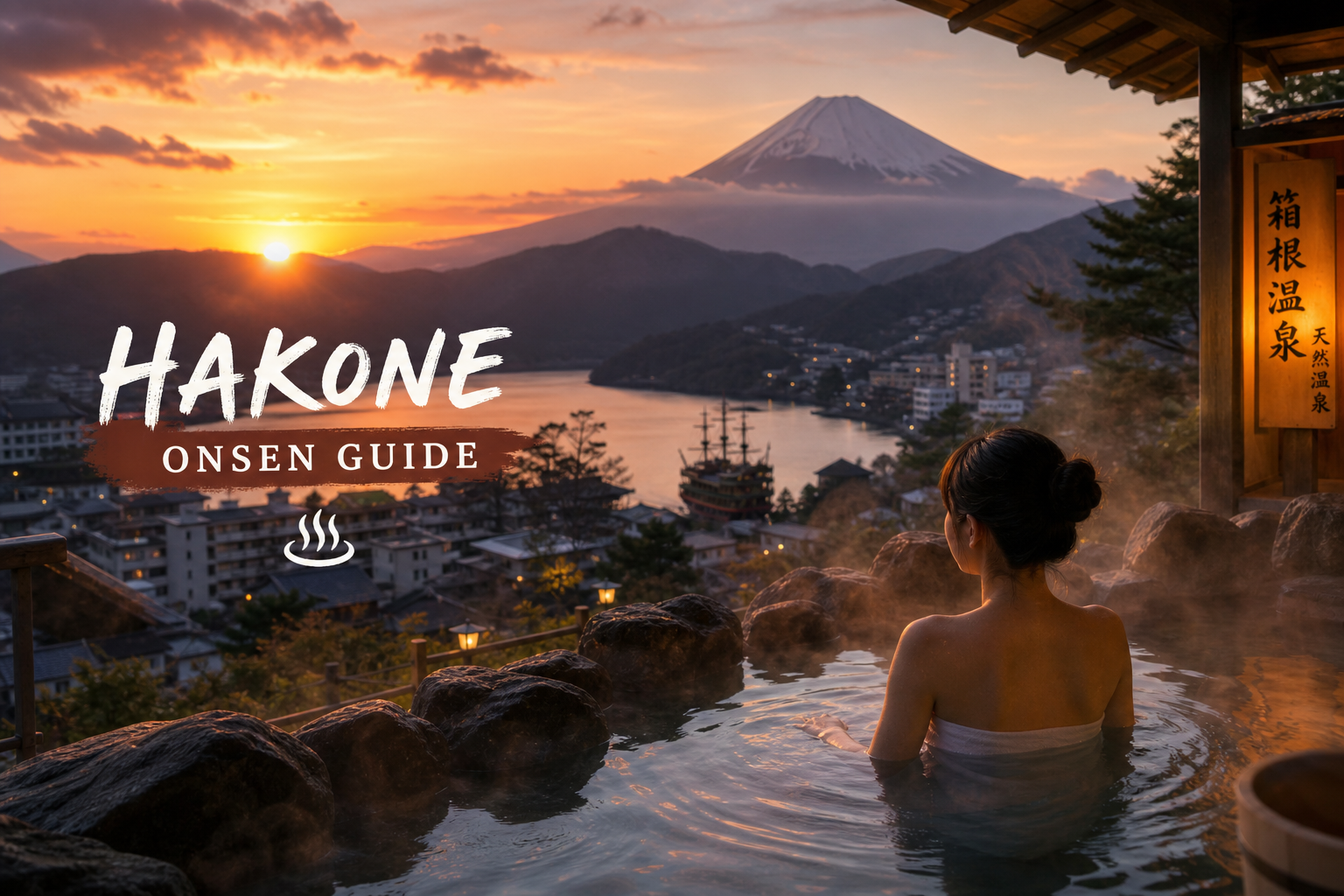
There is something deeply human about lowering yourself into hot, mineral water and choosing to stay a while. No itinerary. No next destination. Just the weight of water, the smell of sulfur, and the quiet instruction of a culture that has been doing this for over a thousand years. Hakone Japan hot springs are not a tourist attraction bolted onto a mountain. They are the mountain’s reason for visitors in the first place.
Many travelers arrive in Hakone as an extension of a Tokyo trip, treating it as a half-day checkbox before racing back to Shinjuku. That misses the entire point. The onsen ritual in Japan was never designed for people in a hurry, it was designed to make hurrying feel absurd. At The Curious Atlas, we keep returning to places where the culture actively asks you to slow down. Hakone is one of them.
This guide is practical: which onsen zone fits your travel style, how to reach it from Tokyo without overcomplicating the logistics, what it costs, how to behave once you’re in the water, and how to handle the tattoo question before it becomes an awkward surprise at the door.
Understanding Hakone’s four onsen zones before you book anything
Hakone is not one place. It is a valley system with distinct zones, each with its own atmosphere, accessibility, and onsen character. Where you stay shapes the entire rhythm of your visit, the difference between zones runs much deeper than geography alone.
The gateway town: what Hakone-Yumoto offers
Yumoto sits at the base of the valley and is the natural entry point for anyone arriving by train from Tokyo. It has the highest concentration of walk-in public baths and traditional ryokan within easy walking distance of the station, making it the most accessible zone for day-trippers and first-time visitors. Hakone Suimeisou is a three-minute walk from the station, and the Tenzan Onsen offers some of the best outdoor rotenburo in the area, set along the Hayakawa River with no roof between you and the cedar canopy above. If your priority is minimal transit complexity and maximum time in the Hakone hot spring baths, Yumoto is where to start.
The mountain heart: Gora, Kowakudani, and Sengokuhara
Gora climbs higher into the valley, quieter and more atmospheric than Yumoto, with boutique ryokan options and the departure point for the Hakone ropeway. One stop beyond Gora on the mountain railway is Kowakudani, where sulfuric steam vents rise through the hillside and the ryokan setting feels genuinely remote. Hakone Kowakien Tenyu, positioned here, offers a private open-air onsen in every room alongside large shared public baths.
Sengokuhara is the most deliberate choice of all. There is no rail connection; you reach it by mountain bus from Yumoto or Gora. In exchange for that extra step, you get adults-only properties like Kinnotake Sengokuhara, wide mountain views, and the kind of quiet that makes the rest of travel feel like noise. This is the zone for travelers who already know what they want and are willing to earn it.
Getting from Tokyo to Hakone Japan hot springs without overcomplicating the journey
Your main transit options and what they actually cost in 2026
The Odakyu Romancecar from Shinjuku is the cleanest single-train option: 85 to 90 minutes to Hakone-Yumoto, around ¥2,470 one-way, reserved seats, no transfers. The Romancecar is the slow traveler’s train. It is scenic, unhurried, and it arrives feeling like part of the experience rather than a chore before it. JR Pass holders can take the Shinkansen to Odawara in 35 to 50 minutes, then transfer to the Hakone Tozan Railway, with total costs running around ¥3,500 to ¥4,500 depending on how much of the fare your pass absorbs. The budget route is the Odakyu local train to Odawara and then local rail, around ¥1,270 but closer to two hours or more.
Making sense of the Hakone Free Pass
The Hakone Free Pass covers round-trip travel on the Odakyu Line between Shinjuku and Hakone, plus unlimited rides on the Tozan Railway, cable car, ropeway, Lake Ashi ferry, and local buses. Note that the Odakyu Romancecar limited-express service requires an additional reserved-seat surcharge even with the Free Pass in hand, worth it, but worth knowing. In 2026, the two-day pass costs ¥7,100 from Shinjuku and ¥6,000 from within the Hakone area. For anyone spending more than one day or planning to move between zones, it pays for itself quickly. For Sengokuhara specifically, the mountain bus is the only practical route since there is no rail connection, and the Free Pass covers this too.
Choosing Hakone Japan hot springs: day-use, overnight, private, and tattoo-friendly
Day-use baths and what to expect on arrival
Most public onsen and day-use facilities in Hakone do not require reservations, you pay at the door and walk in. Hours vary by facility, though many operate roughly between 9am and 11pm, so checking ahead is a good habit. Entrance fees run from around ¥500 to ¥2,200 per person depending on the facility: Tenzan Onsen charges around ¥1,450, while Hakone Yuryo’s larger public bath runs ¥1,700 to ¥2,200 on weekends. The outdoor rotenburo is the defining Hakone onsen experience, steam rising against mountain cedar, the sound of a river below, the sky open above you. Plan your visit around the outdoor pools, not just the indoor ones.
Private onsen (kashikiri), couples, and tattooed travelers
Private onsen baths, called kashikiri, offer the same mineral water in a reserved space. They are ideal for couples, families with children, or anyone with tattoos who wants to bypass public bath restrictions. Hakone Kowakien Tenyu and Kinnotake Sengokuhara both include private open-air onsen in every room, making them the benchmark overnight options for this experience. Private baths at day-use facilities like Hakone Yuryo typically start around ¥10,400 for 120 minutes and can be reserved by phone on the day of your visit.
For tattooed travelers, the situation is workable but requires attention. Tenzan Onsen is the most consistently tattoo-tolerant public day-use bath in the area, though with one specific rule: tattooed guests must enter alone, not with other tattooed companions. Confirm this policy directly with the facility before visiting, as rules can shift. For overnight stays, Ajisai Onsen Ryokan, Ichinoyu Honkan, and Gora Kansuirou have all been reported as tattoo-friendly, but again, verify current policies directly before booking, this is the one detail that changes most frequently.
Onsen etiquette, costs, and what genuinely surprises first-time visitors
The bathing ritual from entry to exit
Undress completely in the changing room. Swimwear is not permitted in traditional public onsen, and this is not a suggestion. Store your belongings in the locker provided and carry only the small provided towel.
Before entering any bath, sit at one of the washing stations along the wall, use the soap and shower head to clean your body thoroughly, and rinse completely. This step is non-negotiable. Keep the small towel out of the bath water at all times, most guests fold it on their head or rest it on the pool edge. Move quietly. No phones, no photography, no loud conversation. The silence in a well-run onsen is not awkward: it is the point. When moving between outdoor pools, you do not need to rewash each time. If you use a sauna, rinse off sweat before re-entering the main bath. The order is flexible; the standard of cleanliness is not.
Costs, timing, and a note on reservations
Public day-use baths generally require no advance booking. Private baths tend to fill quickly on weekends and during the autumn foliage season from late October through mid-November (Tokyo’s weather by season), so a same-day phone reservation is a practical precaution. Ryokan stays require advance reservations and typically run ¥10,000 to ¥30,000 per person per night, usually including dinner and breakfast. That price point is not just accommodation. It is the full slow travel format: a long meal, a private onsen, a futon, and a morning bath before the day begins.
The global slow travel thread: from Hakone’s rotenburo to sacred waters elsewhere
Why every culture eventually arrives at the same ritual
Wherever geology creates warm or mineral-rich water, human cultures build rituals around immersion in it. Iceland’s geothermal pools, Turkey’s hamams, Hungary’s thermal baths, Japan’s onsen, all share the same root instinct: stop moving and let water do something the body cannot do alone. The form changes. The impulse does not. In Hakone, the ritual has centuries of refinement behind it. The etiquette, the ryokan hospitality, the expected silence in the bath: all of it points toward a culture that treats bathing not as hygiene but as practice.
Slow travel and onsen culture are philosophically the same idea. You are not trying to see as much as possible. You are trying to be somewhere fully. The Japanese concept of toji, spending extended time at a hot spring for healing rather than tourism, stretches back well over a thousand years, with some historical accounts placing its origins around the Nara period. It is the original slow travel itinerary, and Hakone has been running it longer than most travel blogs have existed.
The Yucatan parallel: cenotes and Mexico’s version of the sacred plunge
Mexico’s Yucatan Peninsula has its own version of this ritual. Cenotes, the ancient freshwater sinkholes carved into limestone by underground rivers, were sacred to the Maya for thousands of years and remain dramatically beautiful today. Where a Hakone rotenburo is thermal and atmospheric, a cenote is cool, crystalline, and subterranean. The light comes from above through a collapsed cave ceiling. The silence is the same.
The cenote experience is slower than it appears on social media. At its best, it is a long morning in cool water with little else required of you. The Curious Atlas has covered this world in depth, from the most accessible cenotes near Tulum, including quieter options like Cenote Nicte-Ha and Cenote Cristal, to the off-the-beaten-path swimming holes like Suytun Cenote. If Hakone has activated the slow travel instinct in you, Mexico’s Yucatan tends to deepen it.
The practical arc: what to take away from all of this
Hakone Japan hot springs are not best understood as an attraction. They are a posture, a way of arriving somewhere and choosing not to rush through it. The mountain, the mineral water, the ryokan format, the expected silence in the bath: each element reinforces the same instruction. Stay longer than you planned. Do less than you think you should.
The practical summary is straightforward. Pick your zone based on your travel style: Yumoto for accessibility, Gora or Kowakudani for atmosphere, Sengokuhara for real quiet. Use the Romancecar or Hakone Free Pass to simplify transit. Choose between public day-use baths and private onsen based on your comfort level, budget, and tattoo situation. Follow the etiquette exactly as described and confirm tattoo policies directly before arrival.
The slow traveler who finishes a few days among Hakone Japan hot springs and starts wondering where the next warm water waits is asking a good question. The answer might be a Japanese mountain, or it might be a jungle cenote in the Yucatan. Either way, the instinct is worth following.
Leave a Reply