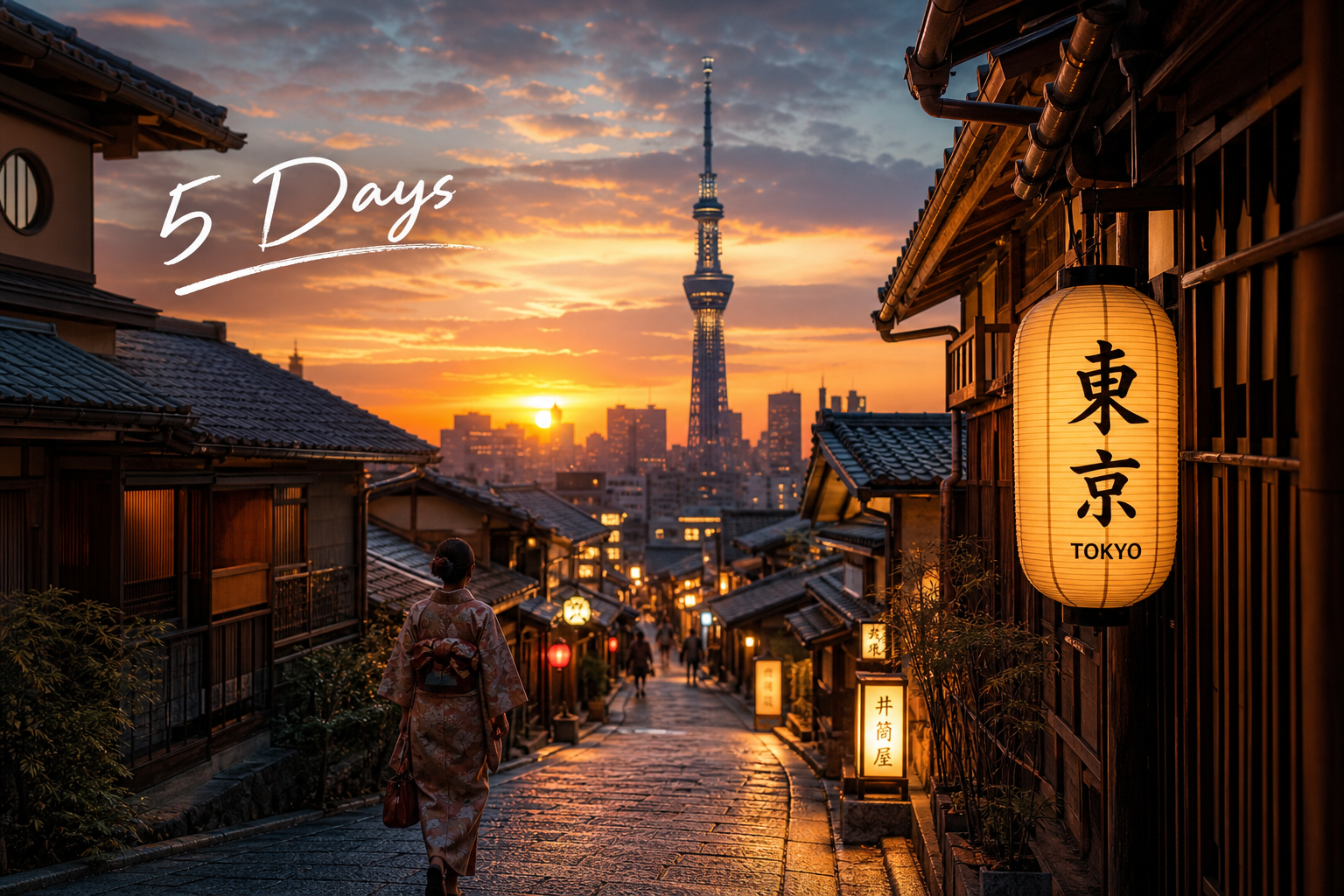
Tokyo is one of the most written-about cities in Asia, and yet most people who visit leave having seen very little of what it actually is. The paradox is this: Tokyo rewards slowness more than almost any destination in the world, and yet nearly every five-day Tokyo itinerary is designed for speed. Twelve neighborhoods in five days. One hour at Senso-ji. A photo at the Shibuya crossing. A conveyor belt sushi lunch eaten standing up. Then back to the airport, passport still damp from the humidity.
This plan works differently. It is built around the idea that Tokyo is not a city in the conventional sense. It is a collection of micro-villages, each with its own pulse, its own street-level logic, and its own way of making you feel like a stranger or a local depending on how much time you give it. At The Curious Atlas, this is the philosophy behind every itinerary we write: depth over distance, rhythm over checklists. Over five days, you will move through Yanaka, Asakusa, Shibuya, and a mountain escape to Nikko, with deliberate gaps left open for the kind of wandering that becomes the story you actually tell when you get home.
Why rushing Tokyo is the biggest mistake first-time visitors make
Tokyo is 23 wards, each functioning almost like a city unto itself. Trying to cover them all is the equivalent of flying into a country and trying to see every region in a weekend. The decision fatigue alone will flatten you. By day three of a packed schedule, the neon starts to blur, the temple gates start to look identical, and the food, which should be the highlight of every waking hour, becomes fuel between transit connections.
The neighborhood vs. attraction mental model
The shift that changes everything is this: stop planning around attractions and start planning around neighborhoods. Tokyo is composed of micro-worlds with distinct personalities. Yanaka is old shitamachi. Nakameguro is quiet, canal-side cool. Asakusa is incense and lanterns and the sound of wooden sandals on stone. When you move through a neighborhood rather than hopping between landmarks, you start noticing things: the tofu seller who has been at the same corner for 40 years, the cat sleeping on a stone wall outside a temple gate, the ramen counter with no English menu and four stools and the best bowl you will eat all week.
What slow travel actually looks like in a dense city
In practice, this Tokyo day-by-day itinerary is built on roughly one neighborhood per half-day, a pace informed by average transit times between districts and the reality that most of Tokyo’s best experiences (temples, markets, small restaurants) are concentrated within walkable clusters. It means eating where the people who actually live there eat, which is rarely the place with the English sign out front. It means accepting that you will not see Akihabara, the Imperial Palace, Odaiba, and Ginza all in the same trip. That is fine. You will see the city instead of the highlights reel, and the city is considerably better.
5-Day Tokyo Itinerary, Day 1: Getting Lost (on Purpose) in Yanaka
Yanaka is the anchor of this entire itinerary, and it earns that position by being the clearest proof that old Tokyo still exists. The neighborhood survived the Great Kanto Earthquake, the World War II firebombing, and the relentless modernization that followed. What remains is a place of narrow lanes, wooden machiya houses, independent shops selling things people actually buy, and roughly 70 temples and shrines in a radius that rewards aimless walking.
Morning: Yanaka Ginza and the streets that time forgot
Start at Yanaka Ginza in the morning, before the afternoon heat arrives. The shopping street is short but dense with life: taiyaki sellers, craft workshops, a tofu shop that has been operating since before most of its customers were born. Wander south into the cemetery, which sounds like a strange recommendation until you are standing beneath its cherry tree canopy on a quiet Tuesday morning, watching an older woman place flowers at a grave, and you realize this is one of the most peacefully human places in the entire city. The cemetery is also the resting place of Yoshinobu Tokugawa, the last shogun of the Edo period, which gives it historical weight that most tourist attractions in Tokyo simply cannot match.
Afternoon: Nezu Shrine and hidden ramen before dark
In the afternoon, make your way toward Nezu Shrine. It shares a visual kinship with Fushimi Inari in Kyoto, the same tunnel of vermillion torii gates, but on a smaller, quieter scale and without the selfie sticks and coach buses. Nezu is genuinely uncrowded on most days, and the Azalea Garden in spring is extraordinary. As evening arrives, search for ramen near Sendagi or Nezu stations. Spots like Kamunabi on Sendagi’s residential streets or Menya Hidamari, which consistently ranks well in Tabelog’s local listings for this area (verify current rankings before visiting, as these change), have no English menus, counter seating for six or eight people, and the kind of broth that makes you understand why Japanese people have such a complicated emotional relationship with noodle soup. Show up, point, sit down, and eat slowly.
5-Day Tokyo Itinerary, Days 2 and 3: Tokyo’s Living Layers, East to West
These two days cover the iconic and the necessary, but they do it at a pace that leaves room for detours. The geography of the itinerary does most of the work: each day is anchored to one side of the city to minimize transit and maximize time on foot.
Day 2: Asakusa at dawn and the east side at its best
Senso-ji Temple, Tokyo’s oldest, belongs to the early morning. Arrive before 8am, and you will find monks, local worshippers, vendors setting up their stalls, and almost no tour groups. The famous Kaminarimon Gate looks completely different before the crowds arrive. Spend the morning in Asakusa, walk the 15 minutes along the Sumida River in the afternoon, and save the Tokyo Skytree for dusk, when the city lights below the observation deck at 350 meters make the price of admission feel entirely reasonable. Book the Skytree online one to four weeks in advance, especially if you are visiting in spring or on a weekend, as popular time slots sell out quickly.
Day 3: Gardens, shrines, and the west side’s real character
Shinjuku Gyoen is not just a cherry blossom spot, though it is spectacular in late March and early April. On any day of the year, it functions as one of the best slow-travel decisions you can make in Tokyo: a large, beautifully maintained garden where people bring their lunches, read books, and move at a pace that feels almost defiant in such a dense city. Spend the morning there, then walk toward Meiji Jingu and into the Harajuku backstreets. Skip Takeshita Street entirely unless you have a specific reason to be there. Cat Street and the Omotesando side streets reveal a neighborhood that is genuinely stylish and navigable, rather than a corridor designed to sell crepes to 14-year-olds. End the day at Shibuya crossing at sunset, which remains one of the most genuinely cinematic urban moments the city has to offer.
Day 4: Why you should leave Tokyo for a day (and go to Nikko)
There is a moment, around day three of any Tokyo trip, when the density starts to accumulate. You need forest. You need altitude. You need silence interrupted only by birdsong and the creak of ancient timber. Nikko, about two hours north by limited express train, provides all of this, and it adds the Toshogu Shrine complex, one of the most ornately carved religious sites in Japan.
What Nikko offers that Tokyo simply can’t
Nikko sits in the mountains of Tochigi Prefecture, and the sensory shift upon arrival is immediate: cedar canopies hundreds of years old, stone lanterns lining forested paths, the smell of incense carried on cool mountain air. Toshogu Shrine, the mausoleum of Tokugawa Ieyasu, is the main draw, and the Yomeimon Gate alone justifies the journey. The famous “see no evil, hear no evil, speak no evil” monkeys carved above a stable near the shrine entrance are an understated detail that most visitors rush past. Rinno-ji Temple, included in the same combo ticket, adds a quieter counterpoint.
Getting there, getting around, and getting back
The most straightforward option from Tokyo is the Tobu Limited Express from Asakusa station, either the Spacia Kegon or the Revaty, which runs directly to Tobu-Nikko station in roughly 1 hour 45 minutes for around ¥2,850 to ¥3,540. If you are holding a JR Pass, the Tohoku Shinkansen to Utsunomiya followed by the JR Nikko Line is fully covered. For a practical step-by-step route and suggested timings, consult this Nikko itinerary. Without a JR Pass, the Tobu route is cheaper and more direct. Aim to leave Tokyo by 7:30am, spend the core of the day at Toshogu and the surrounding complex, and catch a return Limited Express by 5 or 6pm. You will be back in Tokyo by early evening, carrying the particular satisfaction of someone who got out of the city before it could exhaust them.
Day 5: A slow morning and the neighborhoods you almost missed
The final day should not be over-programmed. A trip earns its place in memory not through the number of things you checked off but through the moments when you stopped moving and let a place settle around you. Give yourself two honest options. Each suits a different mood and both are among the best ways to close out a 5-day Tokyo travel plan.
Nakameguro and Daikanyama: Tokyo’s most liveable corner
Option one is Nakameguro and Daikanyama. Walk the Meguro River canal in the morning, stop at one of the independent cafes that line the water, and drift through the bookstores and boutiques at whatever pace your body decides. This area feels like the city’s exhale after four days of stimulation. It is residential, architecturally interesting, and mercifully free of the kind of tourist density that accumulates around the better-known neighborhoods. Daikanyama T-Site, a bookstore complex designed by Klein Dytham Architecture, is worth at least an hour of unhurried browsing.
The TeamLab option (and what to know before you go)
Option two is TeamLab Planets in Toyosu, if immersive digital art is on your list. Between TeamLab Planets and TeamLab Borderless, Planets is the better fit for a slow itinerary. It is smaller, more focused, and the experience of walking barefoot through light-and-water installations has a meditative quality that the larger venue cannot quite replicate. Booking is mandatory and must be done in advance, often up to three months out for peak dates, through the official DMM ticket site or TeamLab Borderless ticket information on Klook (check each platform’s current availability, as ticketing details can change seasonally). There is no walk-in option. If you have not pre-booked, spend the day in Nakameguro and save TeamLab for a future trip when you can plan for it properly.
Practical notes: where to stay, what to book, and how to move
Where you sleep shapes how you experience the city. Shinjuku and Shibuya are common default choices, but for travelers who find sensory overload a real concern, both neighborhoods sit at the busiest transit hubs in Tokyo, not always the easiest place to decompress at the end of a full day. For a slow Tokyo trip, consider basing yourself in Yanaka or the nearby Nezu area, Asakusa, or Nakameguro instead. Hotel Graphy Nezu in the Ya-ne-sen area is a well-regarded option that blends ryokan character with hostel community; rates vary by season and room type, so check current pricing directly with the hotel or via a booking platform. Ryokan Sawanoya in Yanaka offers a more traditional experience. Asakusa has a strong range of boutique hotels and guesthouses at various price points that put you close to Day 2’s itinerary and the Tobu Line for Nikko.
What requires advance booking (and how far ahead)
A short list of non-negotiables: TeamLab Planets requires mandatory pre-booking, often up to three months in advance for preferred time slots during peak periods, confirm current availability via the official DMM site or Klook. The Tokyo Skytree benefits from online booking one to four weeks out, especially for sunset slots. Nikko-bound Limited Express trains during peak seasons (late March through early May, October, and November) should be reserved ahead through the Tobu website or Klook. For seasonal planning and what to expect weather-wise, consult Tokyo’s weather by season: the slow traveler’s guide. Shinjuku Gyoen charges a small entry fee and occasionally has queues, but does not require advance booking. Any guided food walk or neighborhood tour in Yanaka is often worth booking two to four weeks out, and sometimes earlier for popular dates, particularly during cherry blossom season.
Getting around: IC cards, train lines, and airport access
For a five-day Tokyo-focused trip, a Suica IC card is the clear choice over a JR Pass. A 7-day JR Pass costs approximately ¥50,000 and its value depends almost entirely on long-distance Shinkansen travel. Within Tokyo, you pay as you go with a Suica, typically ¥200 to ¥500 per journey, and the card works across JR lines, Tokyo Metro, Toei Subway, and most buses. Load it at any station vending machine. From Narita Airport, the Narita Express connects to major stations in 55 to 80 minutes. From Haneda, the Keikyu Line reaches central Tokyo in around 35 minutes for a fraction of the cost. Both options are compatible with a Suica card.
The city gives back what you bring to it
Tokyo is an act of patience rewarded. This Japan itinerary for 5 days in Tokyo is structured around neighborhoods and pace rather than attraction counts, and that makes it one of the most genuinely rewarding ways to experience a city that never slows down itself. Start with one neighborhood. Eat where locals eat. Leave gaps in the schedule. The best days of any trip are rarely the ones you planned. You will not see everything. That is the point. You will see enough of one thing to actually remember it.
Leave a Reply