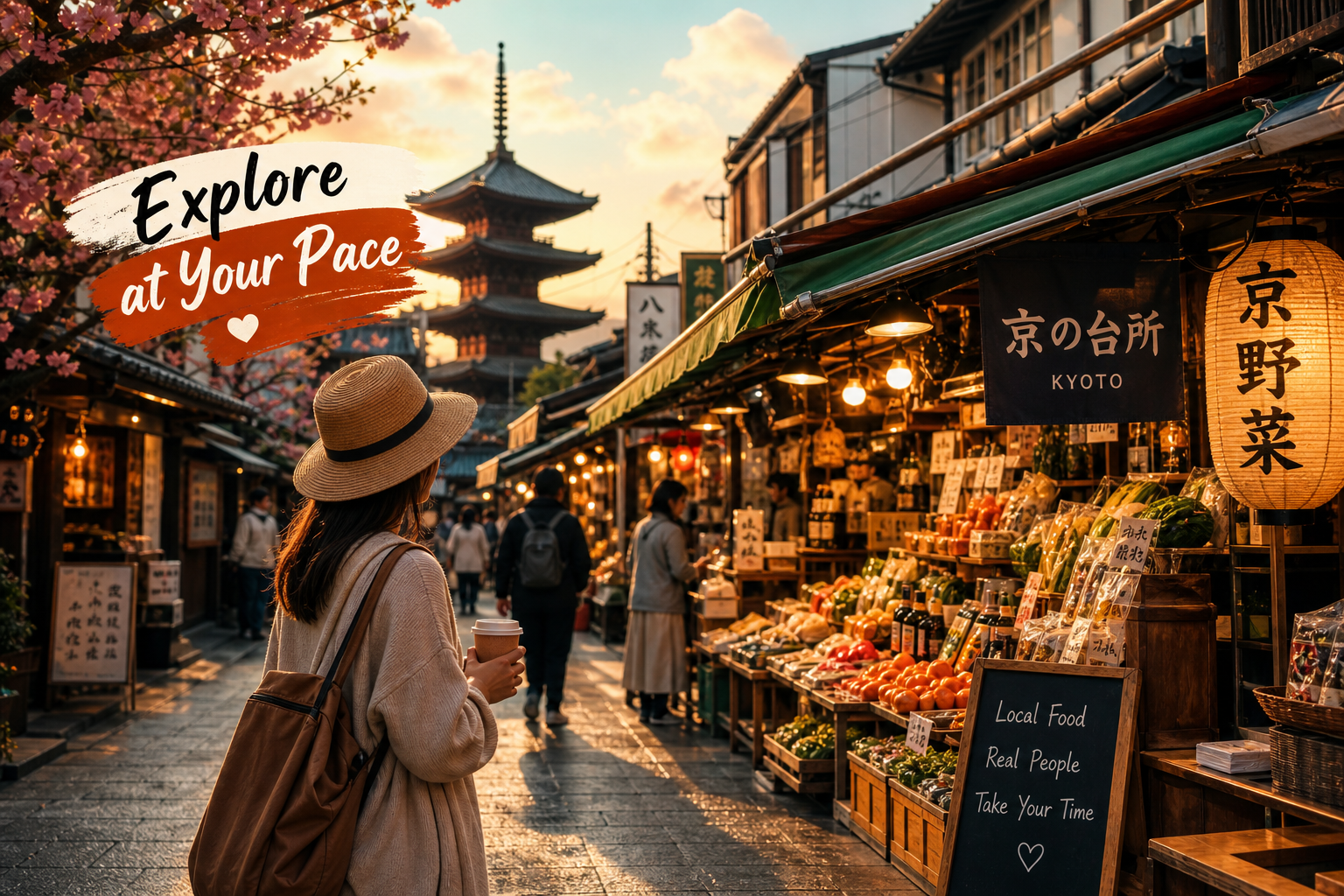
At 7 AM inside Tsukiji’s outer market, one of Japan’s most alive and unrepeatable market experiences, the assault on your senses is total. The air carries grilled scallop smoke, dashi steam, and the sharp brine of fresh tuna sliced open at a counter three feet away. A fishmonger calls out to a regular who hasn’t arrived yet. The entire place operates as if you don’t exist, which is exactly the point.
Japan’s markets look chaotic from the outside. Narrow lanes, hand-painted signs, no clear entrance, no obvious queue logic. But the traveler who stops rushing, resists the urge to photograph everything immediately, and simply stands still for a few minutes discovers something remarkable: these spaces have a deep internal logic. They reward patience in a way that almost no other travel experience does.
This guide covers the major Japanese markets worth building a trip around, what to eat and buy at each, the hidden alternatives most visitors miss, and the practical details you need to arrive prepared. No checklist. No top-ten list. Just a slower way of reading a city through its food stalls.
Why Japan’s markets reveal what the guidebooks miss
Most Japanese markets are not designed for tourists. They are functional, community-driven spaces where restaurant owners, home cooks, and neighborhood regulars shop every week. The vendors know their customers by face. The rhythms of restocking, joking, and haggling (gently, always gently) play out the same way they did last Tuesday and will next month. When you walk into this as a visitor, you are entering a living system, not an attraction.
The “photo-and-leave” approach treats markets as scenery. You get a few images and a vague impression of atmosphere, but you don’t understand anything. The slow traveler’s advantage is different: you arrive before the tour groups, you find yourself returning to the same stall twice without planning to, you watch a vendor prepare the same item for a local customer and then for you, and the gap between those two experiences teaches you more about the place than any guidebook entry could.
Arriving early is the single most important thing you can do. Markets like Tsukiji hit their stride before 9 AM, when the air is cooler, the stalls are fullest, and the people moving through them are there to buy, not to sightsee. That first hour is a different experience entirely from what arrives when the tour buses do.
Tsukiji outer market: Tokyo’s most iconic morning ritual
There is a persistent confusion about Tsukiji that needs clearing up before you go. The inner wholesale tuna auction, which required advance booking even when it was accessible to visitors, moved to Toyosu in 2018. What remains at Tsukiji is the outer market: over 400 stalls spread across narrow lanes around Shin-Ohashi-Dori and the surrounding backstreets. No booking required. No strict entry point. You navigate it on foot, without a set route, following smoke and smell.
What to eat at Tsukiji
The food here is exceptional and specific. Tamagoyaki, the sweet rolled omelette cooked on a flat griddle beside you, is the entry point for most visitors and still one of the best things you’ll eat in Tokyo. Beyond that: grilled scallops with butter and soy, fresh uni on rice eaten standing at a tiny counter with no menu, A5 wagyu skewers served by vendors who clearly don’t need your approval, and tuna sashimi at stalls like Maguroya Kurogin, where the fish is sliced live in front of you.
Eat as you go. Carry cash, because almost every stall operates cash-only. And avoid the larger, menu-forward sushi restaurants clustered near the market’s tourist-facing perimeter. They trade on location, not quality.
Where to find knives and ceramics
The stall clusters at Tsukiji divide roughly into street food vendors and the tool and supply sellers: knife shops, ceramics dealers, dried seafood importers. Both are worth your time, but sequence them. Eat first, while your appetite is fresh and the morning is cool. Then browse the knife shops, where handmade kitchen knives from local craftspeople are often priced lower than at specialist retailers in Tokyo’s shopping districts. A good knife from Tsukiji is a genuinely useful souvenir with a story attached.
Budget two to three hours for a Tsukiji morning. Arriving at 7 AM gives you the best conditions; by 9:30 AM, tour groups start arriving and the pace shifts. End with a sit-down breakfast at one of the small counter restaurants tucked between stalls. This is the unhurried version of the Tsukiji experience, the one that stays with you.
Nishiki market in Kyoto: the covered arcade that feeds a city
Nishiki is four centuries old, roughly two meters wide, about 400 meters long, and home to over 100 shops and stalls. It is called “Kyoto’s Kitchen” not as a marketing slogan but as a literal description: this arcade has fed the city’s temples, restaurants, and households for generations. Understanding its shape is the first practical thing to know. Because it is narrow and linear, crowd timing is critical. Midday and weekend afternoons are nearly impassable. Early weekday mornings before 10 AM, or late afternoon after 4 PM, are when the market belongs to you.
The foods that define Nishiki are Kyoto’s foods. Pickled vegetables (tsukemono) in every color and fermentation stage, fresh yuba (tofu skin), sweet potato skewers, dashi-soaked konnyaku, and grilled mochi with miso glaze. Tanaka Keiran is the vendor for dashimaki tamago, the broth-layered egg roll that is one of Kyoto’s great quiet pleasures. Kimura Fresh Fish, one of the market’s oldest shops, serves sashimi at prices that make you question every sushi restaurant you have ever visited. The tako-tamago, baby octopus with a quail egg inserted in the head, marinated in sweet soy-mirin, is unusual and worth trying once.
Pay attention to where you are in the arcade. The stalls near the Teramachi end are increasingly tourist-facing, with prices and presentation adjusted accordingly. Walk toward Nishikikoji-Takakura and you find the working food suppliers: delivery crates stacked outside, vendors restocking shelves, conversations between regular customers and shopkeepers that have been happening for decades. That stretch of the arcade is the Nishiki worth finding.
Hidden markets and local alternatives worth planning around
Toji Temple’s market runs on the 21st of each month in Kyoto, drawing hundreds of antique dealers, secondhand kimono sellers, and handmade craft vendors onto the temple grounds. It is free to enter. There is no tour group schedule, no admission queue, no fixed pace. You leave when you want to leave, which is the mark of a good market. Kitano Tenmangu’s Tenjin-san market on the 25th is smaller and more local in character, with street food stalls that serve the vendors as much as the visitors. Together, these two temple markets, worth marking on any Japan market calendar you’re building, offer something the major food markets don’t: a window into the antique and craft traditions of the region, at a pace that is entirely your own.
Outside Kyoto and Tokyo, Japan’s morning market tradition runs deep and largely unnoticed by visitors. Wajima’s asaichi in Ishikawa Prefecture is one of Japan’s oldest, running daily along a two-block stretch with fisherwomen selling the morning’s catch and farmers with produce still dusted from the field, a working market scene that has operated this way for over a thousand years. Hakodate’s Asaichi in Hokkaido has a working-port energy entirely different from the curated experience of Tsukiji: live crab, fresh uni, corn from Hokkaido farms, and a briny northern atmosphere that rewards an early start and a long, unhurried breakfast. These lesser-known spots are where the slow traveler’s philosophy pays off most clearly. There is no competition for space. The market vendors have time to talk. The experience is entirely yours to shape.
The Japan National Tourism Organization’s feature on Exploring Japan’s Morning Markets highlights many regional markets and is a useful starting point if you want to look beyond the big names.
What to eat, buy, and skip across Japan’s market scene
The reason food tastes different at Japanese markets isn’t mystical. It’s logistical. Street market fish, pickles, grilled skewers, and fresh tofu are bought from the source, prepared to order, and eaten immediately. The supply chain is measured in meters, not miles. This is why a grilled scallop at Tsukiji tastes like nothing you’ve had before, even if you’ve eaten excellent scallops elsewhere. The quality gap between “market fresh” and “restaurant fresh” in Japan is real and worth experiencing directly.
Beyond food, the markets offer genuine value in a few specific categories. Kitchen knives at Tsukiji’s outer market tool shops are crafted by hand and priced competitively, often well below what you’d pay at dedicated retailers elsewhere in Tokyo. Ceramics, vintage lacquerware, and handwoven textiles at Japan’s flea markets frequently come attached to the history of a specific region or craft tradition. These are not souvenirs in the airport-shop sense. They are objects with provenance.
What to skip: the tourist-facing snack items clustered near market entrances, which are almost always marked up and lower quality than what you find deeper in. The matcha-everything products sold in branded packaging at gift shops adjacent to Nishiki and Tsukiji are designed for photographs, not taste. Walk past them and find the vendor making something in front of you instead.
Practical tips for visiting Japan’s markets
Cash is the fundamental requirement. Most market stalls across Japan are cash-only, and the most reliable ATMs for foreign cards are at 7-Eleven and Japan Post banks, both of which are easy to find near any major market. Withdraw before you arrive. Running out of cash mid-market is the one mistake that genuinely disrupts the experience.
On etiquette: eating while walking is technically frowned upon in Japan, but within the stall lanes of Tsukiji and Nishiki, vendors actively encourage you to eat on the spot. The unwritten rule is to step aside from the flow of foot traffic, eat at or near the stall where you bought, and not carry food for blocks.
Getting to the major markets requires no car and minimal planning. Tsukiji outer market is a five-minute walk from Tsukiji Station on the Hibiya Line or Tsukijishijo Station on the Oedo Line. Nishiki is accessible on foot from Kyoto’s Karasuma-Oike or Shijo subway stations, roughly ten minutes either way. For Toji and Kitano Tenmangu, buses and local trains serve both directly; Google Maps routes these accurately even on market days. Leave your rolling luggage at your accommodation or in a station coin locker. The market lanes are too narrow for anything larger than a daypack, and carrying large bags marks you immediately as someone who hasn’t been here before.
For staying connected while you navigate those routes, check our guide to mobile internet options in Japan for tourists.
Bring a small tote bag (Japan charges for plastic bags), a portable card wallet for your IC card (Suica or ICOCA for tap-and-go transit), and cash in small denominations. That’s the entire kit.
The market is the itinerary
The best Japanese market experience is not the one where you ticked every stall off a list. It’s the one where you stopped twice at the same tamagoyaki griddle, watched the vendor flip a third one, and felt the morning slow down around you. It’s the one where you ate something you couldn’t name, enjoyed it completely, and decided that was enough information.
Japanese markets are built around ritual, repetition, and relationship. The fishmonger who knows your face after two visits. The pickle vendor who hands you a sample before you ask. These things don’t happen in twenty minutes. They happen when you give the market the time it deserves, which is always more than you initially planned.
If Japan is where you’re headed, the question to ask yourself before you arrive isn’t which market to visit. It’s how long you’re willing to stay.
Leave a Reply