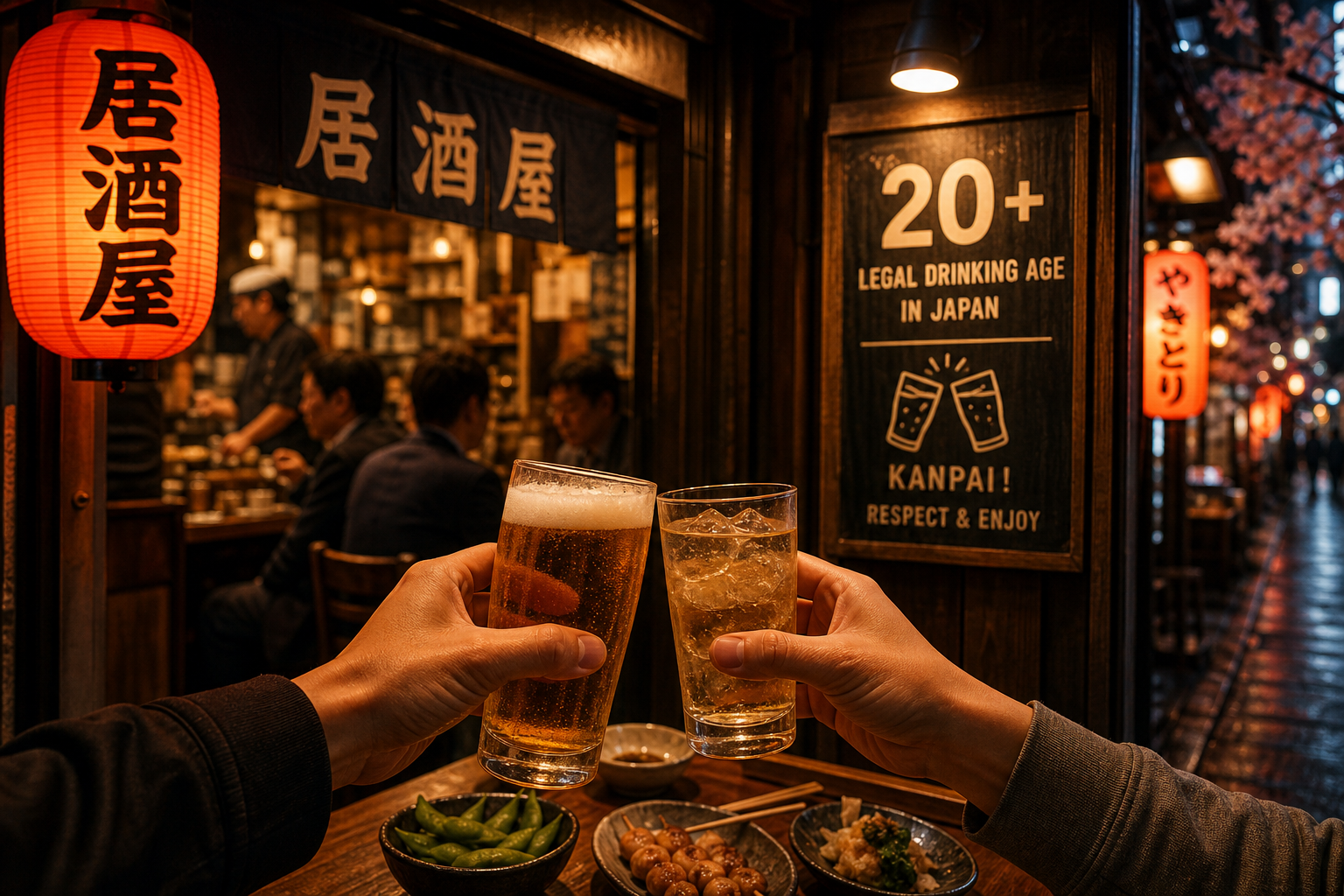
Japan has one of the world’s most storied drinking cultures. The izakaya is a social institution, and sake has a centuries-old history. Yet Japan’s legal drinking age sits at 20, two years higher than Mexico’s minimum of 18, and one year lower than the United States’ federal minimum of 21. That number is worth paying attention to, because the rule isn’t arbitrary. It reflects something real about how Japanese society frames alcohol, adulthood, and the rituals that hold communities together.
Every immersive travel experience starts with understanding the cultural framework behind what’s in the glass, whether that’s tracing mezcal traditions in the Yucatán or stepping into a third-floor izakaya in Osaka. The drink is never the whole story. The law, the custom, and the social code behind it matter just as much. Here’s what you actually need to know before your first night out in Japan.
The core answer is simple: Japan’s legal drinking age is 20, and it has been since 1922. By the time you finish reading, you’ll understand where the law lives, how enforcement works in practice, which ID to carry, what penalties look like, and how to carry yourself inside an izakaya like someone who belongs there.
Japan Drinking Age: The Law & Penalties
Japan’s minimum drinking age is codified in the Minors’ Drinking Prohibition Law (未成年者飲酒禁止法), first enacted in 1922 and still in force today. The statute prohibits anyone under 20 from purchasing or consuming any alcoholic beverage, regardless of nationality or which prefecture they happen to be in. There is no regional carve-out, no tourist exemption, and no grey zone between beer and spirits. The nationwide minimum is 20, full stop.
The law also distributes responsibility deliberately. It doesn’t just target the underage drinker, it holds businesses, parents, and adults accountable for enabling access to alcohol. That framing matters, because it shapes how enforcement actually plays out in practice.
Penalties: Who Really Faces Consequences
The Minors’ Drinking Prohibition Law doesn’t prescribe explicit criminal penalties for the minor themselves. A young person caught drinking typically receives a police warning, has their personal details recorded, and faces social or institutional consequences through school, family, or an employer rather than through a courtroom. The legal framework is deliberately structured to place accountability elsewhere.
The real burden falls on adults and businesses. A venue that sells alcohol to someone under 20 faces fines up to ¥500,000 (approximately $3,300 USD), potential license suspension or revocation, and criminal charges for repeat offenses. Adults who supply alcohol to minors face criminal and civil liability. Parents who knowingly permit underage drinking at home face fines starting at ¥10,000. For foreign visitors, serious violations can trigger visa complications or deportation proceedings.
One specific warning deserves its own emphasis: using a forged or altered ID to purchase alcohol is treated as document falsification in Japan. That charge is separate from the underage drinking violation and carries its own criminal consequences. Japan’s relaxed enforcement atmosphere is real, but the legal teeth exist, they’re just aimed at adults and institutions more than at young people themselves.
Why the Age Didn’t Drop to 18 in 2022
Many visitors arrive confused about this, and reasonably so. In April 2022, Japan lowered its civil age of majority from 20 to 18. Eighteen-year-olds gained the right to vote, sign contracts, and apply for credit cards without parental consent, a significant legal shift. But the drinking age stayed at 20, and that was a deliberate decision, not an oversight.
The government’s rationale centered on public health: specifically, medical evidence around alcohol’s impact on adolescent brain development. Policymakers drew a clean line between civil rights (which 18-year-olds now hold) and health-protective restrictions (which remained in place). The Minors’ Drinking Prohibition Law was explicitly left untouched, along with the tobacco age restriction. Any traveler who arrives assuming a lowered voting age means a lowered drinking age will find themselves mistaken.
Japan Drinking Age: Enforcement for Tourists
The law is clear. Enforcement is considerably softer. This gap between statute and practice is something every visitor to Japan will notice almost immediately, and it’s worth understanding so you don’t misread the situation in either direction.
The Convenience Store Reality
Most convenience stores in Japan use touchscreen age-confirmation prompts at checkout. A customer taps “I am over 20” and the transaction proceeds. Clerks rarely request physical ID in practice, it’s common among long-term residents to go years without witnessing an actual ID check at a konbini. Alcohol vending machines are still present in many areas and technically feature age-verification systems, but these are often ineffective. The system operates largely on an honor basis at the point of sale.
What to Expect at Bars and Izakayas
Bars and izakayas are where tourists are most likely to encounter a genuine ID request, particularly in tourist-heavy districts of Tokyo, Kyoto, and Osaka where authorities monitor public order more closely. Customers who appear young may be asked to present documentation at the door or before being served, especially in areas where venue inspections are more frequent. The staff aren’t being hostile; they’re managing compliance risk. Treat an ID request as a routine procedural moment, not a personal interrogation.
Which ID to Carry in Japan
For tourists, a passport is the most widely accepted form of identification for alcohol purchases. Japanese residents can use a driver’s license or My Number Card. A photocopy or a digital scan on your phone won’t satisfy a venue that’s serious about compliance, those that check will want the physical document. Carry your actual passport when you plan to go out, not a photo of it.
Izakaya Culture: The Social Code Behind the Drink
An izakaya is not a bar in the Western sense. Think of it as a hybrid between a pub and a casual restaurant, a space where you go to eat, share dishes, and stay a while. The social function of the izakaya is deeply embedded in Japanese work culture, friendships, and community life. It’s Japan’s answer to the Spanish tapas bar: a space where food and drink create the conditions for real conversation. You don’t walk in, order a drink, and leave. You settle in.
The Etiquette Every First-Timer Needs to Know
A few unspoken rules define the izakaya experience, and getting them right signals that you’re a thoughtful guest rather than a tourist who wandered in from the street. You don’t pour your own drink; you pour for others at the table, and someone will fill your glass in return. Nobody drinks before the group’s first kanpai (toast). When someone refills your glass, hold it up slightly to receive the pour. Ordering happens in rounds, and food dishes are meant to be shared, not claimed.
When you arrive, staff will greet you with “Irasshaimase!” A nod or a smile is a perfectly appropriate response. If you’re seated in a zashiki area with tatami flooring, remove your shoes. The oshibori (heated towel) you’ll receive is for cleaning your hands, not your face. To get a server’s attention, call out “sumimasen!” clearly across the room, that’s not rude in an izakaya; it’s how the place works. And when your food arrives, a simple “itadakimasu” before you eat is always appreciated.
Kanpai Customs and What They Signal
The kanpai moment marks the official start of the gathering. It signals that the group is present, together, and ready to be in one another’s company. Making eye contact during the toast is considered respectful. If you’re the most junior person at the table, hold your glass slightly lower than the others. Drinking before the kanpai, especially as a guest or newcomer, reads as impatient rather than enthusiastic. Wait, make eye contact, and drink together. The whole ritual takes about ten seconds, but it sets the tone for the entire evening.
Practical Tips Before Your First Night Out in Japan
Always carry your physical passport when you plan to visit bars or izakayas, particularly if you look young. A photocopy won’t work, a digital scan won’t work, and “it’s back at the hotel” won’t help you at the door of a venue in Shinjuku at 10 PM. Make carrying your passport part of your going-out routine in Japan, the same way you’d carry your driver’s license at home.
Enforcement tends to be more visible in major tourist districts, Shinjuku and Shibuya in Tokyo, Dotonbori in Osaka, and the Gion area in Kyoto, than in quieter regional towns. Venues in those areas are more alert to compliance. Regional izakayas in smaller cities often operate on community familiarity and trust, but that familiarity doesn’t automatically extend to foreign visitors. Relaxed enforcement in one neighborhood is no guarantee of relaxed enforcement everywhere.
On the question of public drinking: Japan permits it in many outdoor spaces, including parks and riverbanks during cherry blossom season, and there are no blanket national restrictions. That said, local ordinances in specific areas, including certain train stations and temporary festival zones, may prohibit it. Read local signage, follow the group’s lead, and don’t assume that what’s acceptable in one park applies to every public space.
How Japan’s Drinking Culture Fits Into the Bigger Picture of Travel
Japan’s drinking age of 20 is notable even by global standards. Mexico, for context, sets its minimum at 18, while the United States requires 21. In the Yucatán, alcohol is woven into social and ceremonial life from a legally younger age. The cantina, a communal, food-forward drinking space, shares a certain spirit with the izakaya even as the cultural codes differ entirely. Both reward visitors who arrive prepared and respectful.
Every country’s drinking rules reflect something real about its values: who it trusts, how it defines adulthood, and what role alcohol plays in social ritual. Japan’s decision to keep the drinking age at 20 while lowering the civil age of majority to 18 is a statement about priorities, separating legal personhood from health-related risk. Understanding that distinction before you arrive doesn’t just keep you out of trouble. It makes you a more thoughtful guest, and it opens the door to the kind of immersive cultural experience that no amount of advance research can fully replicate.
Before You Go: The Short Version
Japan’s legal drinking age is 20. It’s set by the Minors’ Drinking Prohibition Law, it applies nationwide to everyone regardless of nationality, and it was not changed when the civil age of majority dropped to 18 in 2022. Enforcement in convenience stores is largely symbolic, but bars and izakayas in major tourist areas check IDs more seriously. Your passport is the most reliable document to carry. Penalties fall hardest on adults and businesses rather than on minors, but document falsification is its own separate criminal matter.
Inside the izakaya itself: wait for the kanpai, pour for others before you pour for yourself, share the food, and treat the space as the communal institution it is. The goal isn’t just compliance, it’s genuine participation in something meaningful about Japanese social life.
Frequently Asked Questions
Can I drink in Japan at 18?
No. Japan’s legal drinking age is 20, and it applies to everyone, tourists included, regardless of the legal drinking age in your home country. The 2022 lowering of Japan’s civil age of majority to 18 did not affect the drinking age, which remains governed by the Minors’ Drinking Prohibition Law.
What ID is accepted for alcohol purchases in Japan?
For tourists, a passport is the most widely accepted form of identification. Japanese residents typically use a driver’s license or My Number Card. Digital photos or photocopies of your passport are generally not accepted by venues that actively check ID.
Is underage drinking in Japan a serious offense?
For the minor themselves, penalties tend to be administrative rather than criminal, usually a police warning and a record. The heavier legal consequences fall on the adults or businesses that provided the alcohol, who face fines of up to ¥500,000, license suspension, and potential criminal charges for repeat offenses.
Do bars in Japan check ID?
Not always, but more often in tourist-heavy districts of Tokyo, Osaka, and Kyoto where police visibility is higher. Customers who appear young are more likely to be asked to show documentation. Convenience stores almost never check ID in practice, relying instead on self-declaration touchscreens at checkout.
Leave a Reply