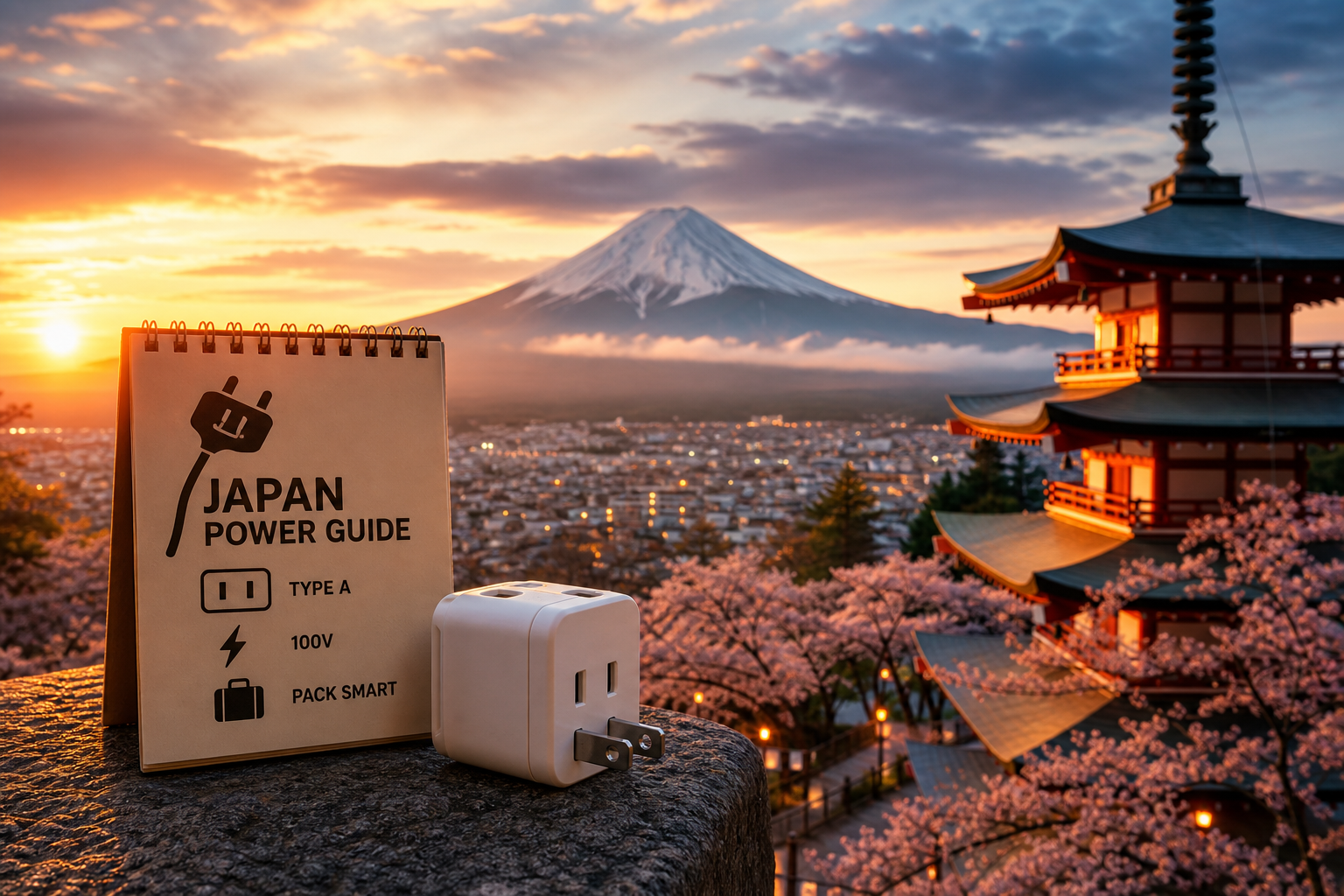
Japan runs on 100 volts, and understanding the Japan power outlet system before you travel is more important than most guides let on. The socket looks almost identical to the one on your bedroom wall at home, which creates a false sense of total compatibility. Most travelers give their electronics zero thought before an international trip, assuming the global infrastructure of power will simply accommodate them. Japan quietly disproves that assumption.
The kind of traveler who spends an afternoon mapping Kyoto neighborhoods the same way they’d research a week in the Yucatán, tends to research gear with the same seriousness as their itinerary. That instinct is right. By the time you finish this guide, you’ll know exactly what plug Japan uses, what 100V means for your specific devices, and whether you need an adapter, a converter, or both.
Japan Power Outlet Basics: The Type A Standard and What to Expect
The two-flat-pin socket you’ll find almost everywhere
Japan’s dominant socket is the Type A: two flat parallel pins, ungrounded, and physically identical to North American plugs. You’ll find this format in Japanese homes, guesthouses, business hotels, and most public spaces. For North American travelers packing two-prong devices, that familiar socket shape means many devices will slot right in without any adapter at all. The visual familiarity is real, but it can create a false sense of complete compatibility, because the voltage behind that socket is meaningfully different from what you’re used to at home.
Japanese outlets are also largely non-polarized, meaning both pins are the same size. In the US, one prong is wider than the other to indicate polarity. In Japan, no such distinction exists. For most consumer electronics this makes no practical difference, but it’s worth knowing if you’re traveling with older or specialized equipment.
Type B outlets: present but not the norm
Type B sockets (two flat pins plus a round grounding pin) do exist in Japan, more commonly found in newer hotels and modern office buildings than in older construction. The catch is that most standard Japanese sockets are two-pin only. If your laptop or camera charger has a three-prong grounded plug, the grounding pin has nowhere to go in the majority of Japanese outlets. A three-to-two prong adapter solves this physically, though it’s worth noting that this type of adapter removes the grounding protection, if you rely on grounded outlets for sensitive equipment, confirm your accommodation’s setup in advance. Pack the adapter if any of your devices have a grounding pin, but go in informed.
Japan’s 100V Voltage and the East-West Frequency Divide
Why Japan runs at 100V when the rest of the world doesn’t
Japan’s electrical grid was built in two distinct phases using imported foreign equipment. Eastern Japan drew on German technology; western Japan on American. The systems were never fully harmonized, and Japan ended up at 100V rather than converging with neighboring countries or aligning with the US’s eventual 120V standard. Wartime unification efforts in the early 1940s locked in 100V nationally, and the proliferation of 100V appliances afterward made any future change economically impractical. Japan kept it.
For travelers, this history matters most when packing devices that aren’t dual-voltage. A 20-volt gap between Japan’s 100V and North America’s 120V is manageable for most electronics. The gap between Japan’s 100V and Europe’s 230V is an entirely different problem, large enough to damage or destroy a device that isn’t built to handle it.
The 50Hz versus 60Hz split across the country
Japan also has an unusual internal frequency divide. Eastern Japan, including Tokyo, Sendai, and Hokkaido, runs at 50Hz. In western Japan, Osaka, Kyoto, Nagoya, and Hiroshima, the standard is 60Hz. The boundary runs roughly along the Fujigawa River in Shizuoka. For the vast majority of modern electronics, this distinction is completely irrelevant. Where it becomes noticeable is with older motorized appliances or precision timing devices: an analog clock calibrated to 60Hz will run slightly slower in Tokyo, and a fan motor built for 50Hz might run marginally faster in Osaka. For most travelers carrying smartphones, laptops, and camera chargers, this is background information rather than a practical concern.
Plug Adapter vs. Voltage Converter: Which One Do You Actually Need?
What a plug adapter does (and doesn’t do)
A plug adapter changes the physical shape of your plug so it fits a foreign socket. That’s the entire job. It does not change the electricity flowing through it. If your device is rated for 100-240V, a plug adapter is genuinely all you need for any Japan power outlet, the device handles voltage conversion internally, which is exactly how modern consumer electronics are designed to work. Manufacturers build global products for global markets, and the dual-voltage spec is the result of that engineering decision. Check the small print on the charger block or power supply: a label reading “Input: 100-240V ~ 50/60Hz” tells you everything. This device works everywhere, and an adapter handles the rest.
When a voltage converter becomes necessary
A voltage converter, sometimes called a transformer, physically steps voltage up or down. Travelers carrying single-voltage devices built for 220-240V will need one for Japan’s 100V supply. The gap is large enough to cause devices to fail entirely or operate in ways that risk damage. The practical rule is straightforward: check every device label before you pack. If it says “100-240V, 50/60Hz,” bring only an adapter. If it lists a single voltage, bring a converter or leave the device home. High-wattage appliances like electric kettles and irons almost never make this calculation worth it. Leave them.
Device-by-Device Breakdown: What’s Safe and What Needs Help
Smartphones, laptops, and camera chargers: pack and plug in
Modern smartphone chargers, laptop power bricks, and camera battery chargers are dual-voltage by design. Most consumer chargers and power bricks produced in the past decade carry a 100-240V rating, but always check the input label on your specific adapter block before assuming. Confirm the “100-240V” input rating, then travel with a basic Type A adapter for whichever Japan power outlet you encounter. These devices represent the bulk of what most travelers actually carry, which means most travelers need nothing more than a small, inexpensive adapter to stay powered throughout Japan.
Hairdryers, straighteners, and heating appliances: a different story
Heating element devices are the primary exception to everything above. Most hairdryers and straighteners sold in Europe, the UK, and Australia are built for 220-240V and will not function safely on Japan’s 100V without a step-up voltage converter. Even some US hairdryers rated at 120V will run noticeably underpowered at 100V. The simplest solution is to leave the hairdryer at home. Most Japanese hotels and ryokans provide one in the room. For straighteners and curling irons, a dual-voltage travel version is worth buying before your trip if you travel frequently.
How to read the voltage label on your device
The label is almost always printed directly on the adapter block, the rectangular piece that plugs into the wall. Look for the input specifications, not the output. A real-world example looks like this: “Input: 100-240V ~ 50/60Hz 1.5A.” If the input range starts at 100V and ends at 240V, the device is dual-voltage and safe for any Japan power outlet with only an adapter. If the input shows a single voltage, such as “120V” or “230V” alone, it is single-voltage and requires a converter. The wattage listed matters too: high-wattage single-voltage devices are rarely worth the effort of converting, since the converters required for 1000W or more are heavy and expensive.
What Travelers from North America, Europe, and Australia Need to Know
North American travelers: the closest match, with one caveat
US and Canadian travelers have the simplest experience of any international visitor to Japan. The plug shape is identical (Type A), so most two-prong devices fit Japanese sockets without any adapter at all. The 20-volt gap between Japan’s 100V and North America’s 120V is close enough that dual-voltage devices handle it without complaint. The one item worth packing is a three-to-two prong adapter if any of your devices have a grounding pin, since most Japanese sockets are two-pin only. Aside from that, North American travelers are mostly set before they even start packing.
European, UK, and Australian travelers: voltage is the real challenge
For travelers from 220-240V countries, the situation requires more preparation. The voltage gap is not a rounding error, it’s significant enough to damage single-voltage devices or cause them to fail entirely. A plug adapter alone is not sufficient for anything that isn’t dual-voltage. The shape difference also requires a physical Type A adapter, since European, UK, and Australian plugs are incompatible with Japanese sockets. The practical approach is to audit every device before packing, confirm which carry the 100-240V dual-voltage rating (most modern chargers and electronics do), and source a travel voltage converter for anything that doesn’t. High-wattage appliances are almost never worth bringing.
Where to Buy Adapters in Japan and How to Pack Smart
Don’t count on hotels or ryokans to provide them
Western-style chain hotels in Japan sometimes have a universal adapter available at the front desk, but availability varies by property and is never guaranteed. Traditional ryokans almost never provide them. The outlet situation in a ryokan room tends to be minimal, often one or two sockets positioned near a low table rather than conveniently distributed around the room. If you’re staying somewhere traditional, email ahead to ask about outlets and available adapters. It’s a reasonable question, and far better than discovering the problem after you arrive.
Where to find certified adapters once you arrive
Japan is one of the easier countries in which to buy quality, certified adapters on arrival. Look for the PSE mark, Japan’s mandatory safety certification, on anything you purchase. Electronics chains like Bic Camera and Yodobashi Camera carry a wide selection and have English-speaking staff in tourist-heavy locations like Akihabara in Tokyo, Umeda in Osaka, and near Kyoto Station. Convenience stores carry basic Type A adapters at low prices for quick fixes. Don Quijote, the discount retailer found in virtually every major Japanese city, is worth checking for budget-friendly travel gear. For travelers arriving at Narita or Haneda, electronics kiosks in the arrivals area sell adapters before you even reach the train platform. You can read more about PSE certification and what to look for when buying adapters in Japan.
A few safety practices worth keeping in mind
- Always verify the voltage rating on a device before plugging into any foreign socket. The label check takes ten seconds and can save an expensive device.
- Avoid cheap, uncertified adapters that lack the PSE mark. Quality matters for electrical safety, and counterfeit adapters are a genuine risk in tourist areas.
- Power strips are restricted or outright prohibited in some Japanese hotels and ryokans. A compact multi-port USB charger is a smarter, more portable alternative.
- If a device feels unusually warm or makes an unfamiliar noise after being plugged in, unplug it immediately and check the voltage rating before trying again.
Pack Right and Focus on Japan
The decisions this guide covers are straightforward once you have the right framework. The Japan power outlet is a Type A socket operating at 100V, a voltage standard found nowhere else and lower than what travelers from North America, Europe, or Australia are used to at home. Most modern electronics are dual-voltage and need only a plug adapter to work safely. Heating appliances and single-voltage devices need a voltage converter, or should simply stay home. North American travelers face the smallest adjustment; European and Australian travelers face the bigger voltage gap and need to prepare accordingly.
Our philosophy is built around immersive, unhurried travel, the kind of trip where you’re fully present in a Kyoto alley or a Tokyo neighborhood market, not sidetracked by avoidable logistics. Sorting out your power situation before departure is exactly that kind of quiet preparation. It removes one category of friction entirely, so when you land, your attention goes where it belongs: to everything Japan has waiting for you. Pack the right adapter for the Japan power outlet you’ll find there, handle it once before you leave home, and it simply stops being a problem.
Leave a Reply